
Plumbing Marketing — A Guide for Independent Plumbing Businesses
Roto-Rooter doesn’t need marketing help. You do. Here’s what actually drives calls for independent plumbers — and it’s not what the agencies are selling.
Plumbing marketing is the combination of strategies that get homeowners to call your plumbing business instead of the national chain — and convert that call into a booked job. Plumbing is an emergency-driven trade, and the emergency does not wait for business hours. The most effective plumbing marketing in 2026 isn’t about ad spend or SEO tricks. It’s about answering the phone when the pipe bursts at midnight — because across home services 48% of callers never reach a person at all, and that share got worse year over year (Invoca Home Services Lead Conversion Benchmarks 2026, 70M+ calls) — having reviews that say “showed up fast and fixed it right,” and following up on every estimate before the customer calls someone else. The review side of that is covered in review management for plumbing businesses, and the wider set of systems in AI tools for plumbing companies.
Drain cleaning is your most important marketing channel.
This sounds counterintuitive because drain cleaning is often your lowest-ticket service. But drain cleaning customers are your highest-potential customers.
If you’re a plumber with 10+ years in your market, a huge portion of your work comes from word-of-mouth. That’s earned trust, and it’s real. What follows builds on that foundation — turning every satisfied customer into a permanent, searchable referral through the systems that scale what your reputation already delivers.
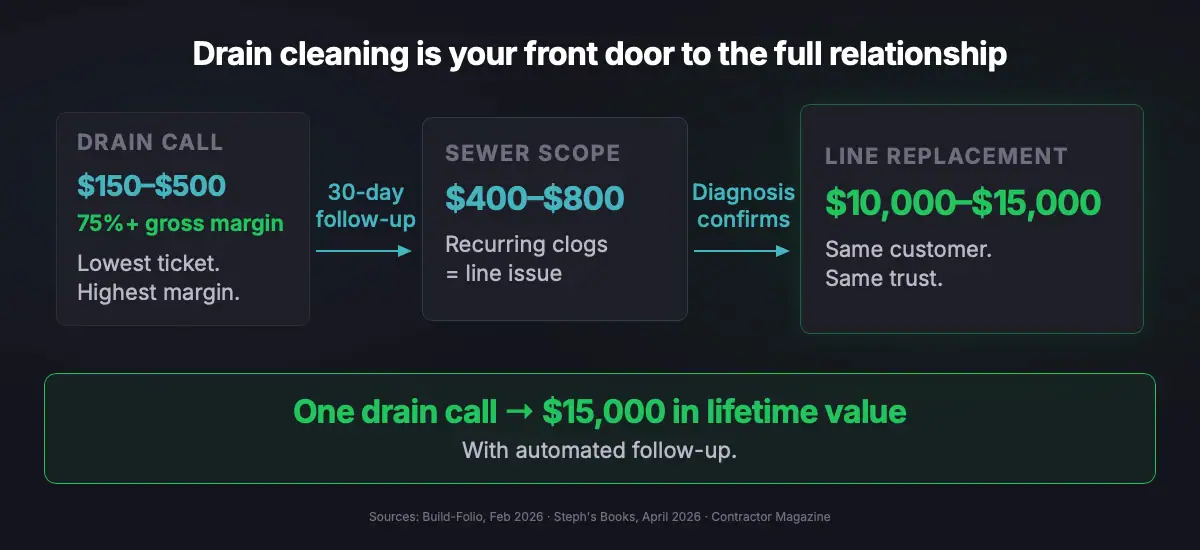
A clogged drain is usually a symptom. The plumber who clears the drain, does excellent work, earns a review, and then follows up 30 days later with “How’s that drain working? Recurring clogs sometimes indicate a line issue worth inspecting” is how a drain call becomes a sewer scope and, sometimes, a line replacement. Drain cleaning averages $246 and a sewer line replacement averages $3,319 (HomeAdvisor, 2026).
Roto-Rooter puts numbers on how much that sequence matters. In its parent company filing, excavation accounts for 36.5% of core revenue while making up only four to five percent of jobs, and the filer states plainly that excavation work is generally sold as a result of initial calls about drain cleaning (Chemed Corp Form 10-K, FY2025, audited). A small share of drain calls produces a third of the revenue. Most professional drain cleaning companies don’t make the bulk of their money from the locally advertised drain cleaning fees — they make it from pipe replacement and re-lining that the drain call uncovers (Contractor Magazine).
This only works with systematic follow-up. Most plumbing companies treat drain cleaning as a one-and-done transaction. The follow-up sequence that turns a drain customer into a full-service account is the single most underutilized growth lever in marketing for independent plumbers.
Plumbing is the most emergency-driven trade — and emergencies don’t leave voicemail.
Plumbing emergencies arrive on their own schedule — evenings, weekends, and holidays. A burst pipe, a backed-up sewer, a water heater failure — these aren’t “let me research my options” situations.
When that call goes to voicemail, the homeowner doesn’t leave a message. They hang up and call the next plumber on the list. Across home services, 48% of callers never reach a person at all, and that share got worse year over year (Invoca Home Services Lead Conversion Benchmarks 2026, 70M+ calls). The first plumber to actually answer is usually the one who gets the job.
How much are missed calls costing your plumbing business? → Use the Revenue Leak Calculator
Across home services, 48% of callers never reach a person (Invoca Home Services Lead Conversion Benchmarks 2026, 70M+ calls). Here’s the part that matters for a small shop: ServiceTitan found that plumbing companies with fewer than five technicians book 24% of their inbound calls, against 59% at companies with more than twenty-five (ServiceTitan, 3,000+ trade businesses). The gap is not skill. It is that a five-person shop has nobody free to pick up when everyone is already on a job.
54% of homeowners now research and hire a plumber in under four hours (BDR, April 2026). They’re not waiting until morning. They’re searching “emergency plumber near me” on their phone while water is on the floor.
An AI voice agent eliminates this gap. It answers every call within two rings at 2am on a Sunday, captures the emergency details, confirms the service area, and routes to your on-call plumber with full context. The customer gets immediate response. You get the job.
The cost of missing one emergency call isn’t just the service charge. It’s the maintenance agreement that customer would have signed, the water heater replacement conversation next year, and the 3–5 referrals that customer would have generated. A customer acquired through paid search costs real money every time. A customer who called you because a neighbour recommended you costs nothing, and a customer already on a maintenance agreement costs nothing twice.A single missed call can represent thousands in lost lifetime value.
Plumbing has the widest margin spread of any trade — and most plumbers don’t know theirs.
The gap between the most profitable and least profitable work in plumbing is enormous. And most plumbing companies track a single blended number that hides the real picture.
| Service line | What drives the margin | What erodes it |
|---|---|---|
| Emergency and drain | Richest of the lines. Urgency sets the price, labour is short, and equipment does much of the work. | Only pays if the phone is answered. A missed emergency call is the whole margin. |
| Service and repair | Strong, and stronger again on flat-rate pricing rather than time-and-materials. | Windshield time between calls. Density matters more than ticket. |
| Water heater replacement | Highest-frequency big ticket, and the most reliable follow-on from a service call. | Equipment cost compresses the margin. Volume, not rate. |
| Remodel rough-in | Larger contract value per job. | Materials-heavy, subcontractors involved, change orders routine. |
| New construction | Predictable schedule and volume. | Thinnest of the lines. Competitive bidding, and payment cycles that tie up cash for months. |
Ordered richest to thinnest. HighRidge does not publish margin percentages for these lines: the figures in circulation trace to content aggregators and to advisory firms whose samples are companies far larger than an independent shop, so a number here would read as precise without being sourced. The ordering is what holds, and it is what should drive where marketing spend goes.
Emergency and drain work sits at the top of that ordering because urgency sets the price and equipment does much of the labour. A homeowner with a backed-up sewer line at 9pm isn’t negotiating.
Service and repair is the volume line, and it runs richer on flat-rate pricing than on time-and-materials. It is the bread and butter for most companies.
Water heater replacement is the most frequent big ticket and the most reliable follow-on from a service call, though equipment cost compresses what you keep.
Remodel rough-ins are materials heavy, involve subcontractors, and carry routine change orders.
New construction is the thinnest line of all — competitively bid, on 60 to 90 day payment cycles that tie up your cash and your best plumbers.
The practical consequence is a marketing one. The lines that pay best are the ones that arrive as an unscheduled phone call, and the line that pays worst is the one you can schedule months ahead. Anything that wins you more of the first and less of the second is worth more than the advertising it costs.
Where plumbing work actually comes from.
In a 2025 workforce study of more than 600 plumbing and heating professionals, 69% said word-of-mouth and customer referrals are their primary source of new business. Building relationships with general contractors came in second at 58%. Digital marketing came in third (Contractor Training Center, reported in phcppros, February 2026).
That ordering matters more than either number on its own. It says the two things that bring in most of the work are both relationships, and the thing most marketing advice is about comes third.
Most plumbing owners already know this. The GC who puts you on every project. The property manager who calls first when a tenant has water coming through a ceiling at 6am. The realtor who sends every buyer with a failing water heater. The HVAC tech who spots a corroded supply line in a crawl space and passes on your number. Those relationships took years to build, they arrive pre-trusted, and they are the reason the phone rings on an ordinary Tuesday.
They also share one limitation. You cannot control the volume or the timing. A builder slows down for a season. A property manager changes vendors when a regional office consolidates. A realtor retires. A reliable pipeline thins without warning, and usually without anyone telling you it is happening.
What makes every one of those relationships more durable is your review profile. The GC checks your reviews before putting you in front of a new client. The property manager who inherits the account checks them before continuing an arrangement they did not set up. The buyer at the end of a realtor referral checks them before dialling the number.
What you can do is turn every satisfied customer into a permanent, searchable referral — through a Google review. 97% of consumers now read reviews before choosing a local business (BrightLocal, 2026), and 73% only pay attention to reviews from the last month (BrightLocal, 2025).
The review does the same job as the neighbor’s recommendation, but it reaches hundreds of homeowners instead of one. And it’s there at 2am when the pipe bursts and the homeowner is searching “emergency plumber near me.”
Every review request you send is a referral request that scales.
Want to see how much revenue your drain calls are leaving on the table?
Reviews are the primary trust signal for plumbing — and trust matters more here than in any other trade.
Plumbing work happens inside someone’s home, often in intimate spaces. The homeowner is letting a stranger into their house to work on systems they don’t understand. Trust isn’t optional — it’s the entire purchase decision.
97% of consumers read reviews before choosing a local business (BrightLocal, 2026), and a burst pipe at midnight is a worse moment than most to be the plumber with four reviews, none of them recent.
Chasing a specific review count is the wrong frame. What matters is your profile measured against the other plumbers your caller is looking at in that same moment, which is a local question and not an industry benchmark.92% of consumers choose a plumber within 24 hours of searching — your reviews need to be there when they look, not “coming soon.”
How does your review profile compare to the competition? → Check your score
The reviews that convert are specific: “Fixed the leak under the kitchen sink in 30 minutes,” “Arrived on time, explained the issue, didn’t try to upsell,” “Called at 6am and they had someone here by 8.” These address the specific anxieties homeowners have about letting a stranger into their home.
Without a prompt, fewer than 5% of happy plumbing customers will leave a review. Automated review requests sent within 2 hours of job completion convert 15–30% of customers into reviewers. That’s the difference between 25 reviews and 250.
Plumbing maintenance plans are the most underleveraged revenue stream in the trade.
A customer on a maintenance agreement is worth more than the same customer without one, and the gap compounds every year they stay. A shop with a meaningful share of revenue under maintenance agreements is less exposed to a slow month than one living entirely on emergencies.
Water damage claims represent 22.6% of all home insurance claims, with an average payout of $13,954 (Insurance Information Institute, 2025). An annual inspection is cheap against that number. That’s the selling point your technicians should be using: “Your inspection prevents the $14,000 insurance claim.”
Most plumbing companies sell maintenance agreements at the point of service: the technician finishes the repair and mentions it. Some customers sign up. Most don’t — they’re focused on the immediate problem.
The follow-up gap is where the money lives. How many customers who declined at point of service received a follow-up offer 2 weeks later? 30 days later? Before the next season change? An automated follow-up sequence — text at 2 weeks, email at 30 days, text before winter — presents the offer when the customer is more receptive. The immediate repair stress has passed. The value proposition is clearer.
Private equity buyers now routinely apply premiums of 1.0x to 2.0x additional EBITDA turns when membership penetration exceeds 25% of active customers (PHCC / Nexstar Network, 2026). Even if you never plan to sell your business, the same math applies: recurring revenue smooths cash flow, increases margins, and makes your business structurally more valuable.
Most plumbers are invisible in AI search — and Roto-Rooter isn’t.
Roto-Rooter (owned by Chemed Corporation) reported $899.9 million in full-year 2025 revenue — essentially flat year-over-year, with EBITDA margins compressing 350 basis points (Chemed Q4 2025 earnings). They have the budget, the data infrastructure, and the digital presence to dominate AI-generated answers.
Independent plumbers don’t have that infrastructure. But they don’t need Roto-Rooter’s budget. They need structured data: consistent citations, schema markup, a complete Google Business Profile, and the review velocity that AI systems use to assess authority and relevance.
The U.S. plumbing industry is a $191.4 billion market, and no single company holds more than 5% of it (IBISWorld, 2026). In a fragmented market, the independent plumber who closes the AI visibility gap in their local market will own those recommendations while Roto-Rooter serves a different geography.
Meanwhile, the industry faces a projected shortfall of 550,000 plumbers by 2027, costing the economy $33 billion annually (IBISWorld). You can’t just hire more people to answer phones — the labor doesn’t exist. Systems that capture calls, collect reviews, and follow up automatically aren’t optional anymore. They’re structural necessities.
Check whether your plumbing business appears in AI search →
What effective plumbing marketing actually looks like.
The independent plumbers who consistently outperform Roto-Rooter in their local market share the same infrastructure:
- Every call answered. Emergency or routine, 24/7. AI voice agent handles after-hours and overflow. Response System
- Every job reviewed. Automated request within 2 hours — the homeowner is still relieved, still grateful. Reputation System
- Every estimate followed up. Repiping, water heater replacements, bathroom remodels — 14-day automated sequence. Revenue System
- Drain cleaning followed up. 30-day check-in converts one-time calls into ongoing relationships.
- Maintenance plans promoted. Automated follow-up 2–4 weeks after completed repairs, seasonal reminders before demand spikes.
- Online presence managed. Consistent citations, complete GBP, schema markup on all service pages.
- AI visibility tracked. Weekly monitoring to close the gap with national chains. AI Visibility Tracking
The franchise has a marketing department running this. You need a system that runs it for you.
Common questions about plumbing marketing
What’s the best marketing channel for plumbers?
Your existing customers. A plumber with 200+ Google reviews and automated follow-up on every job generates more leads from reputation than most companies generate from paid advertising. The U.S. plumbing industry is highly fragmented, with no single company holding more than 5% of it (IBISWorld, 2026). In a fragmented market, reviews are the primary differentiator, and the profile that matters is yours measured against the other plumbers in your market.
How do I get more plumbing customers?
Answer every call, build your review profile, and follow up on every estimate and drain cleaning job. Most plumbing companies lose customers at three points: the unanswered after-hours call, the unasked review request, and the unfollowed estimate. Fix those three gaps before spending on advertising.
Should I focus on service work or new construction?
Service and repair is the richer line, and it is paid when the job is finished. New construction is the thinnest, it is competitively bid, and it runs on 60 to 90 day payment cycles that tie up both your cash and your best plumbers. Every drain cleaning job and water heater replacement you turn down because the crew is on a construction site is margin walking to a competitor. Most independents keep new construction supplemental rather than core.
How do I compete with Roto-Rooter?
Speed and trust. National chains have brand recognition but often slower response times and impersonal service. Roto-Rooter reported $899.9M in 2025 revenue but its margins are compressing — the franchise model has structural overhead your business doesn’t carry. An independent plumber who answers every call in two rings, has more reviews than the local franchise, and follows up personally on every estimate wins the local market — without franchise fees.
How do I turn drain cleaning customers into full-service accounts?
Automated follow-up. A text message 30 days after a drain cleaning — “How’s that drain working? Recurring clogs sometimes indicate a line issue” — reopens the conversation. The plumber who cleared the drain already has trust. The follow-up converts that trust into a sewer scope and, sometimes, a line replacement averaging $3,319 (HomeAdvisor, 2026). Roto-Rooter reports excavation at 36.5% of core revenue on only four to five percent of jobs, sold off the back of drain calls (Chemed Corp Form 10-K, FY2025).
That drain call you ran last Tuesday — what’s it worth in 12 months?
Every emergency call is a maintenance agreement. Every drain clearing is a sewer scope waiting to happen. Your free Revenue Leak Audit shows the gaps: missed after-hours calls, the follow-up sequences that aren’t running, your review profile against Roto-Rooter’s, and whether AI search knows you exist. Real numbers. About 15 minutes of your time.
If the numbers don’t show a clear gap, we’ll tell you — and you’ll have lost nothing but 15 minutes.
Book Your Free Revenue Leak Audit →Or call David directly: 970.508.9555 · Durango, CO