
Landscape Marketing — How to Fill Your Schedule Year-Round
Landscaping is seasonal. Your pipeline doesn’t have to be.
Landscaping marketing is the process of keeping a landscaping or tree service company booked with quality projects throughout the year — not just during the spring rush. The U.S. landscaping services industry generates $184.1 billion in revenue across roughly 696,000 businesses (IBISWorld / Workyard, June 2026), while tree trimming and removal adds another $39.5 billion across 175,000 companies (IBISWorld, 2026). Despite those numbers, roughly 50% of landscaping businesses fail within five years. The difference between the ones that survive and the ones that don’t usually isn’t customer volume — it’s margin visibility, seasonal cash management, and the systems that keep leads from falling through the cracks between March and October. Whether your landscape marketing challenge is filling mowing routes or closing $30,000 outdoor living proposals, the systems that prevent revenue leaks are the same — but the emphasis is different.
Four landscaping business models — and they have different marketing needs.
Landscaping might be the most referral-driven trade there is. A beautiful patio visible from the street sells itself to the neighbors. A hazard tree removal that saves a home during a storm generates three calls from the same block. That dynamic is real and powerful — and nothing in this guide suggests replacing it. What follows is about extending the reach and lifespan of every referral through systems that work year-round, even when the yard signs aren’t visible and the completed projects are covered in snow.
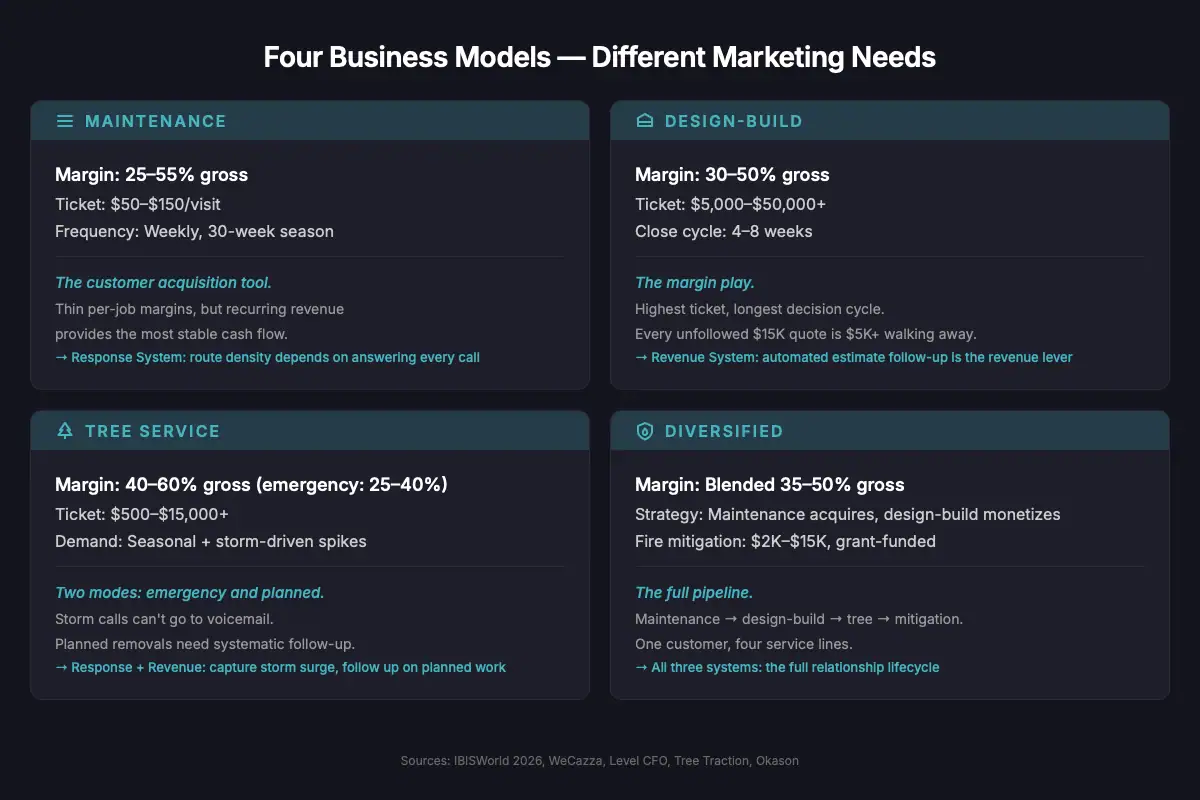
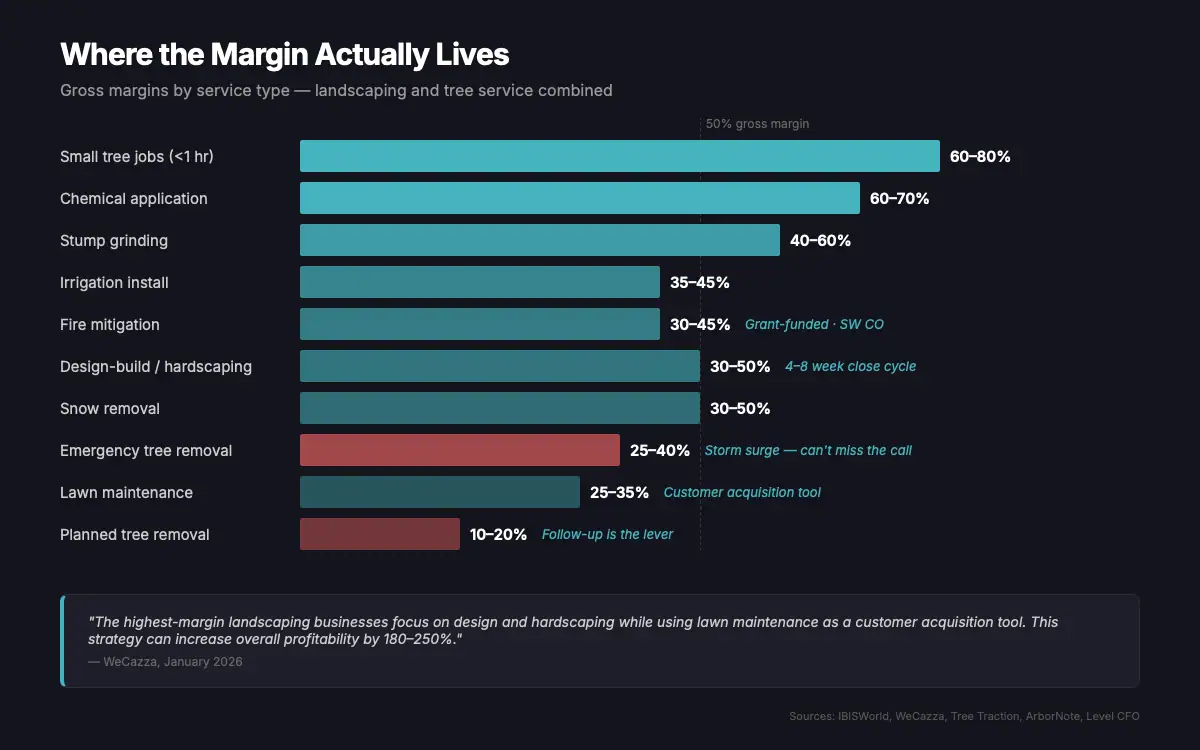
Maintenance-focused companies run weekly mowing routes, seasonal cleanups, chemical applications, and snow removal. Gross margins on maintenance run 25-55% depending on route density and labor efficiency (Service Autopilot via Sideways8, April 2026; IBISWorld), and the recurring revenue provides the most stable cash flow in landscaping. The challenge: thin per-job margins mean you need volume. Missing calls during peak season costs you route density — and route density is the margin lever.
Design-build companies do hardscaping, custom landscapes, irrigation systems, and major installations. Margins run 30-50% (WeCazza, January 2026; PlanPros, August 2025), and ticket sizes reach $5,000-$50,000+. The challenge: long decision cycles (4-8 weeks on a patio project) mean estimate follow-up is where revenue leaks. Every unfollowed $15,000 hardscaping quote is a $5,000+ margin opportunity walking to a competitor.
Tree service and arborist companies operate on different equipment and margin dynamics than landscape maintenance. Standard tree work runs 40-60% gross margins, with emergency storm removal commanding 25-40% because urgency eliminates comparison shopping (Tree Traction / KMF Business Advisors, June 2026). The $39.5 billion US tree trimming industry overlaps heavily with landscaping — many landscapers add tree work, and many tree companies offer landscape cleanup and maintenance. Tree service marketing splits into two modes: emergency storm damage (the call can’t go to voicemail — whoever answers gets a $2,000-$15,000 job) and planned work (removals, trimming, stump grinding) that follows a longer decision cycle where systematic follow-up determines who closes.
In SW Colorado specifically, fire mitigation work — defensible space clearing, fuel reduction, brush removal — creates an additional service line that’s often grant-funded through community wildfire protection programs like FireWise of Southwest Colorado. Fire mitigation jobs run $2,000-$15,000 with 30-45% gross margins, and the grant funding makes them less price-sensitive than typical landscape work.
Diversified operations blend maintenance, design-build, and tree service — using maintenance as the customer acquisition tool and design-build as the margin play.
“The highest-margin landscaping businesses focus on design and hardscaping services while using lawn maintenance as a customer acquisition tool. This strategy can increase overall business profitability by 180-250%” (WeCazza, January 2026)
A customer who hires you for a $5,000 patio and stays for $200/month in maintenance is worth $7,400 in year one and $2,400 every year after (Okason, March 2026). A fire mitigation client who becomes a landscape maintenance customer adds the same recurring revenue on top of the initial project fee. Recurring revenue with predictable margins is how you build a business, not just a job.
A note about referrals. Referrals have three limitations that every landscaping and tree service company eventually runs into: (1) it takes a full season of visible completed work before the referrals start flowing; (2) they’re geographically concentrated — one neighborhood produces referrals, but the next town over doesn’t know you exist; (3) they go dormant in the off-season when no one is admiring outdoor work or noticing hazard trees.
You can’t dial up referrals in February.
What extends the life and reach of every referral is your Google review profile. A completed patio produces one neighbor referral. A Google review from that same customer — mentioning the patio, the design work, the clean crew — produces dozens of potential leads over months. A hazard tree removal with a review mentioning “safe, professional, cleaned up everything” does the same for tree service searches.
The review does the same trust-building job as the yard sign, but it works year-round, across the entire service area, and it shows up in AI search answers.
Ask for the review the day the project completes. That’s when the customer is standing in the yard — or looking at the stump where the dangerous tree used to be — and most willing to share the experience.
The spring rush exposes every gap in your operation.
Every landscaping company knows the pattern: March through May, the phone rings nonstop. Homeowners who’ve been staring at their yard all winter want mulching, planting, grading, retaining walls, and full landscape redesigns — all at once. Tree service companies see a parallel spike as homeowners notice winter storm damage and dead limbs before the growing season.
The problem isn’t demand. It’s capacity to capture it. During peak season, you’re on job sites. Your crew is on job sites. The phone rings. Nobody answers.
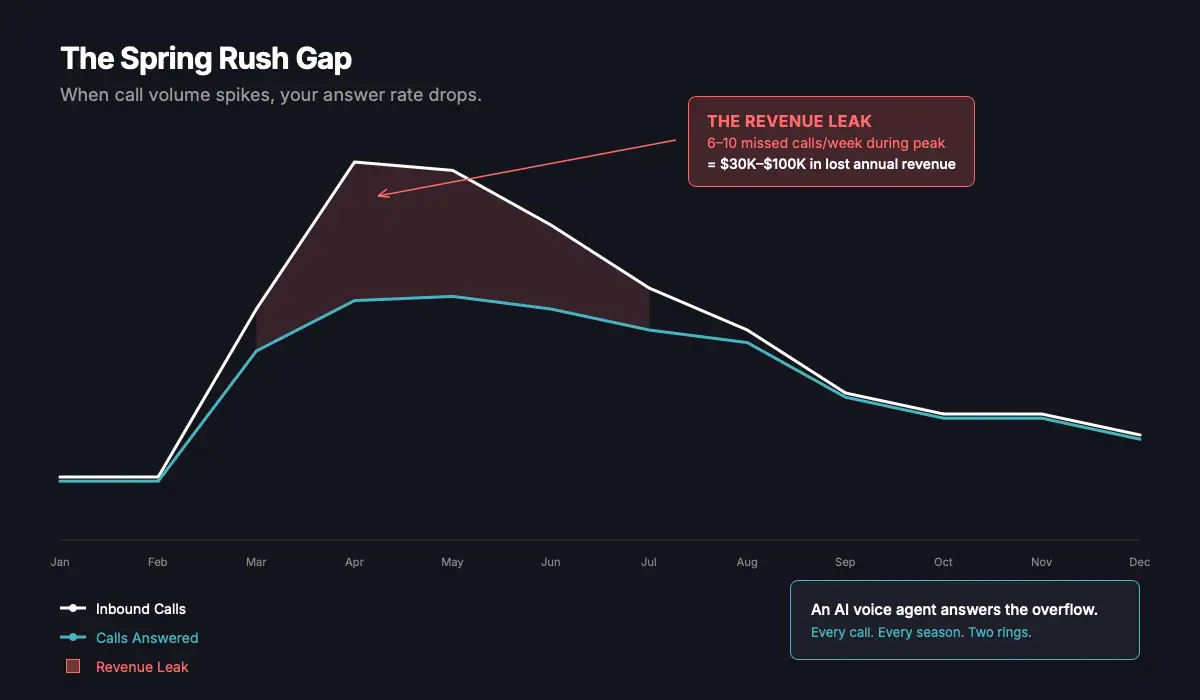
A single week of peak season might produce 30-50 inbound calls. If you’re missing 20%, that’s 6-10 lost opportunities — customers who will hire someone else and won’t call back. The landscaper or tree service who gets those calls isn’t necessarily better — they’re just available. Sometimes it’s the fly-by-night crew that undercuts on price and disappears mid-season. Other times it’s the larger operation with a dedicated office manager answering phones. Either way, the job goes to whoever picks up.
How much are missed calls costing your landscaping business? → Use the Revenue Leak Calculator
An AI voice agent handles the overflow: answers every call, captures the project details (mulching? hardscaping? full design? tree removal? stump grinding?), confirms the service area, and books the estimate. You review the lead summary between jobs instead of returning missed calls at 8pm when the customer has already committed to someone else.
Off-season pipeline isn’t a marketing problem — it’s a follow-up problem.
The feast-or-famine cycle in landscaping isn’t inevitable. It’s a symptom of not following up on peak-season estimates.
During spring and summer, you send proposals for projects that won’t start until fall — or even next spring. The customer is planning ahead. They get your quote, they get two others, and they sit on all three while they finalize their budget.
Without follow-up, you’re relying on the customer to remember you when they’re ready. Most won’t.
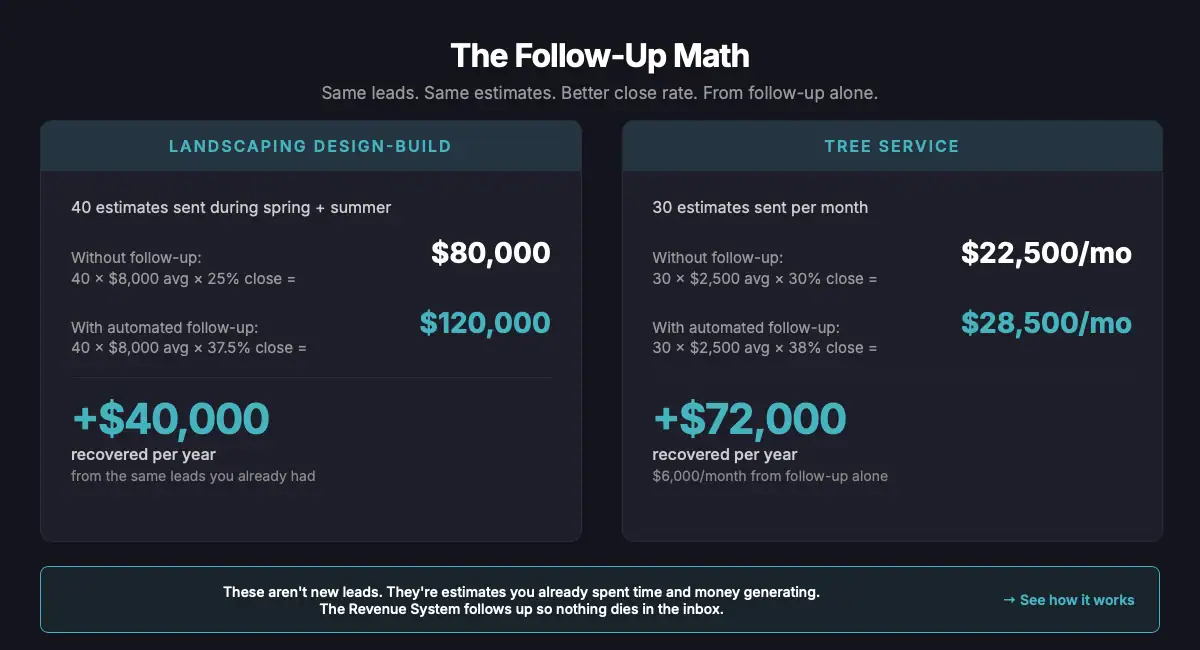
Here’s the math for landscaping: A company sends 40 design-build estimates during spring and summer, closing at 25%. That’s 10 booked projects. Following up systematically on the other 30 — even recovering just 5 more at an $8,000 average ticket — adds $40,000 in revenue from leads you already generated. No new advertising. No additional marketing spend. Just follow-up on work you already quoted.
Landscaping design-build:
40 estimates × $8,000 average ticket
25% close rate = $80,000
37.5% close rate = $120,000
Difference: $40,000/year — from the same leads you already had.
Tree service:
30 estimates/month × $2,500 average ticket
30% close rate = $22,500/month
38% close rate = $28,500/month
Difference: $72,000/year — $6,000/month from follow-up alone.
Automated follow-up sequences keep your estimates alive through the decision period: text at 24 hours, email at one week, text at two weeks. For hardscaping and design projects with 4-8 week decision cycles, extend the sequence to 30 days. For tree service quotes on planned removals, a 14-day sequence is usually sufficient. Not aggressive — just present.
PE buyers pay 2-3x higher EBITDA multiples for maintenance-heavy landscaping operators because recurring revenue is predictable (Level CFO, April 2026). The same logic applies to your business even if you never plan to sell: building recurring maintenance revenue and following up on project estimates systematically smooths the seasonal swings that kill most landscaping companies.
Landscape design marketing is a different game — and the leads prove it.
If you run a design-build landscape company — custom patios, outdoor kitchens, retaining walls, water features, full property redesigns — your lead dynamics are fundamentally different from a maintenance company filling mowing routes.
A lawn care lead is triggered by a seasonal need: the grass is growing, the leaves fell, the snow piled up. The homeowner searches, compares prices, picks fast. Speed-to-answer and competitive pricing drive the decision. The whole cycle — search to hire — often happens in 48 hours.
A landscape design lead follows a completely different journey. The trigger isn’t urgency — it’s aspiration. A new home purchase. A neighbor’s stunning patio. A renovation project. A decade of staring at the same yard. The homeowner starts researching weeks or months before they call anyone. They browse Instagram and Pinterest for style direction. They scroll Houzz portfolios. They search “landscape designer near me” and evaluate websites visually before ever reading a word. More than 40% of renovating homeowners say a clearer timeline would have improved their project experience (Houzz, 2025) — meaning they’re evaluating you on process transparency, not just pretty pictures.
By the time a landscape design prospect calls, they’ve already narrowed their list to two or three firms based entirely on what they’ve seen and read online. The call isn’t the beginning of the decision — it’s the end of a weeks-long research process. If nobody answers that call, you don’t get a second chance. They’ve already invested too much effort narrowing their list to start over.
Portfolio is your primary conversion asset — not price, not speed. Landscape design customers are hiring a vision, not a service. Before/after project photos on your Google Business Profile, your website, and in your reviews are the single most persuasive marketing asset in landscape design. Every completed project should generate both a Google review AND a portfolio entry — the review provides trust, the photos provide proof. Building that review flow consistently is covered in review management for landscaping companies, the broader shift in how AI is changing landscaping marketing, and AI search recommendations for landscaping companies covers where homeowners increasingly start.
Reviews need to describe the design process, not just the finished product. “They listened to what we wanted, presented three design concepts, stayed on budget, and the final patio exceeded what we imagined” tells the next prospect exactly what working with you will feel like. “Great work, nice patio” tells them nothing. Design-build clients are buying a process as much as a product — your reviews need to reflect that.
Follow-up must match the decision timeline. The national median landscape design fee is $4,200, and the full project behind it often runs $15,000-$100,000+ (Lawn Love / ProScape AI, 2026). Nobody commits to that in three days. They’re comparing concepts, finalizing budgets, waiting on HOA approvals, coordinating with other renovations. A 30-day automated follow-up sequence — text at day 1, email with a portfolio link at day 7, text at day 14, email at day 21, check-in text at day 30 — keeps your proposal alive through a decision cycle that routinely stretches 4-8 weeks. The firms that stay present close. The firms that send the proposal and wait lose to the competitor who followed up on day 10.
Landscape design firms generating $2M-$5M in project revenue typically run three marketing layers in parallel: social media and community presence for awareness, Google Business Profile and SEO for consideration, and paid search plus CRM follow-up sequences for closing (BSPKN, June 2026). The firms that treat landscape design marketing the same as lawn care marketing underinvest in portfolio, over-rely on referrals, and lose the highest-ticket projects to competitors who show up better online.
Fire mitigation is a revenue channel most landscapers and tree companies overlook.
In SW Colorado’s wildfire interface zones, fire mitigation work — defensible space clearing, brush removal, fuel reduction — is a significant and growing service category. Between 2021 and 2022, wildfires accounted for over $11.2 billion in damage across the United States. Insurance requirements are increasingly mandating defensible space, and community programs like FireWise of Southwest Colorado actively fund this work through grants.
The grant-funding dynamic changes the economics: the customer is spending community or insurance money, not personal funds. Decision cycles are different — often community-organized and seasonal. And the work itself is less price-sensitive than typical landscape jobs.
The fire mitigation customer often becomes a landscape maintenance customer. The homeowner who hires you to clear defensible space around their property is a homeowner who cares about their outdoor environment — and will need ongoing landscape maintenance, tree trimming, and seasonal cleanup.
This follow-up path is the same pipeline that works in plumbing (drain cleaning to sewer scope to line replacement): the entry service leads to the ongoing relationship if you follow up systematically. A 60-day automated sequence converting mitigation clients to maintenance clients captures this revenue that otherwise walks away when the mitigation project ends.
Want to see what your unfollowed estimates are costing you?
Landscaping and tree service reviews need to show the work — literally.
Landscaping is one of the few trades where the result is visible and photogenic. A completed patio, a redesigned front yard, a clean mulch bed with defined edges, a hazardous tree safely removed with a pristine cleanup — these are before/after stories that drive both Google review engagement and social media reach.
How does your review profile compare to your competitors? → Check your score
Reviews that include project descriptions — “Built a beautiful stone patio,” “Redesigned our entire front yard,” “Removed a 60-foot dead pine safely – clean crew, finished on time” — help both Google and AI search engines understand the range of services you offer and recommend you for specific queries.
For tree service companies, reviews that mention specific work types are especially valuable: “emergency removal after the storm,” “crane work on a dangerous cottonwood,” “fire mitigation – professional assessment and clean execution.” These detailed reviews give AI search engines specific evidence to recommend you for high-value queries.
Automated review requests sent the day the project completes — while the customer is still admiring the new landscape or the safely cleared property — produce the most detailed, most enthusiastic reviews. Wait three days and you get “Good job” or nothing.
The target: 150+ Google reviews with new ones arriving weekly and specific mentions of the project types you want more of.
Landscapers and tree services are invisible in AI search.
When a homeowner asks ChatGPT “best landscaping company in [city]” or Google’s AI Overview synthesizes an answer for “tree removal near me,” the answer is increasingly generated by AI — not a list of 10 blue links.
Right now, those AI answers are dominated by national chains, lead aggregators, and franchise operations. Independent landscapers and tree service companies with better reviews, better work, and better prices are invisible — because their online data isn’t structured for AI consumption.
The fix is structural: consistent business citations across all directories, schema markup on your website, a complete Google Business Profile, and steady review velocity. These are the same foundations that drive traditional SEO and Google Maps rankings. AI search visibility is the layer that compounds on top.
For landscaping and tree service companies, the opportunity is especially strong because most local competitors haven’t addressed AI visibility at all. The company that builds its AI search presence now will own those recommendations in their local market before competitors arrive.
For landscape design companies, AI visibility matters even more because the prospect’s research journey is longer and more search-dependent than any other landscaping segment. A homeowner planning a $30,000 outdoor living project will ask AI assistants “best landscape designer near [city]” or “landscape design companies with good reviews in [area]” before they ever pick up the phone. If your business doesn’t appear in those AI-generated answers — with portfolio evidence and detailed reviews backing the recommendation — you’re invisible during the exact window when the highest-value decisions are made.
Check whether your landscaping business appears in AI search →
What landscape marketing actually requires.
The landscaping and tree service companies that consistently grow without depending on seasonal luck share the same infrastructure:
- Every call answered. Especially during spring rush when all crews are in the field. AI voice agent captures overflow, after-hours inquiries, and storm-surge tree service calls. Response System
- Every project reviewed. Automated text on completion day — while the customer is still admiring the work or the safely cleared property. Reputation System
- Every estimate followed up. 14-day sequence for maintenance proposals, 30-day for large design-build projects, 14-day for tree service quotes. Revenue System
- Design portfolio working 24/7. Project photos on GBP, website, and woven into review responses — the highest-value prospects research visually before they ever call.
- Off-season visibility maintained. Quarterly GBP updates, seasonal service content, consistent directory listings year-round.
- Fire mitigation customers followed up. 60-day sequence converting mitigation clients to maintenance clients.
- AI visibility tracked. Weekly monitoring so you know when homeowners in your area are finding you — or your competitor. AI Visibility Tracking
Common questions about landscape and tree service marketing
How do landscaping companies get more customers?
Start with the customers you already have. Every completed project is a review opportunity that generates future business. Landscaping and tree service companies with 100+ Google reviews mentioning specific project types get significantly more inbound calls than companies relying purely on word-of-mouth and yard signs. The U.S. landscaping market has nearly 696,000 businesses — no single company holds more than 5% market share (IBISWorld, 2026). In a fragmented market, reviews and speed-to-answer are the primary differentiators.
How do I keep my landscaping business busy in winter?
Winter pipeline is built in summer and fall through follow-up. Estimates for spring projects, maintenance agreement renewals, snow removal contracts, and holiday lighting services all keep revenue flowing. Fire mitigation work can extend into fall and early winter in many markets. The companies that go dark from November to March book later in the spring than those that stay visible year-round.
How much should a landscaping company spend on marketing?
Industry benchmarks suggest 5-10% of revenue, but the highest-ROI marketing for landscapers is reviews and follow-up — both essentially free once automated. A strong review profile generates inbound calls that paid advertising can’t match for quality. The average homeowner spends approximately $300 per month on landscaping services (Angi) — the customer who finds you through reviews costs you nothing to acquire.
How is marketing a landscape design company different from marketing lawn care?
The customer journey is completely different. Lawn care leads are triggered by seasonal need — the homeowner searches, compares prices, and hires within days. Landscape design leads start with aspiration — a homeowner researches for weeks, browses portfolios on Houzz and Instagram, evaluates websites visually, and narrows to two or three firms before making a single call. For design-build companies, your portfolio and your process reviews are more important than your price. Automated follow-up sequences need to run 30 days instead of 14 because decision cycles on $15,000-$100,000 projects are measured in weeks, not days.
Should landscapers use social media?
Before/after project photos work exceptionally well for landscaping and tree service because the results are visual and dramatic. Instagram and Facebook drive awareness, and landscaping has the strongest visual content opportunity of any trade — a completed patio or a hazardous tree removal is compelling content. But social media supplements — it doesn’t replace — your Google review profile and website presence. Homeowners research on Google before they check Instagram.
How do I handle the spring rush without missing calls?
An AI voice agent answers every call you can’t, captures project details (mulching, hardscaping, design, tree removal, stump grinding), confirms the service area, and books estimates. During peak season, this can capture 10-20 additional leads per week that would otherwise go to voicemail and to your competitor.
Does this apply to tree service and arborist companies too?
Yes. Tree service companies share the same core challenges — seasonal demand, missed calls during busy periods, low review volume, and unfollowed estimates. The margin structure is different (emergency storm removal runs 25-40% vs. standard removal at 10-20%), and the equipment investment is higher, but the systems that capture leads, collect reviews, and follow up on estimates are identical. In SW Colorado specifically, fire mitigation work creates an additional service line that feeds into ongoing landscape maintenance relationships.
Spring rush is coming. Will your pipeline be ready?
Your free Revenue Leak Audit shows the gaps before peak season exposes them: missed calls during the rush, off-season estimates that went unfollowed, review velocity against the landscaper or tree company outranking you, and whether homeowners can find you in AI search. Build the pipeline before you need it. Your market. Your numbers. About 15 minutes of your time.
Book Your Free Revenue Leak Audit →Or call David directly: 970.508.9555 · Durango, CO