
Estimate Follow-Up: Why Quoted Work Goes Quiet
The job is not lost because the price was wrong. It is lost because nobody followed up.
You wrote the estimate. Drove to the site, measured the job, spent 45 minutes writing it up, and sent it over. Then silence. A week goes by. Two weeks. You assume they went with someone cheaper.
They didn’t. They forgot.
The follow-up gap in home services is massive — and measured
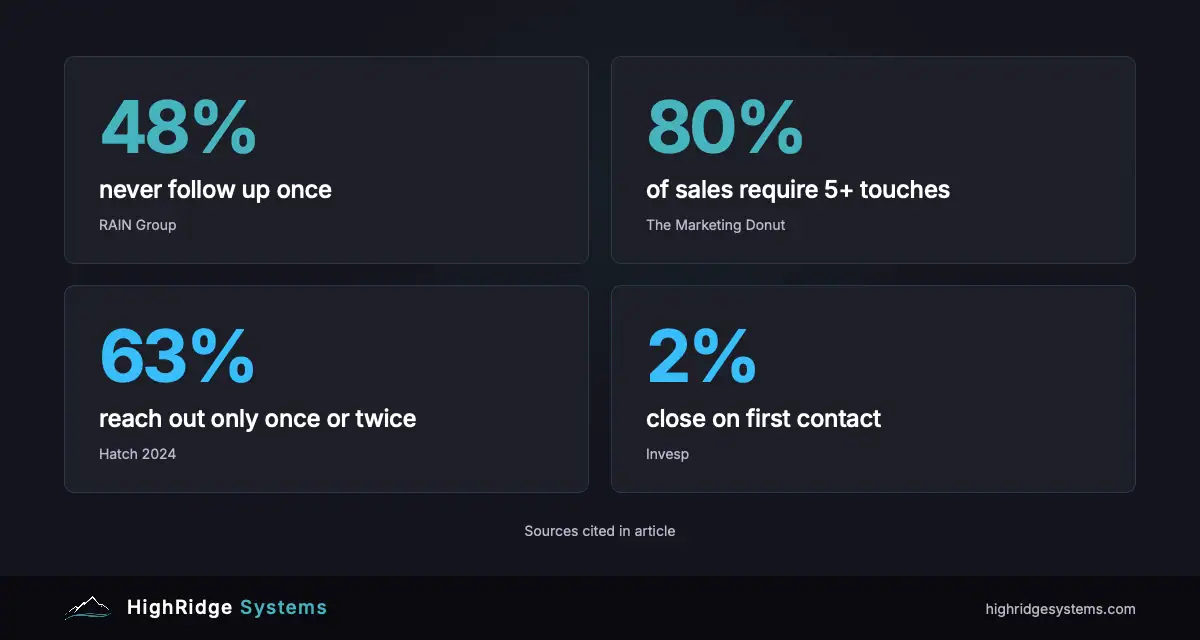
According to a recent Hatch State of the Home Improvement report, 63% of home improvement companies reach out to quoted leads only once or twice before marking them as lost. Just 14% follow up four or more times. (Hatch, 2024)
The pattern is not that contractors refuse to follow up. It is that they stop early, right at the point where the decision is still open.
The 2026 data makes the case even sharper. Hatch’s April 2026 estimate follow-up analysis found that 80% of home improvement deals do not close in the home, and 43-53% of deals that do close happen on days 2 through 30 after the estimate is delivered. (Hatch, April 2026) That means nearly half your future revenue is sitting in a follow-up window that most contractors never work.
Jobber’s 2026 Home Service Trends Report, a survey of 1,050 U.S. contractors conducted in December 2025, found that 69% of contractors report a quote win rate above 50%. (Jobber, 2026) But the spread between average and top quartile is enormous: 21% of newer businesses report win rates below 30%, and many do not track their numbers at all. Nearly 90% of the high-confidence cohort, the businesses that are fully booked with growing demand, close more than half their quotes. The difference is not the work. It is the system around the work.
Almost none of that follow-up is automated. In most shops it happens by memory, between jobs, when somebody happens to have a minute.
You already know some version of this. You have seen the estimates sitting in the outbox. What you may not have had is a way to close the gap without adding another person to the payroll.
Speed-to-lead: why every hour costs you bookings
The follow-up gap compounds with the speed gap. The 2007 InsideSales/MIT Lead Response Management study by Dr. James Oldroyd tracked more than 15,000 leads and found that contacting a lead within 5 minutes made firms 21 times more likely to qualify the lead compared to waiting 30 minutes, and 100 times more likely to make contact at all. (InsideSales/MIT, 2007, reported via Ainora)
A separate 2011 Harvard Business Review study auditing 2,241 U.S. companies found the average first response time was 42 hours. Twenty-three percent of companies never responded at all. (HBR, 2011)
The 2026 contractor-specific data is just as stark. Jobber’s survey of 1,050 contractors found that only 20% respond to new leads within an hour, meaning 80% do not. Just 60% respond the same day. (Jobber, 2026) HVAC contractors are the slowest responders of any trade surveyed, with only 11% replying within the hour, despite having the highest average job values and some of the strongest AI adoption in the industry.
Meanwhile, customer expectations are moving in the opposite direction. The same Jobber survey found that 56% of homeowners expect a response within the hour. One in four customers cited response speed as a key factor in choosing which contractor to hire.
Every hour between your estimate and your follow-up reduces the probability that the customer books. Not by a small margin — by a documented, measurable one. And your customers are telling you they expect faster than what you are delivering.
What the follow-up gap costs by trade
The revenue impact is not abstract. Hatch’s estimate follow-up data shows that the best-performing campaigns use 6-8 touches over roughly 7 days, with SMS the most responsive channel and a multi-channel strategy (text, email, phone) delivering the highest conversion. (Hatch, April 2026) Here is what the data shows across the verticals where we work, based on industry benchmarks and a conservative assumption of 40 estimates per month:
HVAC: Across 70 million home services calls, 45% of qualified leads book during the call itself. (Invoca, 2026) What separates the top quartile is not the pitch — it is whether anyone goes back to the estimates that did not close on the spot. Jobber’s 2026 report found HVAC contractors were the slowest of any trade to respond to leads, with just 11% replying within the hour, despite carrying the largest average job sizes. (Jobber, 2026) Take your own numbers: your monthly estimate count, your average job value, and the share that close without a second touch. The distance between that share and what a scheduled follow-up sequence produces is the number that matters, and it is yours rather than an industry average. HVAC has the tools. It does not have the follow-up execution.
Plumbing: Emergency demand converts better than almost any other trade, because the customer has already decided they need the work done. But non-emergency work — water heater replacements, repiping estimates, fixture upgrades — follows the same aging pattern as every other trade. Those quotes die quietly when nobody checks in.
Roofing: The distance between an average roofer and a top-quartile one is explained by follow-up discipline far more than by pricing or salesmanship. Roofing also carries one of the largest average job values of any trade, which means a single recovered estimate pays for a great deal of follow-up. Take your own close rate on the estimates that did not book on the day, and see what a scheduled sequence does to it.
Restoration: Speed is the primary conversion factor, and mitigation tickets are large enough that one recovered job outweighs a month of follow-up effort. But post-emergency restoration estimates — drying, demolition, reconstruction — have longer decision cycles and the same follow-up problem as any other trade. The homeowner handled the emergency, then stalled on the rebuild. Nobody called back.
Dental: The 2025 Planet DDS Dental Industry Outlook found that the average case completion rate was just 42%, meaning more than half of accepted treatment never actually gets scheduled. (Planet DDS, 2025) The gap between diagnosis and completed treatment is a follow-up gap, not a clinical one.
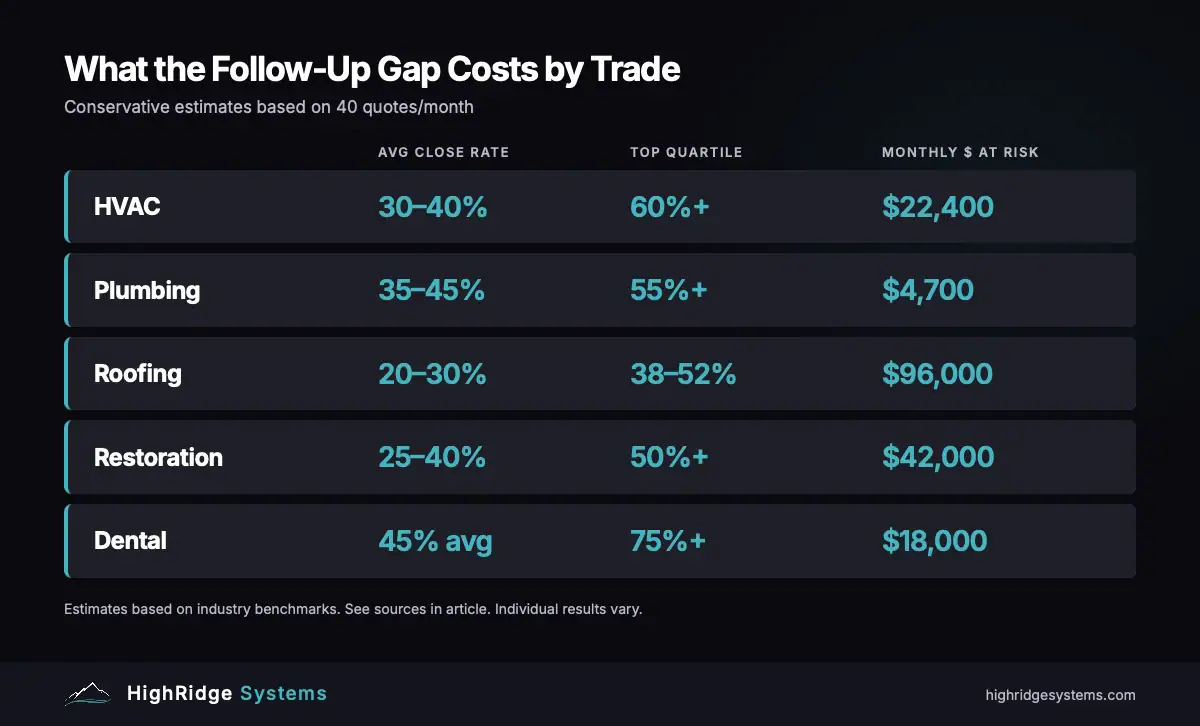
The estimate follow-up pattern is the same in every vertical. The estimate is not dead. Nobody asked again.
How much is the follow-up gap costing your specific business?
Why manual estimate follow-up breaks down in service businesses
Because you are on a job. Your team is on jobs. The dispatcher has six things happening at once. The person who was going to call that estimate back is now under a house running a sewer camera.
Manual follow-up requires someone to remember, check the CRM, write the message, and send it at the right time. That person does not exist in most service businesses — not because the team is lazy, but because following up on 40 open estimates while running 40 active jobs is not a people problem. It is a capacity problem.
The tools most contractors already use — the field service platforms that run your dispatch and invoicing — have follow-up tabs and basic automation features. But none of them natively handles the full sequence of multi-channel follow-up, conditional logic, and cross-system reporting that actually moves unsold estimates to booked jobs. The follow-up tab exists. The follow-up problem persists.
The gap is not the feature — it is the execution.
What automated estimate follow-up actually looks like
A structured nurture sequence fires automatically when an estimate is sent and not accepted within a defined window. The sequence adapts to the trade:
HVAC replacement estimate (not accepted after 2 hours):
Touch 1 — Text: “Hi [name], this is [tech] from [company]. Just sent over the AC replacement estimate. Any questions about the options? Scheduling is open next week.”
Touch 2 (24 hours) — Email with financing options and a note about seasonal demand: “Tune-up season fills fast — we can lock in your install date now.”
Touch 3 (5 days) — Text: “Following up on the estimate from Tuesday. We are holding your pricing through Friday. Want us to get you on the schedule?”
Roofing hail damage estimate (not accepted after 48 hours):
Touch 1 — Text: “Hey [name], following up on the roof estimate. Your insurance claim has a filing window — happy to walk you through the next steps.”
Touch 2 (4 days) — Email with before and after photos from a similar job and a link to reviews.
Touch 3 (10 days) — Text: “Just want to make sure the hail damage estimate does not fall through the cracks. We can still match the adjuster’s timeline if we get started this month.”
Dental implant treatment plan (not scheduled after 48 hours):
Touch 1 — Email: “Hi [name], Dr. [dentist] wanted to follow up on the treatment plan from your visit. Any questions about the procedure or the payment options?”
Touch 2 (5 days) — Text: “Quick reminder — your insurance benefits reset at year-end. Scheduling now locks in this year’s coverage.”
Touch 3 (14 days) — Personal call from the office with a specific scheduling offer.
The sequence stops the moment the customer books. No pestering. No over-sending. Just the follow-up that would have happened if someone on your team had the bandwidth.
The cost of the gap vs. the cost of closing it
A dedicated follow-up coordinator is a salary line, and a real one. They are effective during business hours and when they remember to check the pipeline. They take vacations. They prioritize some estimates over others based on gut feel. They cannot follow up on 40 estimates at optimized intervals while also answering phones and scheduling jobs.
An automated follow-up system runs on every estimate, every time, at the intervals proven to recover the most jobs. It costs a fraction of the salary. And it does not take sick days, forget to check the CRM, or let the Tuesday estimate age into oblivion because Wednesday brought 12 new calls.
The businesses that close the follow-up gap do not do different work. They just do not let the work they have already done go to waste.
Contractors who close the follow-up gap recover revenue from estimates they have already written. The estimates you sent last month are already aging out. The ones from this week still have a window.
How big is the follow-up gap in your business?
Follow-up is one of several gaps quietly draining contractor revenue. For the complete picture of where AI is producing real returns, see AI for Contractors: What’s Working, What’s Hype, and What It’s Actually Worth.
Common questions about estimate follow-up
How many follow-ups does it take to close a sale?
More than most contractors make. In home services specifically, Hatch’s 2026 analysis found that 80% of deals do not close in the home, with 43-53% closing on days 2 through 30 — meaning nearly half of revenue depends on what happens after the estimate is handed over.
What percentage of contractor estimates close without follow-up?
Jobber’s 2026 survey of 1,050 contractors found that 69% report a win rate above 50%, but 21% of newer businesses close fewer than 30% of their quotes. The gap is largely explained by follow-up consistency — 63% of contractors reach out only once or twice before marking a lead as lost.
What is estimate follow-up automation?
Estimate follow-up automation is a system that sends timed text messages, emails, or calls to prospects after an estimate is delivered and not accepted. The sequence fires automatically and stops when the customer books, recovering jobs that would otherwise be lost to inaction.
How much revenue do contractors lose from poor follow-up?
It depends on your estimate volume, your average job value and your current close rate, which is exactly why a borrowed industry figure cannot tell you. Run it against your own numbers in the Revenue Leak Calculator.
What is the ideal follow-up timeline for estimates?
Best practices show the first follow-up should happen within 2 hours of estimate delivery for time-sensitive work, or within 24 to 48 hours for larger projects. A sequence of 3 to 5 touches over 10 to 14 days recovers the highest percentage of unsold estimates.
The Revenue Leak Audit measures your follow-up gap specifically.
We look at how many estimates go out, how many convert, and what the delta is worth in actual dollars. Then we show you what closing even 10-20% of that gap looks like — specific to your vertical and your volume. Free. About 15 minutes of your time.
Book Your Free Revenue Leak Audit →Or call David directly: (970) 508-9555 · Durango, CO