
The Calls You Miss Are Worth More Than the Calls You Answer
After 5pm, your phone is your most expensive revenue leak.
After-hours calls – inbound calls arriving before 8 am, after 5 pm, on weekends, and on holidays – represent 40-60+% of total call volume for service businesses and carry ticket values 30-70% higher than standard daytime calls. (ServiceTitan via PCN, 2026) 85% of callers who reach voicemail hang up without leaving a message. (Invoca, 2023)
For a typical service business, unrecovered after-hours calls represent $7,000-$10,000 per month in lost revenue – the single largest phone-based revenue leak most businesses never measure. An after hours answering service is necessary. The review side of after-hours reputation impact is covered in review management for service businesses, and the broader infrastructure shift in AI for contractors.
Your phone rings at 6:47 pm. You’re at dinner. It goes to voicemail. The caller – a homeowner with water pouring through the ceiling – hangs up and calls the next plumber in the search results.
That call was worth more than any call that came in at 10 am. And it’s not an anomaly. It’s the pattern.
73% of the week, nobody is answering your phone.
A standard business runs 8am to 5pm, Monday through Friday – 45 hours. The week has 168 hours. That means 123 hours per week – 73% of available time – your phone either goes to voicemail or rings out.
Industry data consistently shows that 40-60+% of inbound calls to service businesses arrive during those unstaffed hours. (ServiceTitan via PCN, 2026) For home service contractors specifically, that range stretches to 35-65% depending on trade and season. For dental practices, 45% of calls come outside the 9-to-5 window. (CallRail, 2025)
These aren’t people browsing. After-hours callers are people with urgent problems who need someone now. The homeowner whose AC died at 9pm in July. The restaurant owner with a dead walk-in cooler on a Saturday. The parent whose child cracked a tooth at a Sunday soccer game.
The reason is simple: most consumers work during the same hours businesses are open. Their only opportunity to call is before work, during lunch, after work, or on weekends. Your business hours don’t match your customers’ availability.
The calls you’re missing are the most valuable calls you’ll get.
This is the part most businesses miss entirely. After-hours calls aren’t just additional volume – they’re higher-value volume.
Industry data shows that after-hours calls in home services carry ticket values 30-70% higher than standard daytime calls. (ServiceTitan via PCN, 2026) An emergency plumbing call at 9 pm isn’t a $200 faucet repair – it’s an $800 burst-pipe remediation. An HVAC call on a Saturday in January isn’t a routine tune-up – it’s a $1,200 furnace repair. A dental emergency on a Sunday isn’t a routine cleaning – it’s a $400-$800 crown or extraction.
Emergency calls, which carry the highest ticket values, disproportionately occur at night and on weekends. HVAC and plumbing emergency call volume can spike to 5-10x baseline during extreme weather. (industry emergency-call analysis, 2026)
The calls that arrive when you can’t answer are disproportionately the calls you most want to answer. This solidifies the need for a contractor answering service.
85% of callers who reach your voicemail will never call you back.
The data here is unambiguous.
85% of callers who reach voicemail hang up without leaving a message. They don’t leave their name and number and patiently wait. They call the next business. (Invoca, 2023) Of the small percentage who do leave a message, 45% have already contacted a competitor by the time the business calls back. (industry call-handling analysis, 2026)
78% of customers buy from the first company that responds to their inquiry. The business that answers wins. (MIT / InsideSales.com, 2007)
After hours, the competition for that job isn’t your quality of work, your reviews, or your price. It’s whether you picked up the phone.
After-hours call patterns hit every trade – but the math is different in each.
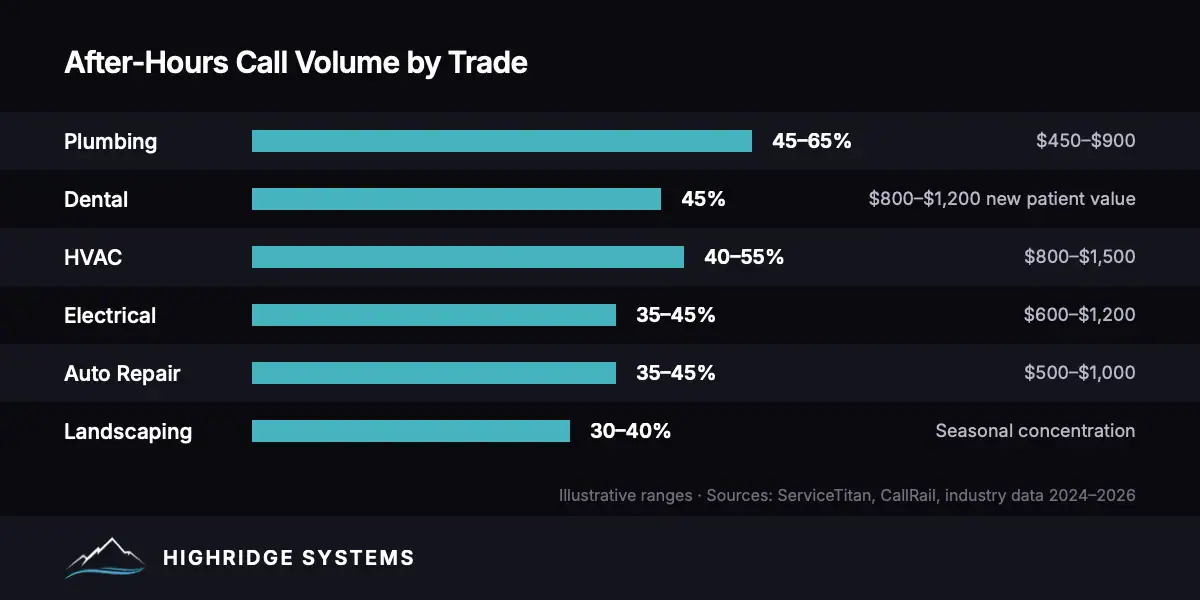
After-hours call volume and value vary by vertical, but the revenue impact is universal. Here is what the data shows across the primary service verticals:
- HVAC. 40-55% of calls come after hours. Emergency calls spike dramatically during heat waves and cold snaps – up to 5-10x baseline. Average after-hours ticket: $800-$1,500. 68% of inbound HVAC calls are emergency or urgent in nature. (CallRail, 2025)
- Plumbing. 45-65% of calls come after hours – the highest share of any home service trade. 62% of plumbing emergencies happen outside regular business hours. Average emergency call value: $450-$900. (ServiceTitan, 2025)
- Dental. 45% of calls come outside the 9-to-5 window. Most are appointment requests, not emergencies – but the caller who can’t reach your office at 6pm books with the practice that answers. Average new patient value: $800-$1,200 in first-year revenue. (CallRail, 2025)
- Auto repair. 35-45% of calls come after hours. Breakdowns and accidents don’t follow a schedule. Average after-hours repair ticket: $500-$1,000. Callers searching after 5pm have immediate, non-deferrable need.
- Electrical. 35-45% of calls come after hours. Flickering breakers, burning smells, and exposed wires carry a safety urgency that makes callers less likely to leave a voicemail and more likely to call the next result. Average after-hours ticket: $600-$1,200.
- Landscaping and outdoor services. 30-40% of calls come after hours – lower than emergency trades, but concentrated on evenings and weekends when homeowners are home and looking at their property. Seasonal spikes around spring and fall.
The pattern is consistent: your after-hours problem is worst when your revenue potential is highest.
See what missed calls cost in your specific trade →
The revenue math on after-hours coverage.
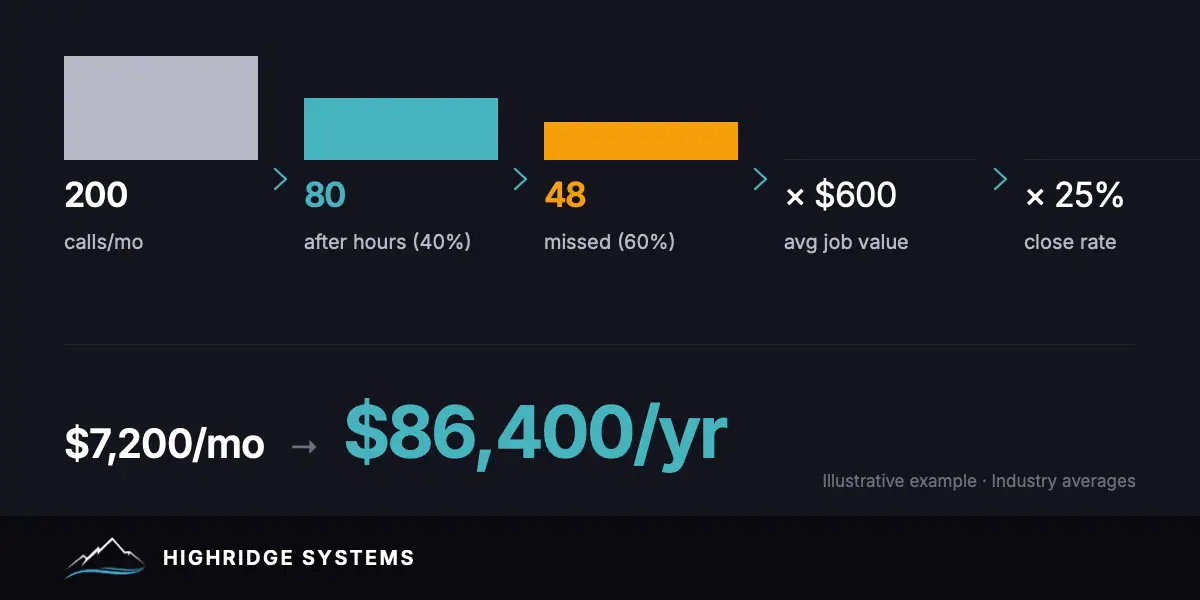
A service business receiving 200 calls a month with 40% arriving after hours has 80 after-hours calls. Missing 60% of those – the industry average for businesses without after-hours coverage – means 48 missed opportunities per month.
At a conservative $600 average after-hours job value and a 25% close rate, that’s 12 lost bookings worth $7,200 per month – $86,400 per year.
For a dental practice receiving 150 calls a month with 45% arriving after hours, the same structure applies with different inputs: 68 after-hours calls, 41 missed, at an $800 average new patient first-year value and a 30% booking rate – $9,840 per month in recoverable revenue.
These are illustrative examples using industry averages. Your actual numbers depend on your call volume, trade, and market. The Revenue Leak Audit calculates them with your data.
Book Your Free Revenue Leak Audit →
The morning callback myth.
Many business owners assume they’ll return after-hours calls first thing the next morning. It’s a rational decision: you’re on a job, you’re at dinner, you’re with your kids. You’re not ignoring those calls because you don’t care. You’re making a perfectly reasonable calculation – I’ll get to it in the morning.
The problem is that reasonable and effective aren’t the same thing.
First, the customer has already called someone else. By 8 am, they’ve found a plumber, booked an HVAC tech, or scheduled a dental appointment. Your callback arrives after the job is taken.
Second, morning is when your active jobs start. The callback gets pushed to 10 am, then noon, then after this job. Lead conversion drops 10x between a 5-minute response and a 30-minute response. (MIT / InsideSales.com, 2007) By morning, you’re not 30 minutes late – you’re 12 hours late.
Third, voicemail doesn’t capture the information you need. Even the 15% who do leave a message often give an incomplete picture. You call back, get their voicemail, and the phone tag begins.
This is the execution gap in miniature: you know you should answer every call. You have the phone in your pocket. The problem isn’t awareness or tools – it’s that you’re busy doing the work your business exists to do. What’s missing isn’t a phone. It’s a system that answers when you can’t. See how AI changes the math for contractors for the broader picture.
Voicemail is not a coverage strategy. It’s a customer-deflection system.
The standard leave a message and we’ll call you back assumption treats voicemail as a safety net. The data says it’s a trapdoor.
85-86% of first-time callers don’t leave a voicemail. (Invoca, 2023; NICE inContact, 2025) The median caller hold tolerance is 90 seconds – after that, they hang up, and the behavioral data applies: they don’t call back, they call a competitor. (NICE inContact, 2025)
For businesses running paid ads, the economics are worse. You paid for that click. The caller reached your line after hours. Voicemail picked up. They hung up. Your cost per acquisition just doubled, and the lead went to a competitor who answered.
A human answering service carries a recurring per-minute cost and a monthly minimum. Operators take messages. They don’t book appointments, answer service-specific questions, or integrate with your scheduling system. A full-time after-hours receptionist costs a full salary plus benefits, covers limited hours, and still calls in sick.
An AI voice agent is a different category entirely – managed response infrastructure. It answers in under a second, every hour of every day. It doesn’t take messages. It asks the right questions, books the appointment directly into your calendar, and routes urgent calls immediately. The customer hangs up with a confirmed booking.
Here’s what that looks like at 11pm: your phone rings. The AI answers on the first ring. It asks what happened. It captures the address, the urgency, the caller’s name and number. It books the first available morning slot into your dispatch calendar. It sends the customer a text confirmation. You wake up to a full schedule – and the caller who would have gone to a competitor is already booked.
See how the Response System works →
Your after-hours problem is worst during your highest-revenue windows.
After-hours call patterns have dramatic seasonal variation – and the spikes align with the moments when each job is worth the most.
HVAC after-hours volume surges during the first heat wave of summer and the first hard freeze of winter. Plumbing emergency calls spike when pipes freeze. Dental practices see after-hours call increases around back-to-school season and holidays. Auto repair shops see evening and weekend call volume climb during vacation travel season.
The seasonal pattern creates a compounding problem: your after-hours gap is widest precisely when each missed call is worth the most. A missed HVAC call on the first 95-degree day of summer isn’t a $300 tune-up – it’s a $1,500 emergency repair from a caller who will pay premium rates for same-day service.
Businesses with after-hours coverage see a 15-25% revenue increase from this single change. (industry after-hours coverage analysis, 2026) Businesses deploying AI answering solutions report a 27% increase in booked appointments within the first 90 days – entirely from calls that were previously going unanswered, with no additional marketing spend. (Accenture, 2025)
Common questions about after-hours calls
What percentage of calls to service businesses come after hours?
40-60+% of calls to service businesses arrive outside standard 8am-5pm hours. For some trades – plumbing in particular – the figure reaches 65%. The pattern is consistent across industries because most consumers work during the same hours businesses are open, so evenings, weekends, and lunch breaks are when they call.
How much does a missed after-hours call cost?
It depends on your average ticket and how many callers book. For an HVAC or mechanical shop the expected value of one missed call is about $169 – a $500 blended ticket, a 45% close rate on qualified leads, and a 0.75 conservative haircut for the calls that were never jobs. (Invoca, 2026, 70 million calls)
Run it with your own numbers rather than an industry average: your ticket, your close rate, the same haircut. And that is only the first job. The larger loss is the relationship behind it – the repeat work, the referrals and the reviews that customer would have generated.
Do customers actually leave voicemails?
No. 85-86% of first-time callers who reach voicemail hang up without leaving a message. Of those who do leave a message, nearly half have already called a competitor by the time the business returns the call. Voicemail feels like coverage, but the data shows it functions as a customer-deflection system.
What is the difference between an answering service and an AI voice agent?
A traditional answering service staffs human operators who take messages and relay them. They carry a recurring per-minute cost, do not book appointments, and do not integrate with your calendar or CRM. An AI voice agent answers instantly, asks qualifying questions, books appointments directly into your scheduling system, routes emergencies, and sends confirmation texts – around the clock. See the Response System for how managed AI answering works.
What is the fastest way to capture after-hours revenue?
An AI voice agent that answers every call – after hours, weekends, holidays – is the fastest single change a service business can make to recover lost revenue. Businesses deploying after-hours AI answering report measurable revenue increases within 60-90 days. The Revenue Leak Audit shows you the specific gap in your business.
Is your after-hours phone worth $7,000 a month – or nothing?
Your free Revenue Leak Audit includes after-hours call analysis – how many calls come in outside business hours, what they’re worth in your specific trade, and what capturing them looks like with an AI voice agent answering around the clock. Free. About 15 minutes of your time.
If the numbers don’t show a clear gap, we’ll tell you – and you’ll have lost nothing but about 15 minutes.
Book Your Free Revenue Leak Audit →Or use the Revenue Leak Calculator · Or call David directly: 970.508.9555 · Durango, CO