
Auto Repair Marketing — What Independent Shops Need to Know
You’re losing customers to shops that do worse work. Not because they’re better — because they answer faster, ask for reviews, and follow up on every declined service. Here’s exactly what to fix and auto repair marketing that works.
Whether you call it auto repair marketing, car repair marketing, or just “getting the phone to ring” — the goal is the same: getting vehicle owners in your service area to call your shop instead of the dealership or the franchise chain — and converting that call into a booked appointment. The most effective auto repair marketing in 2026 isn’t about competing with dealership ad budgets. It’s about answering every call, collecting reviews that prove your integrity on every job, and following up on every recommended service before the customer forgets or goes somewhere else.
The U.S. auto repair industry generates roughly $89.6 billion in revenue across more than 270,000 independent shops. (Auto Care Association, 2026 Factbook) Independent shops account for approximately 71–75% of all auto repair locations in the country. (IBISWorld; WifiTalents, 2026) But two-thirds of American drivers say they don’t fully trust auto repair shops (AAA, 2026) — a trust deficit that honest, certified independent shops can close faster than anyone else in the industry.
Independent shops compete on three fronts — and each one has different marketing dynamics.
The auto repair industry is one of the most fragmented in the U.S. economy — no single company holds more than 5% market share. But that fragmentation means independent shops face competitive pressure from three distinct directions simultaneously:
Dealership service departments retain about 41% of the automotive service market. (Mordor Intelligence / S&P Global, 2025) Their advantage is warranty coverage, OEM parts access, and connected-car diagnostics that funnel customers back to the service lane. Their disadvantage is price — dealership labor rates run 20–50% higher than independent shops in most markets — and impersonal service. The owner of a 2019 Subaru Outback doesn’t want to sit in a sterile waiting room watching a progress screen. They want to talk to someone who knows the vehicle and will explain what’s actually wrong.
Quick-lube and tire chains (Valvoline, Jiffy Lube, Midas, Firestone, Goodyear) compete on convenience and national brand recognition. Valvoline’s $625 million acquisition of Breeze Autocare (S&P Global, 2025) signals that the quick-lube segment is scaling aggressively with digital scheduling and regional economies of scale. Their advantage is walk-in convenience and marketing budget. Their disadvantage is limited service scope — when the check engine light comes on, the quick-lube sends them somewhere else. That somewhere should be you.
National parts and service networks — NAPA AutoCare, AAA Approved Auto Repair — aren’t competitors. They’re force multipliers. NAPA AutoCare is the largest network of independent mechanics in the United States with over 14,000 locations. AAA Approved Auto Repair has over 7,000 certified facilities. These programs give independent shops the warranty backing, brand credibility, and customer trust signals that level the playing field against dealerships and chains — without franchise fees or corporate control.
The independent shops that thrive in 2026 use network affiliations (NAPA, AAA) for credibility, their own review profiles for trust, and their speed and transparency for competitive advantage.
The marketing math changes based on the size of your shop.
Not every auto repair shop runs the same way. A two-bay owner-operator has a completely different set of constraints than a six-bay established operation with ASE Master technicians and a dedicated service advisor. The auto repair marketing strategies that fill one shop’s bays can be irrelevant to the other.
If you’re a 1–3 bay shop where the owner is also the lead mechanic, your biggest constraint is time. You can’t answer the phone while you’re under a car. You can’t follow up on estimates while you’re diagnosing a transmission issue. You can’t ask for reviews while you’re rebuilding a brake caliper. Your marketing problem isn’t generating awareness — you’ve been in the community long enough that people know your name. Your problem is capturing the demand that already exists. Every call that goes to voicemail because you’re elbow-deep in an engine bay is a $550 job walking to the next shop. An AI voice agent that handles calls while you work is the single highest-ROI investment for a shop at this size — it’s the extra front-counter person you can’t afford to hire.
If you’re a 4–8 bay established shop with multiple technicians and a front counter, your constraints are different. You have someone answering the phone — most of the time. But during peak hours when three customers are checking out and the phone rings twice, calls still slip. At your scale, the revenue leaks aren’t obvious — they’re hidden in the 15–20% of calls your counter misses during rush periods (Marchex data shows the industry average is up to 21%), the declined services that never get followed up, and the maintenance customers who drift to Jiffy Lube because nobody reminded them their oil change was due. Your marketing challenge is systematic retention and follow-up across hundreds of customer relationships — work that no front-counter person can do manually at scale.
If you’re a shop with NAPA AutoCare, AAA Approved, or both, you’ve already invested in credibility infrastructure that most competitors don’t have. Your marketing challenge is extracting full value from those investments — featuring your certifications and warranties prominently in your online presence, leveraging the AAA member referral pipeline, and using the NAPA brand to differentiate against both the dealership and the Jiffy Lube. Most certified shops treat these affiliations as wall plaques. The ones that treat them as active marketing assets consistently outperform.
What every customer is actually worth — and why it changes how you think about marketing.
Most shop owners think about each job individually. A brake job is $450. An oil change is $75. A diagnostic is $120. But this per-transaction view massively understates what a customer is actually worth to your business.
A vehicle owner who finds a mechanic they trust doesn’t leave. They come back for oil changes, tire rotations, brake work, timing belts, transmission service — every maintenance and repair need that vehicle has for the next 5–10 years. And they have more than one vehicle. And their spouse has a vehicle. And their kid just turned 16 and bought a used Honda that needs everything.
The math: a single household with two vehicles averaging $600 in annual maintenance and repair per vehicle generates $1,200 per year. Over a five-year relationship, that’s $6,000. Add the 3–5 referrals that a genuinely satisfied customer produces (Hook Agency, 2025: 71–73% of consumers verify word-of-mouth recommendations online before calling), and the fully loaded lifetime value of one new customer easily reaches $10,000–$15,000.
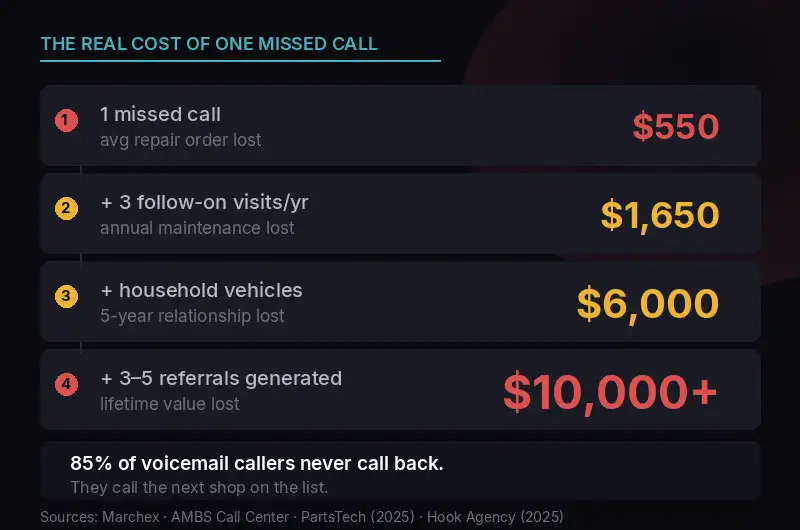
That changes the math on every auto repair marketing decision. A missed phone call isn’t a lost $550 repair order — it’s a lost $10,000 relationship. An unrequested review isn’t just a missed star on Google — it’s a referral network that never gets built. A declined service that nobody follows up on isn’t a $200 brake fluid flush that slipped away — it’s the first crack in a relationship that eventually sends that customer to the dealership.
The gap between shops that systematize this and shops that do not is measurable. Shops with systematic retention and follow-up processes keep 60–70% of their customers within 12 months. Shops without them retain 30–40%. (Launch Advisor, 2026) That gap carries a price: independent shops without systematic retention lose an estimated $50,000–$100,000 per year to customer churn alone. (Buildify, February 2026)
When you see every customer through the lifetime value lens, the investment in systems that capture every call, request every review, and follow up on every declined service stops looking like a cost and starts looking like the highest-return investment in the business.
Every shop owner knows this intuitively. You have customers who have been coming in for years — the ones who bring both family cars, refer their neighbors, and call you first every time. The system does not create that loyalty. It makes sure you never accidentally lose it to a missed call, a forgotten follow-up, or a review that never got requested.
See what a Revenue Leak Audit reveals for your shop →
The economics of auto repair favor the independent shop — if you know your margins.
The average independent auto repair shop in the U.S. generates roughly $1.2 million in annual revenue. (WickedFile / PartsTech, 2026) But that average hides enormous variation — a two-bay owner-operator pulling $500K versus a high-volume eight-bay operation clearing $2M+.
What matters more than revenue is where your margin lives:
Labor is where the money is. Labor charges account for 50–60% of total revenue and generate 50–65% gross margins. Diagnostics, electrical work, and European/specialty vehicle repairs push that even higher — up to 65–70% in well-run shops. (Simpro, June 2026; AutoLeap, April 2026) Every hour your technicians spend on billable work at $100–$150/hour is your highest-margin revenue.
Parts generate 30–40% of revenue but carry lower margins — typically 20–40% gross profit depending on your markup matrix and supplier relationships. (BusinessDojo, 2026) NAPA AutoCare members get additional rebates and pricing advantages that improve parts margin — one of the tangible financial benefits of network membership beyond the warranty and brand.
Maintenance and scheduled service is the most underappreciated revenue stream. Oil changes, brake inspections, fluid flushes, and tire rotations run 40–55% gross margin and — critically — build the recurring relationship that leads to the high-ticket diagnostic and repair work. The customer who comes in for a $75 oil change twice a year is the customer who calls you when the transmission starts slipping on a $3,000 repair.
EV and hybrid service is an emerging margin opportunity. EV owners spend 25% more on specialty repairs, and shops that invest in hybrid/EV training report 15% higher revenue per tech. (Gitnux, 2026) The infrastructure tailwind is real: more EVs on the road every year, and most dealerships are the only current option. Even if EV service isn’t core to your business today, a dedicated service page on your website captures search traffic from “EV repair near me” and “hybrid mechanic” — queries that are growing 40%+ year over year and have almost no independent shop competition.
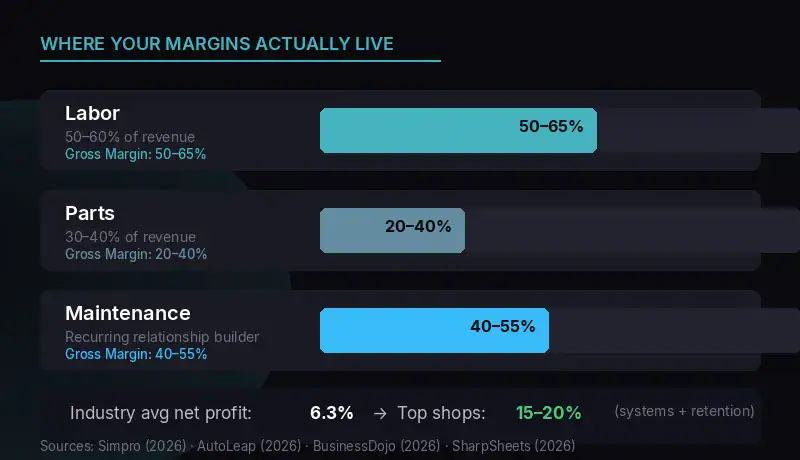
The industry-wide average net profit margin is approximately 6.3%. (SharpSheets, 2026) Top-performing shops hit 15–20%. The difference isn’t volume — it’s operational efficiency, billable hour utilization, parts procurement strategy, and customer retention. A healthy shop targets around $550 in average repair order value. (PartsTech 2025 survey of 752 shops)
Americans are keeping their cars longer — and that’s the best thing that’s ever happened for independent repair.
The average age of vehicles on U.S. roads hit a record 12.8 years in 2025. (S&P Global Mobility) Passenger cars specifically average 14.5 years. CCC Intelligent Solutions projects the average will reach 13 years by 2026.
This isn’t temporary. It’s structural. New vehicle prices average over $50,000. Inflation persists. Consumers are choosing to maintain rather than replace — and that maintenance demand flows disproportionately to independent shops, not dealerships.
S&P Global Mobility describes it directly: “As vehicles stay on the road longer, the aging fleet is turning into a boon for the car and auto parts aftermarket.” The aftermarket repair “sweet spot” — vehicles 6 to 14 years old — now represents the largest share of vehicles in operation, and vehicles older than that will account for 70% or more of VIO for the next five years.
For an independent shop, this means your addressable market is growing every year. The 2015 Subaru that just crossed 100,000 miles needs brake work, a timing belt, maybe a head gasket. The 2012 Ford F-150 towing a camper in the San Juans needs suspension work and a transmission flush. These are your jobs. The dealership doesn’t want them — the warranty has long expired.
The question isn’t whether the work exists. It’s whether those vehicle owners can find you, trust you, and reach you when they need you.
The trust problem is auto repair’s biggest marketing challenge — and your biggest opportunity.
Two-thirds of American drivers don’t fully trust auto repair shops. (AAA, 2026) Only 17% of consumers feel they’re always fairly charged for car repairs. (ConsumerAffairs) This is the foundational challenge that defines auto repair marketing.
But here’s the paradox: independent shops are the most trusted segment of the industry. 72% of consumers prefer independent shops over dealerships. (Gitnux, 2026) The distrust isn’t aimed at the guy down the street who’s been fixing cars for 20 years — it’s aimed at the category as a whole, built over decades by a small percentage of bad actors.
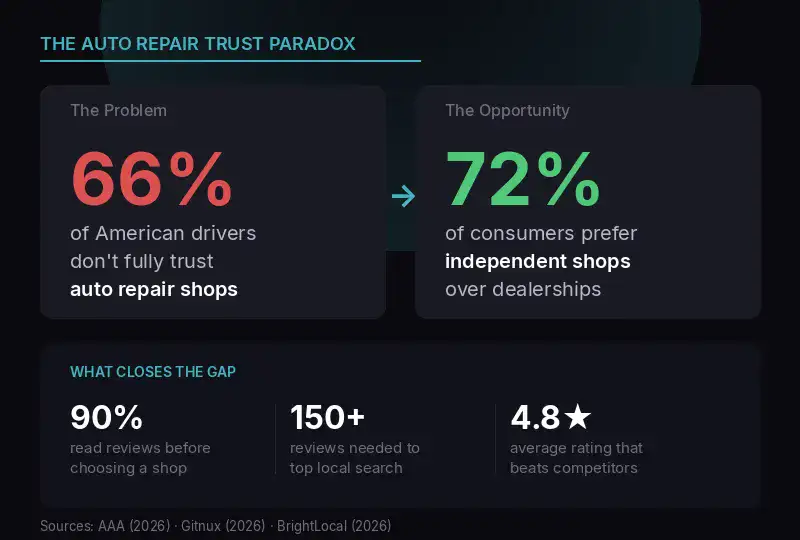
For an independent shop with genuine integrity, this trust deficit is a marketing opportunity, not a barrier. Every Google review that says “honest estimate, no upsell, explained everything” erodes the category-wide skepticism and builds shop-specific trust.
90% of consumers read reviews before choosing a repair shop. (Saphek, 2026; a widely cited local consumer review survey) A single star increase in average rating correlates with 5–10% more revenue for an auto repair shop. (AAA, 2026) A shop with 50 reviews at a 4.8 average beats a review-less shop every time — even at higher prices. The reviews that convert are specific: “timing belt replaced, quote honored to the cent, car returned clean.” One detailed review is worth ten that say “great service.”
Certifications amplify trust. ASE certification, NAPA AutoCare membership, AAA Approved status — these are third-party trust signals that validate what your reviews are saying. A shop that’s NAPA Gold Certified with ASE Master technicians and a 36-month/36,000-mile nationwide warranty isn’t asking the customer to take their word for it. The credentials do the talking.
Digital vehicle inspections are the trust-closing mechanism — and most shops are barely using them.
The trust conversation in auto repair has always had one structural weakness: the customer can’t see what the technician sees. “Your brake pads are worn” means nothing to someone who’s never looked at a brake pad. “Your CV boot is torn” sounds like it could be real or could be an upsell. The customer has no way to evaluate the recommendation — so they default to skepticism.
Digital vehicle inspections (DVI) eliminate this gap. A photo of a brake pad at 2mm next to a new pad at 12mm. A video of a leaking gasket with fluid dripping. A side-by-side comparison of a clean cabin filter and the customer’s filter that looks like it was used to strain coffee for a year.
More than 7 in 10 customers now expect to see photos, videos, and digital estimates — not just a verbal explanation — when they bring their car in for service. (AutoOps, 2025) Shops using digital inspections report higher approval rates on recommended services and stronger customer retention — because the customer can see exactly what their car needs and why.
The auto repair marketing connection: DVI results that go to the customer via text message (with photos) become the evidence that drives reviews. “They showed me exactly what was wrong — photos and everything” is the kind of review that converts skeptical shoppers into booked appointments. The transparency isn’t just operational — it’s your most powerful marketing asset.
See what gaps a Revenue Leak Audit uncovers →
The phone problem is the revenue problem.
Independent auto repair shops live and die by the phone. About 70% of independent-shop customers book service by phone, and only 10% book online. (CDK Global, 2026) That is a heavier phone reliance than dealerships, where digital booking has more traction. For an independent shop, the phone is not one channel among many. It is how customers reach you.
Which is why an unanswered call hurts more here than almost anywhere. Up to21% of automotive service calls go unanswered. (Marchex call analytics across multi-location service operators) The Automotive Service Association puts it closer to one in four — nearly 23% unanswered during regular business hours. (Automotive Service Association, 2026) And 85% of voicemail callers never call back. (AMBS Call Center) They call the next shop on the list.
The reason customers still call, even for routine work they could book online, is not age and it is not simply urgency. It is uncertainty. When a customer does not know what is wrong, a booking form cannot help them. They do not have a service to select from a dropdown. They have a noise, a warning light, and a question about whether the car is even safe to drive. Pied Piper’s 2025 mystery-shopping study across nearly 4,900 service requests found the same divide: the phone wins for complex, undiagnosed problems, while online scheduling handles routine oil changes and maintenance. (Pied Piper, 2025) The customer with a mysterious clunk wants to talk to a person. And their real questions, how long will it take and how am I getting to work, are ones no booking form answers.
When every bay is full and the front counter is three deep, the phone is the first thing that slips. It slips exactly when the highest-value, least-certain callers are trying to reach you.
An AI voice agent eliminates this gap. It answers overflow calls within two rings, captures the vehicle information and symptom description, confirms the service area, and books the appointment or routes the emergency. The customer gets immediate professional response. You get the job.
Remember the lifetime value math: missing one call isn’t a lost $550 repair order. It’s a lost $10,000+ relationship — the follow-on visits, the maintenance revenue, the referrals that customer would have generated over the next five years.
A note about referrals. Auto repair is one of the most referral-driven businesses that exists. When someone asks “know a good mechanic?” and a friend gives your name — that’s the highest-converting lead in the industry. Referral customers trust you before they arrive. They’re less price-sensitive. They convert faster and stay longer.
But referrals have the same limitation in auto repair that they have in every trade: you can’t control the volume or timing. One great transmission repair produces three referrals over two months. Then nothing until the next person asks at a dinner party. You can’t forecast your schedule around that pattern — and you can’t dial it up when the bays are empty in January.
What you can do is turn every satisfied customer into a permanent, searchable referral — through a Google review. When someone asks “know a good mechanic?” in 2026, the friend gives your name. Then the person Googles you before calling. If your Google profile shows 200 reviews mentioning honest pricing, ASE-certified technicians, and same-day service — the referral converts. If it shows 30 reviews and a 4.2 average, they keep searching.
Recommended service follow-up is the biggest revenue leak in auto repair.
Every competent auto repair shop does a vehicle inspection during service. Most shops present recommended services — tires are worn, brake fluid needs flushing, cabin filter should be replaced, alignment is off. Industry data shows only about 42% of that recommended work actually gets approved at the time of the visit — meaning 58% of the work your technicians identify gets declined or deferred. (Coruzant, citing industry data, June 2026) The customer says “not today — just do what I came in for.”
Those declined services don’t disappear. The vehicle still needs the work. But without systematic follow-up, the customer forgets, puts it off, or — more often — drives into the quick-lube three months later and hears the same recommendation from someone else.
An automated follow-up sequence changes this: a text message 2 weeks after service — “Your technician noted your brake fluid was due for a flush. Want to schedule that?” — followed by an email at 30 days and a text at 60 days before the next seasonal service window.
This isn’t aggressive upselling. It’s the digital version of what the best service advisors have always done — calling the customer to remind them about the work their vehicle needs. The difference is that it happens consistently on every customer, not just the ones your advisor remembers.
The declined-service follow-up sequence is the single highest-ROI marketing investment for most auto repair shops because the diagnostic work is already done, the trust is already established, and the customer already knows your shop. You’re not generating a new lead — you’re converting revenue you’ve already earned the right to.
Find out how much revenue is leaking from your unfollowed declined services →
The technician shortage makes your systems more valuable — not less.
The Bureau of Labor Statistics forecasts a shortage of 68,000 auto technicians every year for the next decade. TechForce Foundation projects a shortfall of hundreds of thousands of techs through 2026. The average age of an auto technician is approximately 40 years — retirements are outpacing new entrants. (Auto Care Association, 2026 Factbook; BLS)
Nearly six in ten repair shops say the technician shortage has a “high” or “moderate” impact on their business. (PartsTech 2025 survey of 752 shops) The top cited factors: low compensation and negative perception of the industry.
When your capacity is constrained — when you can’t just hire another tech to handle more volume — every bay-hour becomes precious. Which means every customer interaction is more valuable. Not just the revenue from this visit, but the lifetime value of a relationship that fills your schedule with reliable, returning customers instead of one-time strangers who found you on a lead service.
The practical implication: if your best technicians are spending 8 hours a day under cars (as they should be), your front-of-house systems need to handle the customer communication, the follow-up, and the retention without depending on anyone’s memory, a whiteboard, or a sticky note on the monitor.
NAPA and AAA aren’t just badges — they’re marketing infrastructure you’re probably underusing.
For independent shops that are NAPA AutoCare Centers, AAA Approved, or both — these affiliations are marketing assets that most shops dramatically underutilize.
NAPA AutoCare provides the 36-month/36,000-mile nationwide warranty (honored at over 14,000 locations), the NAPA EasyPay financing option, the NAPA TRACS shop management system, CRM and marketing partnerships, the Team Tool Rebate for technician retention, and the Gold Certified program that recognizes the top-performing shops — over 800 nationwide by end of 2025. (NAPA / Counterman, May 2025) These are trust signals that belong on your website, your Google Business Profile, your review response templates, and your estimate cover sheets.
AAA Approved Auto Repair provides the AAA member referral pipeline (AAA has over 60 million members), the 24-month/24,000-mile parts and labor guarantee, free vehicle maintenance inspections for members, dispute resolution if issues arise, and annual facility inspections that serve as third-party quality verification. The AAA Approved program celebrated its 50th anniversary in 2025 — half a century of consumer trust equity that your shop can borrow.
The marketing mistake most auto repair shops make is treating these as badges on the wall rather than active marketing messages. Your NAPA Gold Certification and AAA Top Shop awards belong in your Google Business Profile description, in your review request messaging, in your email signatures, and on dedicated landing pages on your website that AI search engines can find and reference.
But here’s what NAPA and AAA don’t do: they don’t answer your overflow calls. They don’t send review requests after every job. They don’t follow up on declined services. They don’t run seasonal maintenance reminder sequences. They don’t track your AI search visibility against the local dealership.
The certifications give you the credibility infrastructure. You still need the operational auto repair marketing system that converts that credibility into booked appointments, collected reviews, and retained customers. That’s the gap between having the badges and having the bays full.
See how the system works alongside your existing certifications →
Independent auto repair shops are invisible in AI search.
When a vehicle owner asks ChatGPT “best mechanic in Durango” or Google’s AI Overview synthesizes an answer for “auto repair near me,” independent shops almost never appear. The recommendations are dominated by national chains, dealership service departments, and directory aggregators.
The reason isn’t quality. It’s data structure. Dealerships have consistent citations across hundreds of directories, schema markup on every service page, and massive review volume aggregated across locations. National chains have SEO teams and structured data implementations that independent shops simply haven’t invested in.
For a single-location shop, the fix is the same foundation that drives traditional search visibility: consistent business citations across all directories, schema markup on your website (LocalBusiness, AutoRepair, AggregateRating), a complete Google Business Profile with all services listed, and steady review velocity with specific service mentions.
One overlooked angle: video. A 90-second walkthrough of your shop — clean bays, certified technicians working on vehicles, your NAPA Gold plaque on the wall — posted to your Google Business Profile can increase profile engagement significantly. Google data indicates profiles with 100+ photos receive substantially more calls than those without visuals.
The shops that build their AI search presence now — while competitors haven’t even thought about it — will own those AI-generated recommendations in their local market by the time the majority of vehicle owners rely on AI for shop selection.
Check whether your auto repair shop appears in AI search →
What independent auto repair shops need to get right in 2026
Independent auto repair shops account for more than 70% of all repair facilities in the United States, yet most are invisible in the places vehicle owners now search — AI-generated recommendations from ChatGPT, Claude, Google AI Overviews, and Perplexity. The core auto repair marketing challenges for single-location shops are consistent: unanswered calls during peak hours (up to 21% industry-wide), low review volume relative to dealerships and chains, declined services that never get followed up, and no presence in AI search results.
The shops that grow without increasing ad spend share the same operational foundation: an AI voice agent that captures every overflow call, automated review requests after every completed job, a follow-up sequence on every declined service recommendation, and structured online data (citations, schema, Google Business Profile) that gives AI engines specific reasons to recommend them. For NAPA AutoCare and AAA Approved shops, these systems convert existing certification credibility into booked appointments and collected reviews — closing the gap between the trust they’ve earned and the visibility they’re missing.
Auto repair shop marketing in 2026 isn’t about outspending the dealership. It’s about out-systemizing them.
What auto repair marketing actually looks like as a system.
Most shops are not short on software — they are short on someone running it. The shop management system tracks declined services but nobody sends the follow-up. The Google Business Profile exists but nobody responds to reviews. The phone system logs missed calls but nobody calls back. The gap is not technology. It is execution.
The car repair marketing strategies that actually move the needle are not campaigns — they are systems. The independent auto repair shops that consistently grow without depending on expensive advertising share the same infrastructure:
- Every call answered. Including the 4:30pm call when the counter is three deep and both lines are ringing. AI voice agent captures overflow, qualifies the issue, and books the appointment — or routes the emergency tow. Response System
- Every job reviewed. Automated text within 2 hours of vehicle pickup — while the relief of having the car fixed and running is still fresh. Reputation System
- Every declined service followed up. Automated sequence at 2 weeks, 30 days, and 60 days for recommended services not performed during the visit. Revenue System
- Every maintenance customer retained. Oil change reminders, seasonal service recommendations, mileage-based maintenance alerts — automated and personalized to the vehicle.
- Every inspection shared digitally. Photos and video of findings texted to the customer for transparent approval — and the evidence that drives detailed, trust-building reviews.
- Online presence managed. Consistent citations, complete GBP with all services and certifications listed, schema markup on service pages.
- Certifications featured prominently. NAPA AutoCare, AAA Approved, ASE certifications visible on every customer-facing surface — digital and physical.
- AI visibility tracked. Weekly monitoring across ChatGPT, Claude, Perplexity, and Google AI Overviews. AI Visibility Tracking
The dealership has a BDC department running this. The franchise has a corporate marketing team. You need a system that runs it for you — while your technicians focus on what they do best.
Common questions about auto repair marketing automation
How do I compete with dealership service departments?
You compete on price, transparency, and relationship — not ad budget. Independent shops charge 20–50% less than dealerships for the same work, and the customer talks to the person who actually works on their car — not a service writer who’s never held a wrench. ASE certification, NAPA warranties, and AAA approval match or exceed the dealership credentials. Add a review profile that proves honesty, and you’ve built a competitive position that no dealership marketing budget can replicate.
How many Google reviews does an auto repair shop need?
More than your closest competitor. The average independent shop collects roughly 2 reviews per month (ProsperQR, July 2026 — 73 shops, 6,764 reviews), so a shop earning them weekly pulls ahead fast. In most markets, 150+ reviews puts you at the top of local search and AI-generated recommendations. Specificity matters as much as volume: reviews naming the actual service — “replaced the timing belt,” “diagnosed the electrical issue that two other shops missed,” “honest about what needed fixing now vs. what could wait” — give both Google and AI search engines specific evidence to recommend you.
How important is answering the phone for auto repair shops?
Critical. Up to 21% of service calls go unanswered across the industry (Marchex), and 85% of those callers never call back (AMBS Call Center). During peak hours when the front counter is overwhelmed, an AI voice agent captures the overflow — answering within two rings, gathering vehicle and symptom information, and booking the appointment. For a shop running $550 average repair orders, missing even 3 calls per week means roughly $85,000+ in lost annual revenue — and far more when you factor in the lifetime value of those lost customer relationships.
Do auto repair customers still book by phone, or online?
Overwhelmingly by phone. About 70% of independent-shop customers book service by phone and only 10% book online (CDK Global, 2026) — heavier phone reliance than dealerships. Pied Piper’s 2025 study found the same split: phone wins for complex, undiagnosed problems, while online scheduling handles routine oil changes. When a customer does not know what is wrong, they call — a booking form cannot answer “is my car safe to drive?”
Should I invest in digital vehicle inspections?
Yes — they’re the single most effective trust-building tool in modern auto repair. A digital inspection with photos of worn brake pads, a leaking gasket, or a cracked belt does what no amount of verbal explanation can: it shows the customer exactly what their car needs and why. More than 7 in 10 customers now expect digital transparency — inspection photos, electronic estimates, text updates — as standard practice. (AutoOps, 2025) Shops using digital inspections report higher approval rates on recommended services and stronger customer retention.
How do I find a trustworthy mechanic?
Look for third-party certifications (ASE-certified technicians, NAPA AutoCare, AAA Approved), a strong Google review profile with specific service mentions, and transparent communication — shops that send digital inspection photos and provide written estimates before any work begins. The most trustworthy shops have nothing to hide, and they prove it by showing you exactly what your vehicle needs.
Are independent auto repair shops better than dealerships?
For out-of-warranty vehicles, independent shops typically offer the same or better quality work at 20–50% lower cost. The technicians are often more experienced across multiple vehicle makes. The service is more personal — you talk to the person working on your car, not a service writer relaying messages. And with NAPA AutoCare or AAA Approved shops, you get warranty coverage that matches or exceeds the dealership’s. The data supports it: 72% of consumers prefer independent shops over dealerships. (Gitnux, 2026)
How do I grow my auto repair business?
Start with the customers you already have. Most shops chase new leads while ignoring revenue in their existing base — declined services never followed up, maintenance customers who drifted to the quick-lube, reviews never requested. Systematize those three first, then build to 150+ reviews and make sure every call gets answered. Growth in auto repair isn’t about spending more on ads — it’s about capturing more of the demand that already exists.
Does AI search really matter for auto repair shops?
When a vehicle owner asks ChatGPT “best mechanic near me” or Google’s AI Overview generates a recommendation, independent shops are almost never in the answer — dealerships and chains dominate. Meanwhile, AI-generated answers are appearing on a growing share of search queries. The shops that build their AI presence now — clean citations, schema markup, review velocity, service-specific content — will own those recommendations before competitors arrive.
Is your auto repair shop losing customers to the dealership — or to voicemail?
Your free Revenue Leak Audit shows exactly where — missed calls during peak hours, declined services that never got followed up, review velocity compared to competitors and the local dealership, and AI search visibility in your market. Specific to your shop, your competitors, your numbers.
If the numbers don’t show a clear gap, we’ll tell you — and you’ll have lost nothing but 15 minutes.
Book Your Free Revenue Leak Audit →Or call David directly: 970.508.9555 · Durango, CO