
Chiropractic Marketing — How Practices Get More New Patients
Your front desk missed three new patient calls this week. You’ll never know about them.
A well-rounded chiropractic marketing plan in 2026 doesn’t start with Facebook ads or SEO tricks. It starts with three things most practices neglect: answering every new patient call — including during treatment hours — building a review profile that earns trust before the patient walks in, and converting corrective care patients into membership plans that generate recurring revenue. The chiropractic industry generates $17.7-24 billion in annual U.S. revenue across approximately 39,300 practice locations, with roughly 70,000 licensed chiropractors treating more than 35 million Americans annually (Vertical IQ 2026; IBISWorld 2026; ACA). The practices that grow fastest aren’t running bigger ad budgets. They’re plugging the leaks in the patients they already attract.
The phone problem is the #1 marketing problem — and it’s not unique to chiropractors.
This is the operational bottleneck that no amount of advertising can fix: the practitioner physically cannot answer the phone during treatment sessions.
Chiropractic care has always grown through word-of-mouth — a patient who gets relief tells their spouse, their coworker, their running partner. Roughly 50% of patients still choose providers based on personal recommendations. What’s changed isn’t the importance of referrals — it’s that 44% of referred patients now verify online before booking (MyChiroPractice, May 2026). The referral gets them interested. Your Google profile gets them to call.
A chiropractor has 15-minute appointment slots. The practitioner is with patients back-to-back. Most practices run with a front desk staff of one — sometimes two. That person handles check-ins, check-outs, scheduling, insurance verification, and phone calls simultaneously. When a new patient calls during a busy period — and new patients almost always call during busy periods — the call goes to voicemail.
The new patient, who was already nervous about trying a new practitioner, gets a recording. They hang up and call the next practice on their list.
Per our analysis of the SW Colorado practitioner market, ringing phones go to voicemail 60-80% of the time during treatment hours for solo and small practices. That translates to roughly $318 in lost revenue per missed new patient call. A practice missing just one new patient call per day loses approximately $82,000 annually (SkipCalls analysis, 2026).
The average business takes 42 hours to respond to a new lead — and 23% never respond at all. Contacting a lead within 5 minutes makes you 21 times more likely to convert (Harvard Business Review).
How many new patient calls is your practice missing? → Use the Revenue Leak Calculator
You can spend $3,000/month on Google Ads driving new patient calls. If 30% of those calls go to voicemail because the front desk is overwhelmed, you’re paying $3,000 to send patients to your competitor. An AI voice agent answers overflow calls in a natural, conversational voice — not a phone tree. It asks about the patient’s condition, confirms insurance information, and books the first appointment while the practitioner treats the patient in the room.
A note about referrals. Referral growth has a ceiling. The volume is set by your existing patient base — not by anything you can increase on demand. Professional referral networks (PCPs, physical therapists, personal-injury attorneys) take months or years of relationship-building before they produce consistently, and even then the flow is intermittent.
Here’s what’s changed: 44% of chiropractic patients who arrive via personal referral now verify the recommendation online before booking (MyChiroPractice, May 2026).
- Your friend says “go see Dr. Smith.”
- You Google Dr. Smith. If the Google profile shows 130 reviews and a 4.8 average, you book.
- If it shows 38 reviews and a 4.1 average, you keep looking — even though a trusted friend recommended the practice.
The full playbook for that is in online review management for chiropractic practices, and the wider technology picture in AI for chiropractic and wellness practices.
Reviews are the verification layer that determines whether your referrals convert.
Practices that systematize both referral asks and review requests — ideally through the same automated follow-up sequence — generate 30-50% more word-of-mouth referrals than practices that rely on organic goodwill alone (BSPKN, June 2026).
Insurance vs. cash-pay determines which marketing lever matters most.
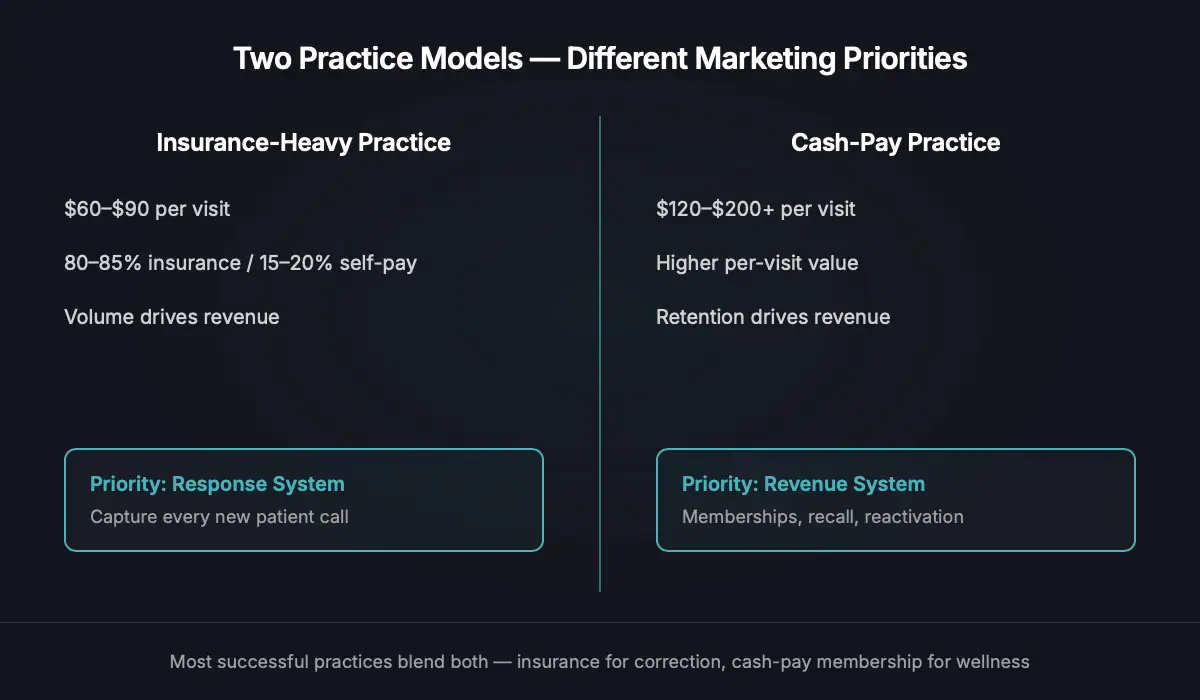
The chiropractic revenue model varies more than most people realize:
Insurance-heavy practices (80-85% insurance / 15-20% self-pay, per Nuvasuite, October 2025) need volume — more new patients to sustain revenue against lower reimbursement rates ($60-$90 per visit for heavy insurance practices, per KlinDeck, April 2026). For these practices, the Response System — capturing every new patient call — is the highest-priority investment. Every missed call is a lost new patient at a time when volume is the revenue driver.
Cash-pay practices ($120-$200+ per visit) need retention — keeping existing patients on maintenance plans because each visit is higher-value. For these practices, the Revenue System — automated recall sequences, membership renewal reminders, treatment plan adherence check-ins — is where the revenue leverage sits.
The growing trend is hybrid: insurance for initial corrective care, cash-pay membership for ongoing wellness.
“Many successful practices use insurance for the initial phase of care, then transition patients to cash-pay maintenance programs. ‘Your insurance covered your correction phase. For ongoing wellness care, I recommend our monthly maintenance program at $99/month'” (Rework, 2026)
What does your practice’s patient retention rate actually look like? → Check your score
Membership plans are the single biggest revenue lever in chiropractic.
Monthly membership plans ($99-$175 basic for 4 adjustments, $200-$350 premium including therapy and priority scheduling, per PatientPayments 2026 / CT Acquisitions) are the single biggest growth lever and valuation driver in chiropractic — and in most other appointment-based practices. Practices with 35-55% of revenue from pre-paid plans and memberships trade at the top of PE valuation multiples (CT Acquisitions, June 2026).
A membership plan isn’t just a billing model. It’s a marketing tool:
It locks in the patient relationship. A patient paying $99/month doesn’t comparison-shop other chiropractors. They’re committed. Membership retention targets 90%+ monthly (Care Plan Pro, 2026). Annual retention benchmarks for health and fitness clinics sit at 70-85% — far higher than the 40-60% retention rate most practices see with non-member patients (myZHealth 2025).
It generates reviews and referrals. A membership patient visits 3-4 times per month. That’s 3-4 opportunities for a great experience worth reviewing. Members also refer at significantly higher rates than one-time patients because they’re invested in the practice.
It creates predictable revenue. 100 members at $125/month is $12,500 in recurring revenue before a single walk-in. That’s the revenue base that smooths seasonal fluctuations and lets you invest in growth.
Family memberships priced at 2-2.5x the individual rate drive significant increases in per-household revenue and retention — because the entire family is invested in the practice (Pryme Practice Journal, 2026).
The corrective-to-wellness transition is where most practices lose the membership opportunity. The patient finishes their 12-visit corrective plan, feels better, and drifts. Without an automated transition offer — presented at visit 10 or 11, before the plan ends — the patient simply stops coming. An automated sequence that presents the wellness membership offer at the right moment in the care plan converts at dramatically higher rates than a verbal mention at the front desk.
Want to see how your practice’s retention compares — and what membership revenue you’re leaving on the table?
Patient retention generates more revenue than patient acquisition — and it’s almost entirely automated.
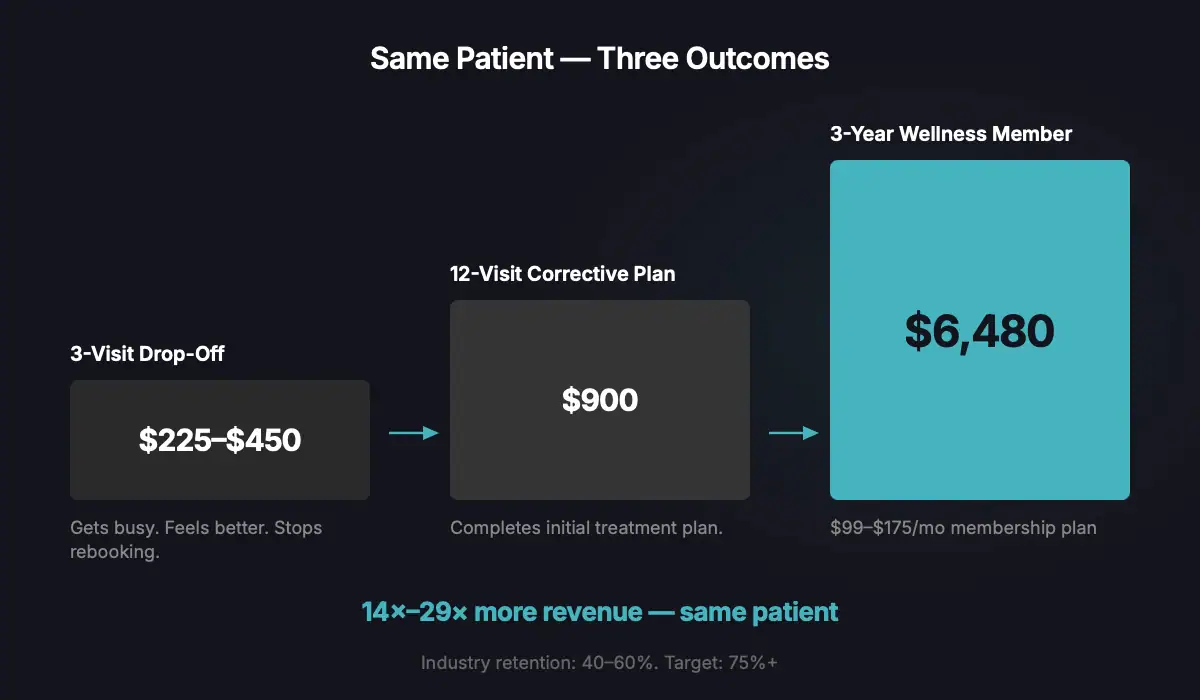
A new patient who comes for 3 visits and stops is worth $225-$450. A patient who completes a corrective plan generates $900. A patient who converts to monthly wellness care is worth $6,000-$9,000 over three years. The math is overwhelming: retaining 10 existing patients generates more revenue than acquiring 30 who don’t return.
The probability of selling to an existing or lapsed patient is 60-70%, versus 5-20% for a new prospect (Marketing Metrics). Acquiring a new patient costs 5-25x more than retaining one (Harvard Business Review). A reactivation campaign markets to an audience you already own, at almost no acquisition cost.
The biggest retention gap: patients who finish their initial treatment plan and don’t rebook. They’re not dissatisfied — they got busy. They feel better. They forgot.
Without follow-up, 30-40% of patients fall off within 60 days (Operating Brain analysis). Most practices retain only 40-60% of patients, and about 25% quit before finishing an active care plan (myZHealth, 2025). The target: above 75% retention (Financial Models Lab, 2026).
Automated reactivation sequences change this: text at 2 weeks after the last visit, email at 30 days, text at 45 days. Each message includes a direct booking link. Simple, consistent, effective.
Practices that automate reactivation maintain 40-60% higher active patient counts than practices that rely on the front desk to manually call lapsed patients.
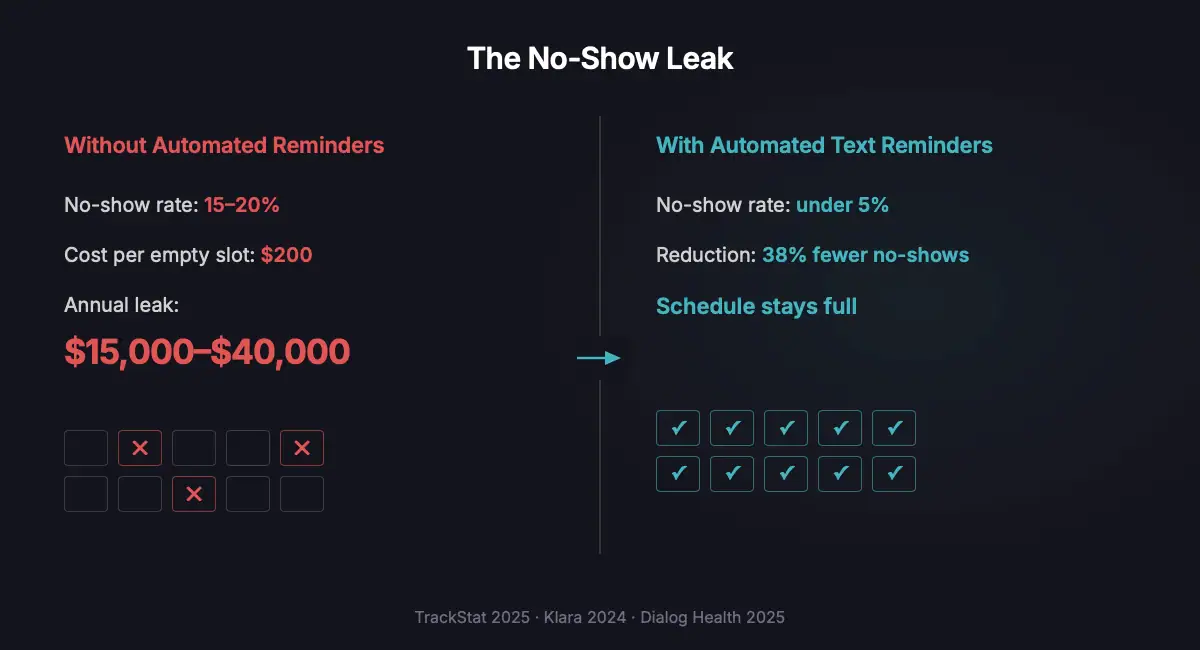
No-shows compound the problem. Without automated reminders, 15-20% of chiropractic appointments go unfilled — a $15,000-$40,000 annual leak per clinic (TrackStat, 2025). Each empty appointment slot costs approximately $200 in lost revenue (Dialog Health, 2025). Text reminders reduce no-shows by roughly 38% (Klara, 2024), and practices with full reminder automation maintain under 5% no-show rates.
Reviews drive new patient decisions — not referrals alone.
77% of patients start their search for a provider on Google, and 84% read online reviews before they ever pick up the phone (rater8, 2025). The traditional chiropractic patient acquisition model — physician referrals — is declining. Today, the majority of new chiropractic patients self-refer: they search Google, read reviews, and call the practice that looks most trustworthy.
How does your practice’s review profile compare to competing practices? → Check your score
Reviews that convert new patients are specific: “Explained the treatment plan clearly,” “No pressure to sign up for a long-term package,” “Got relief after the first visit,” “Front desk was friendly and efficient.” These address the specific anxieties new patients have about chiropractic care.
The optimal timing for automated review requests in chiropractic is after the 3rd visit — when the patient has experienced results and built trust. Too early (after visit one, before results) produces generic reviews. Too late (after visit ten) produces nothing.
Well-run practices have net margins of 30-55% — higher than most other healthcare clinic types — because overhead is structurally lean: no lab fees, low supply costs, less infrastructure than physical therapy or dental (KlinDeck, April 2026). The constraint on growth isn’t margin — it’s patient volume and retention. Both are system problems.
Check whether your practice appears in AI search →
What a well-rounded chiropractic marketing plan actually requires.
The practices that grow consistently — without depending on bigger ad budgets — share the same infrastructure:
- Every new patient call answered. AI voice agent handles overflow when the practitioner is in session and the front desk is with patients. No new patient call goes to voicemail. Response System
- Reviews requested at the right moment. Automated text after the 3rd visit — when the patient has experienced results. Reputation System
- Inactive patients reactivated. Automated sequence starting 2 weeks after the last visit, with direct booking links. Revenue System
- Membership plans promoted systematically. Automated transition offer at the end of corrective care plans — presented at visit 10 or 11, before the plan ends.
- No-shows recovered. Automated text reminders 24 hours and 2 hours before appointments. Same-day rebooking sequence for missed visits.
- Service pages for each condition. Back pain, neck pain, headaches, sports injuries, prenatal care — each with its own page for search visibility.
- AI visibility tracked. Weekly monitoring for health-related searches in your area. AI Visibility Tracking
If you run a multi-disciplinary practice with massage therapists, acupuncturists, or other providers under your roof, the same systems cover every provider. The phone problem, the passive review collection, the retention attrition — these are universal across appointment-based practitioners. The system doesn’t change. It just covers more chairs.
Common questions about chiropractic marketing
How do chiropractic practices get more new patients?
Answer every call, build your Google review profile, and make sure your online presence describes the specific conditions you treat. Most practices lose new patients at the phone — not at the marketing stage. The calls are coming in. They’re just not being answered during treatment hours. Contacting a new lead within 5 minutes makes you 21 times more likely to convert than waiting 30 minutes — yet the average practice takes hours or never responds at all.
How many Google reviews does a chiropractic practice need?
More than the competing practices in your area. In most markets, 150+ reviews with a 4.7+ average puts you at the top of local search. Review velocity — how many new reviews you get per month — matters as much as total volume. Request reviews after the 3rd visit for the highest-quality responses.
How do chiropractic membership plans work?
A membership plan is a monthly subscription giving patients access to a defined set of services at a fixed price — typically $99-$175/month for basic plans (4 adjustments) or $200-$350/month for premium plans including therapy and priority scheduling. Practices with 35-55% of revenue from memberships trade at the top of industry valuation multiples. The key is automating the transition offer at the end of corrective care — presenting the wellness membership at visit 10 or 11, before the plan ends and the patient drifts.
How do I keep patients coming back after their initial treatment plan?
Automate your reactivation outreach. Patients who finish their treatment plan and don’t rebook aren’t dissatisfied — they’re distracted. An automated text-and-email sequence starting 2 weeks after their last visit, with a direct booking link, reactivates 20-30% of lapsed patients. The probability of re-engaging a lapsed patient is 60-70% — compared to 5-20% for acquiring a new one.
How much do no-shows cost a chiropractic practice?
No-shows and last-minute cancellations cost the average clinic $15,000-$40,000 per year (TrackStat, 2025). Each empty slot represents approximately $200 in lost revenue. Automated text reminders reduce no-shows by roughly 38% — and practices with full reminder automation maintain under 5% no-show rates compared to 15-20% without.
Does this apply to acupuncturists and naturopaths too?
Yes — the same three problems (can’t answer phone during sessions, passive review collection, retention attrition) apply to every appointment-based wellness practitioner. If you run a multi-disciplinary practice, the systems are identical. The only differences are appointment length, per-visit revenue, and insurance vs. cash-pay mix.
Your next new patient is calling right now. Is anyone answering?
Your free Revenue Leak Audit shows where new patients are falling off: missed calls during treatment hours, review gaps versus competing practices, lapsed patients who stopped rebooking, and whether AI search is sending health-related queries to your competitors. Your practice. Your numbers. About 15 minutes of your time.
If the numbers don’t show a clear gap, we’ll tell you — and you’ll have lost nothing but 15 minutes.
Book Your Free Revenue Leak Audit →Or call David directly: 970.508.9555 · Durango, CO