
Dental Practice Marketing — What Keeps the Schedule Full
Your most profitable patient is the one who’s already in your charts. Most practices lose them quietly.
Dental practice marketing is the process of keeping a steady flow of patients calling, booking, and returning — without depending on insurance directories or word-of-mouth alone. The most effective dental marketing in 2026 focuses on three things most practices overlook: answering every call immediately (including after hours), collecting reviews after every visit, and running recall sequences that actually bring lapsed patients back. The review side is covered in managing online reviews for dental practices, and the broader shift in how AI search changes local visibility.
Dental practices leak revenue in three places — and most never measure any of them.
The average dental practice generates $600,000 to $1.2 million in annual revenue with 1,200 to 2,000 active patients. (ADA Health Policy Institute, 2025) Margins run 30-40% for well-managed general practices. (Dental Economics, 2025) But those top-line numbers hide three persistent revenue leaks that compound silently year over year.
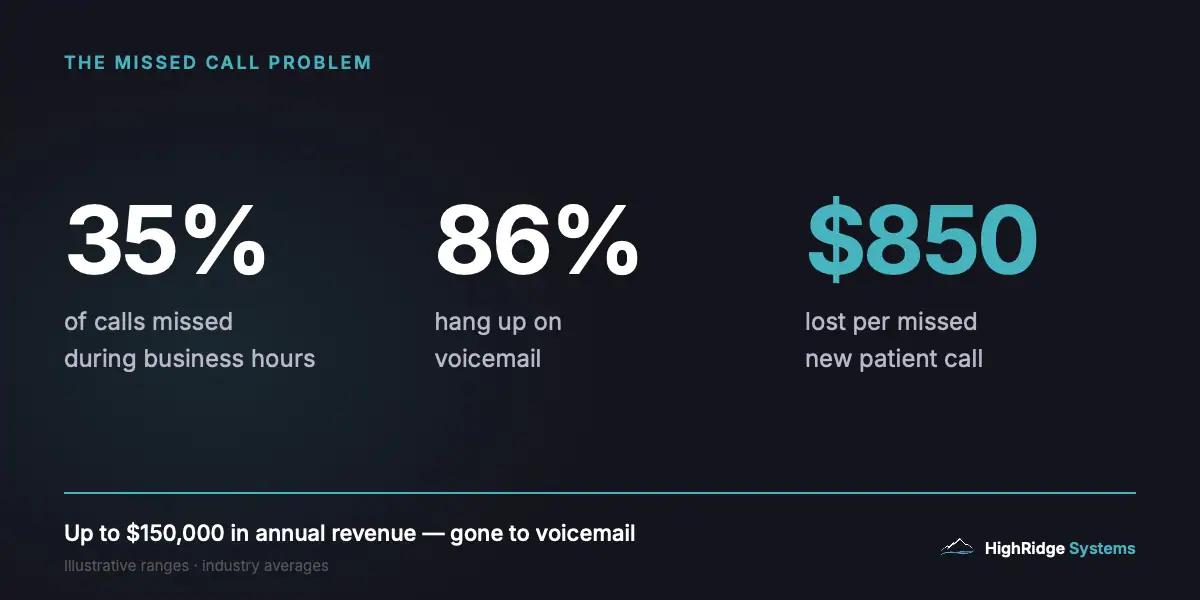
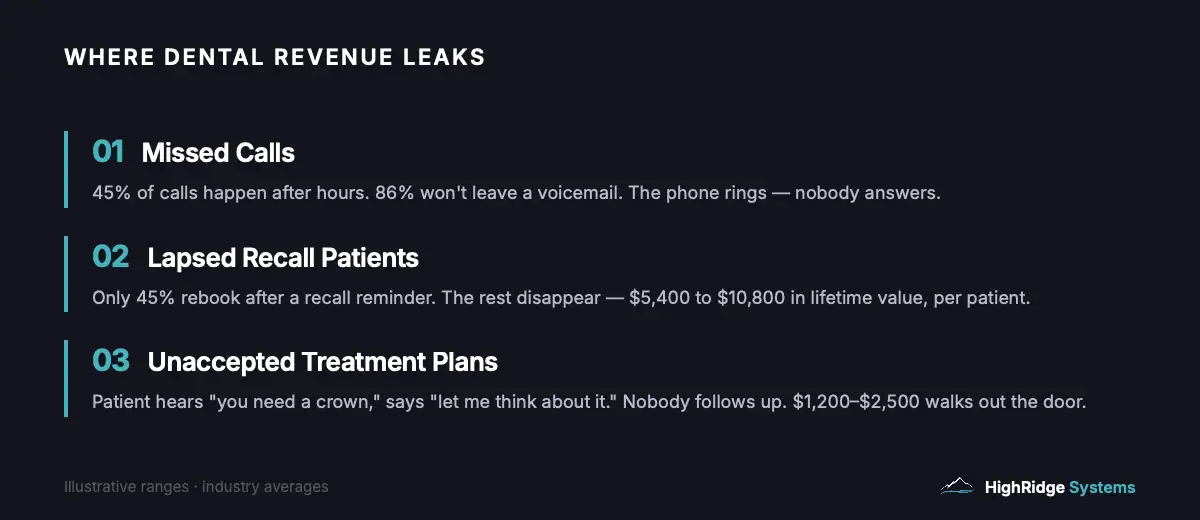
Leak 1: Missed calls. The average dental office misses between 28% and 38% of incoming calls during normal business hours — roughly one in three. (Dental Economics, 2025; Patient Prism, 2026) Nearly 80% of those missed calls are appointment-related. (Patient Prism, 2026) And 86% of patients who reach voicemail hang up without leaving a message. (Forbes, 2024) They call the next practice on the list. Each missed new patient call represents roughly $850 in immediate first-visit revenue and $5,500 to $7,500 in lifetime value. (Delmain, 2026; Patientdesk.ai, 2026)
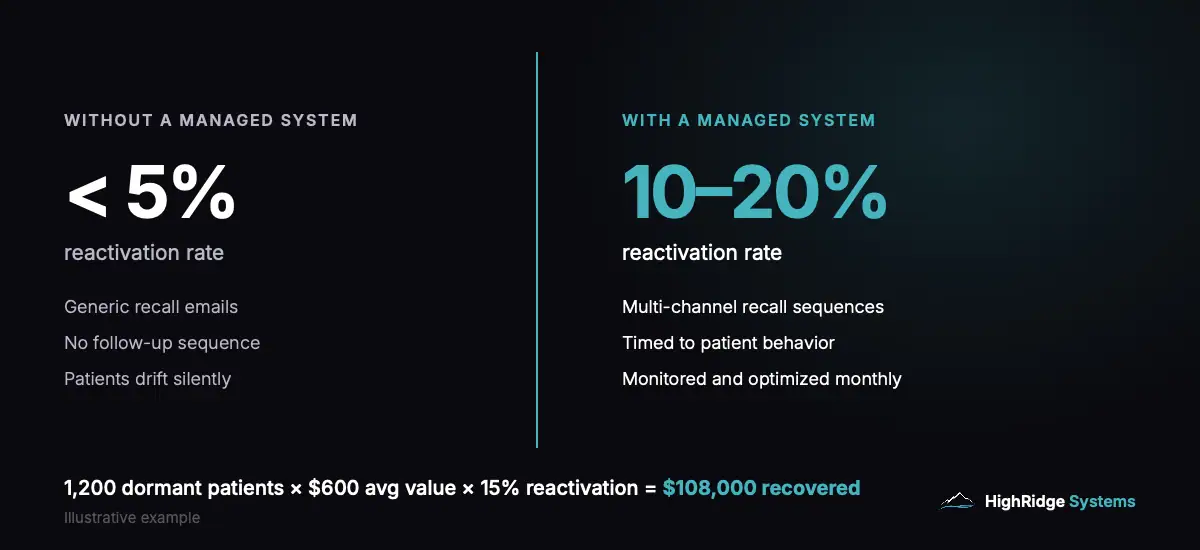
Leak 2: Lapsed recall patients. Only 45% of patients rebook after receiving a standard 6-month hygiene reminder. (Dental Intelligence, 2025) The other 55% either ignore the reminder or intend to call back and never do. A practice with 1,200 dormant patients at an average annual value of $600-$800 is sitting on $720,000 to $960,000 in potential revenue. Reactivating even 10% recovers $72,000 to $96,000 annually — at a fraction of the cost of acquiring new patients. (Clerri, 2026; RevenueWell, 2025)
Leak 3: Unaccepted treatment plans. When a patient hears “you need a crown” and says “let me think about it,” most practices never follow up. That is a $1,200 to $2,500 procedure walking out the door. Industry data shows treatment acceptance rates average 60-65%, meaning 35-40% of recommended treatment goes unscheduled. (Dental Intelligence, 2025) Systematic follow-up within the first 14 days recovers a measurable percentage of those cases — but most practices have no follow-up system at all.
These three leaks share a common trait: they are not marketing problems. The practice already earned the patient’s attention — the call came in, the patient showed up, the treatment was recommended. The revenue leaked because nobody answered, nobody followed up, or nobody asked the patient to come back.
Want to see where revenue is leaking in your specific practice? Run the Revenue Leak Calculator →
The real cost of a lapsed patient is not one missed cleaning — it is the entire relationship.
A single dental patient generates $5,500 to $7,500 in lifetime value across hygiene visits, restorative work, and referrals. (Delmain, 2026) Losing that patient to recall attrition does not cost $200 (one missed cleaning). It costs $5,500 or more in future revenue that now goes to another practice.
The math on acquisition versus reactivation makes this sharper. Acquiring a new dental patient costs approximately $312 through marketing — paid search, direct mail, insurance directory placement. (Clerri, 2026) Reactivating a dormant patient through a managed recall sequence costs roughly $12 per patient reached. That is a 26x cost difference. (Clerri, 2026)
Yet most practices spend the marketing budget chasing new patients while the existing patient base quietly erodes. Patient retention in dental runs about 78% annually, meaning roughly 22% of patients drift away each year. (Dental Intelligence, 2025) For a practice with 1,500 active patients, that is 330 patients lost per year — each representing thousands in lifetime value.
The practices that grow are not necessarily the ones with the biggest ad budgets. They are the ones that keep the patients they already have.
Most dental practices have tried the tools. The tools are not the problem.
Most dental practices have tried the tools. The recall software. The patient communication platform. The review tool that sends one email and gives up. The tools are not the problem — most of them work fine. The problem is the space between buying the software and getting the result. Someone has to configure it for your practice. Monitor whether it is performing. Adjust it when it is not. That someone is what most practices have been missing.
A practice management system handles clinical data — charting, billing, insurance claims. A communication tool sends reminders. But who is actually managing the recall sequences, optimizing the review request timing, and answering the phone at 7pm when a patient chips a tooth? That gap — between owning the software and getting the outcome — is where revenue leaks.
Service businesses spend $200 to $500 per month on software subscriptions — review tools, scheduling tools, CRM platforms, answering services — and still miss 30% of calls, collect fewer than 5 reviews per month, and lose 15-20% of their patient base every year to recall attrition. The software captured the data. Nobody acted on it. That gap — between data and action — is where a managed system earns its keep.
Dental practices have the highest-stakes review challenge in local healthcare.
Patients choose a dentist the way they choose almost no other healthcare provider — by reading reviews first. A patient referred to a cardiologist rarely checks Google reviews. A patient choosing a new dentist almost always does.
This makes dental one of the most review-sensitive verticals in local services. The practice with 200+ Google reviews mentioning specific services — implants, cosmetic work, pediatric care, same-day crowns — wins the comparison search. The practice with 40 generic reviews loses it, regardless of clinical quality.
The challenge is that dental work, when done well, does not naturally prompt reviews. A successful cleaning is routine. A pain-free filling is forgettable. Unlike a plumber who fixed a visible leak or an HVAC tech who restored heat in January, the dentist’s best work is often invisible to the patient — which means the practice has to be more intentional about asking.
Automated review requests sent within 2 hours of checkout — while the experience is still fresh — are the only reliable method for building review volume at scale. Before you invest in any other marketing channel, check your practice’s current review profile.
The target: 100+ Google reviews with specific service mentions. “Got my first cleaning here — gentle, on time, great staff” or “Dr. [Name] did my implant consultation — thorough explanation, no pressure.” These detailed reviews give both Google and AI search engines specific evidence to recommend your practice for high-intent searches.
AI search is changing how patients find dentists — and most practices are invisible.
When a patient asks ChatGPT, Google AI, or Perplexity “best dentist near me for implants” or “family dentist in [city] with good reviews,” independent practices almost never appear. National chains, insurance directories, and aggregator sites dominate those answers.
The reason is data density. AI systems recommend businesses they have enough structured evidence to feel confident about. A practice with 200 reviews mentioning specific services, a website with dedicated pages for each service type, and consistent directory listings gives AI systems multiple data points to draw from. A practice with 40 reviews and a single-page website gives AI nothing to work with.
The opportunity for dental practice marketing is that AI search visibility is still early. Most competitors have not optimized for it. The practice that builds the right foundation now — reviews, service pages, schema markup, consistent citations — establishes an advantage that compounds over time as AI search adoption grows.
Building AI visibility for dental practices follows the same principles as traditional local SEO but adds a layer: structured content that AI systems can parse and cite. Individual service pages for cleanings, implants, cosmetic dentistry, emergency care, and pediatric dentistry give AI systems specific answers to recommend. A single Services page with a bulleted list does not.
Check whether your dental practice appears in AI search →
45% of dental calls happen after hours. Who answers yours?
Dental carries a unique urgency profile among healthcare services. A broken tooth at dinner. A child’s toothache at bedtime. Swelling that started Saturday morning. These are not clinical emergencies in the ER sense, but they feel urgent to the patient — urgent enough that they will not leave a voicemail and wait until Monday.
45% of calls to dental practices happen outside standard business hours. (Ainora, 2025) The practice that answers those calls — even with an AI voice agent that captures the patient’s name, phone number, and appointment request — books the patient. The practice that sends those calls to voicemail loses them to whoever answers first.
The after-hours call is also disproportionately likely to be a new patient. Existing patients know the office hours and may call back. New patients, searching for help with an immediate concern, will call the next result on the list if the first one does not answer.
An AI voice agent does not replace the dentist’s clinical judgment. It captures the inquiry — name, phone number, type of appointment requested (emergency, cleaning, consultation, cosmetic) — and books or routes it for morning follow-up. The patient gets a response. The practice gets the appointment. Nothing falls through.
What dental practice marketing actually requires.
- Every call answered. Including the patient calling at 7pm with a broken crown. AI voice agent captures the inquiry, books the appointment or routes the emergency. Response System
- Every visit reviewed. Automated text within 2 hours of checkout — timed to the moment of peak satisfaction, before the patient moves on with their day. Reputation System
- Every lapsed patient recalled. Multi-channel recall sequences — text, email, phone — managed and optimized monthly so dormant patients come back. Revenue System
- Every treatment plan followed up. 7/14/30-day automated follow-up on unaccepted treatment — crowns, implants, cosmetic work — so recommended care does not expire silently and overall dental patient retention is improved.
- Service pages for every treatment type. Separate pages for general dentistry, implants, cosmetic, pediatric, emergency, cleanings. Each page gives search engines and AI systems a specific entry point.
- AI visibility tracked. Weekly monitoring of how your practice appears (or does not appear) when patients ask AI for dental recommendations in your market. AI Visibility Tracking
The corporate dental chain has a marketing department running all of this. You need a system that runs it for you — and someone behind it making sure it works.
Common questions about dental practice marketing
How do dental practices get more Google reviews?
Ask — and ask immediately. Automated review requests sent within 2 hours of checkout are the most reliable method. The key is timing: ask while the cleaning, filling, or consultation is still top of mind. A practice collecting 15-20 reviews per month will outpace competitors within 6-12 months in both Google Maps ranking and AI search visibility.
What is the most cost-effective way to grow a dental practice?
Reactivate lapsed patients. Acquiring a new patient costs approximately $312 through marketing. Reactivating a dormant patient costs roughly $12. So it’s not just about how to get more dental patients, it’s understanding patient retention is just as critical.(Clerri, 2026) A managed recall system that brings back even 10% of dormant patients can generate $72,000 to $96,000 in annual revenue — with virtually no ad spend. Growth from recall and retention is the highest-margin growth a dental practice can pursue.
How much should a dental practice spend on marketing?
Industry benchmarks suggest 3-8% of gross revenue. (ADA, 2025) But the highest-ROI dental practice marketing is not paid advertising — it is reviews, recall, and speed-to-answer. A strong Google review profile, an AI voice agent that answers every call, and a managed dental patient recall system cost a fraction of ad spend and address the revenue leaks that advertising cannot fix. Advertising brings patients to the door. Systems keep them from walking out the back.
Do I need to replace my existing software?
No. Most dental practices already have a practice management system (Dentrix, Open Dental, Eaglesoft) and possibly a communication tool. A managed dental practice marketing automation system layers on top of what you already use — filling the gaps between your existing tools, not replacing them. If your current tools are underperforming, the system replaces them at contract renewal. If they are working, the system adds what they cannot: after-hours call answering, managed recall sequences, and optimized review collection that someone actually monitors and adjusts.
Is this HIPAA-compliant?
Yes. Every dental system is built with HIPAA compliance from the ground up — Business Associate Agreement in place, data encrypted at rest and in transit, minimum necessary standard applied throughout. The system captures appointment type and contact information. It never touches diagnoses, treatment history, or clinical records. Your practice management system handles clinical data. The growth system handles the calls, reviews, and recall sequences that keep patients coming back.
Is your dental practice marketing process efficiently recovering every patient who is already in your charts?
Your free Revenue Leak Audit shows the gaps — missed calls, recall attrition, review velocity compared to competitors, and AI search visibility for your practice in your market.
If the numbers do not show a clear gap, we will tell you — and you will have lost nothing but about 15 minutes.
Book Your Free Revenue Leak Audit →Or call David directly: 970.508.9555 · Durango, CO