
Electrical Contractor Marketing — What Gets Electricians More Calls
Your best marketing channel is the customer who just hired you. Most electricians miss it.
Electrical contractor marketing is the process of generating consistent calls and booked jobs for independent electricians — without depending on word-of-mouth alone. The most effective electrician marketing in 2026 focuses on three things most contractors overlook: answering every inquiry immediately, collecting reviews after every job, and capturing the growth segments — EV charger installs, panel upgrades, solar interconnection — where demand is rising and customers are less price-sensitive. The review side is covered in managing online reviews for electrical contractors, and the broader shift in AI for electrical contracting businesses.
Electrical contracting splits into two worlds — and the revenue math is different in each.
The U.S. electrical contracting industry generates $347.5 billion in revenue across roughly 251,789 firms, the vast majority under $2M in annual revenue. (IBISWorld, January 2026; Northeastern Advisors, January 2026) But that massive industry number hides a fundamental split.
Service and repair work runs 45–55% gross margin — up to 65–70% for well-run residential service departments. (Simpro, June 2026) This is the highest-margin work in electrical. But many shops treat it as an afterthought — something to keep the phone ringing between construction projects.
New construction and commercial bid work runs 25–30% gross margin at best. (Simpro; Profitability Partners, June 2026) Competitive bidding drives prices down. Payment cycles stretch 60–90 days. And your most experienced electricians spend weeks on construction sites while high-margin service calls go to competitors.
“A dollar of residential service revenue is worth roughly twice as much in gross profit as a dollar of commercial bid revenue.” (Simpro, June 2026)
“Keeping new construction below 25–30% of total revenue is ideal.” (Profitability Partners, June 2026)
If you’re an electrical contractor doing 70% commercial bid work and 30% residential service, your blended margins will almost always trail a contractor doing 50/50 — even on the same total revenue. (Steph’s Books, April 2026)
Want to see where revenue is leaking in your specific mix of service and construction work?
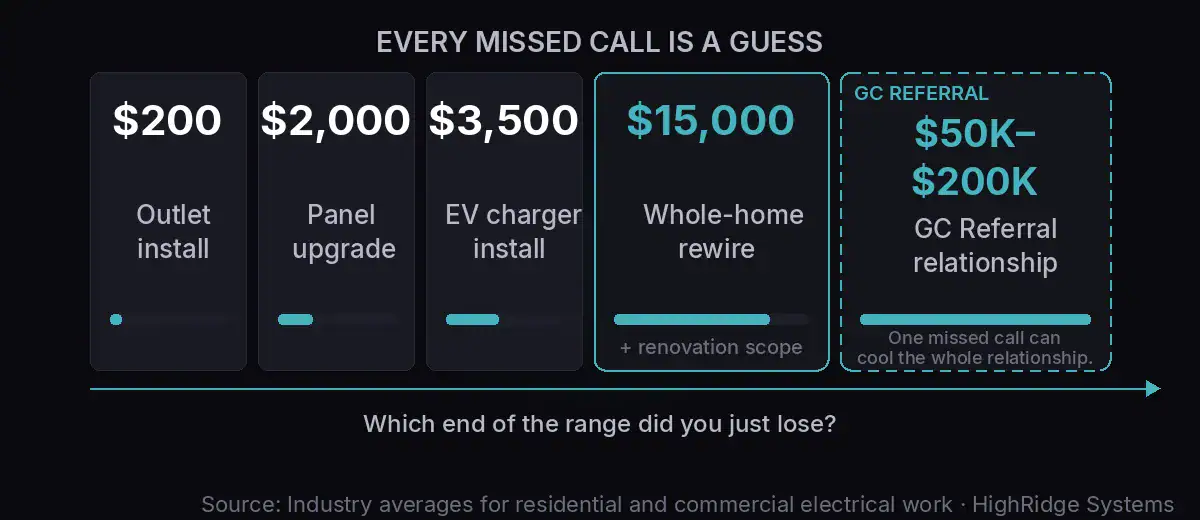
EV chargers, panel upgrades, and solar are the growth segments — and they change the marketing math.
No other trade has a structural tailwind like electrical does right now.
EV charger installations run $1,200–$3,500 per job. The federal 30C tax credit covers up to 30% of costs. Homeowners installing an EV charger typically work with one electrician, not three — they’re not price-shopping the way they might for a basic outlet install. (Profitability Partners, June 2026) Colorado EV charger demand is growing 40%+ year over year. (Operating Brain analysis)
Panel upgrades (100A to 200A) run $1,800–$3,500. Every EV, heat pump, and modern kitchen creates load demands that older panels can’t handle. A panel upgrade is also the entry point to a full rewiring conversation — a $7,000–$27,000 job. (Pipeline On, June 2026)
Solar interconnection and battery storage work is expanding rapidly. Solar and storage comprised 83% of renewables in 2025. (Simpro) Electricians certified for this work command premium rates.
The marketing insight: these growth segments attract customers who search differently. “EV charger installation near me” is a specific, high-intent query. The electrician who shows up in that search with strong reviews and fast response wins a $2,500 job with minimal competition. The electrician who only markets “electrical services” generically doesn’t show up at all.
Electrical also carries a unique urgency profile among trades. A flickering breaker panel after a storm, a burning smell near an outlet, an exposed wire during a renovation — even when these aren’t true emergencies, they feel urgent enough that callers won’t leave a voicemail and wait. The first electrician who answers gets the job. Speed-to-answer matters in every trade, but in electrical, it’s amplified by the safety undertone of nearly every call.
Electricians have the hardest review problem in the trades.
Of all service businesses, electricians collect the fewest reviews relative to the volume of work they do. The reason is simple: when electrical work goes right, it’s invisible. The lights turn on. The outlet works. The panel doesn’t trip. The customer is satisfied — but nothing dramatic happened worth writing about.
Compare this to HVAC (the customer went from freezing to warm — emotional relief) or plumbing (the leak stopped — visible result). Electrical work is the only trade where perfection is invisible.
This means electricians have to be more intentional about review collection than any other contractor. Before you change anything, check your electrical company’s online reputation. Automated review requests sent within 2 hours of job completion — before the customer moves on and forgets the experience — are the only reliable way to build volume.
The target: 100+ Google reviews with specific mentions of the work performed. “Upgraded our panel to 200 amp — clean work, passed inspection first time” or “Installed our EV charger the same week we called.” These detailed reviews give both Google and AI search engines specific evidence to recommend you for those high-value searches.
Most electricians are invisible in AI search — but the growth segments are wide open.
When a homeowner asks ChatGPT or Google AI “who installs EV chargers near [city]” or “best electrician for panel upgrades in [city],” independent electricians almost never appear. National chains and general contractor platforms dominate those answers.
The challenge for electricians is compounded by the review gap. Fewer reviews means less data for AI systems to draw confidence from. An electrician with 35 reviews gives AI systems very little to work with. One with 200 reviews mentioning specific services — EV chargers, panel upgrades, rewiring — gives AI systems multiple specific reasons to recommend.
Building AI search visibility for electricians starts with the same foundation as every other trade: robust reviews, consistent citations, schema markup, and detailed service pages. But the growth segment opportunity is unique to electrical: pages specifically optimized for EV charger installation, panel upgrades, and solar work give AI systems targeted content to recommend you for high-value queries your competitors haven’t claimed yet.
Check whether your electrical business appears in AI search →
A note about referrals. Electrical contracting has traditionally been one of the most referral-dependent trades. Most residential electricians built their businesses on builder relationships, general contractor networks, and homeowner word-of-mouth.
Those relationships are valuable — and they took years to develop.
The problem is that referral volume is set by your existing network, not by anything you can actively increase this month. When a new competitor shows up with a strong Google presence and starts capturing EV charger and panel upgrade searches, your referral network doesn’t grow to match.
What amplifies referrals in 2026 is your online verification layer. When a neighbor recommends “my electrician,” the homeowner doesn’t call immediately — they Google you. (71–73% of home service customers verify word-of-mouth online before calling, per Hook Agency, 2025)
If your Google profile shows 150 reviews mentioning EV chargers and panel upgrades, the referral converts. If it shows 35 generic reviews, the homeowner keeps searching.
Reviews are the digital verification layer that makes your referral network convert — and the automated review request is what builds that layer.
Service industry data shows 80% of deals don’t close in the home, and 43-53% close on days 2 through 30. (Hatch, April 2026) For electrical contractors averaging $5,000 per proposal, the follow-up window is where the money is.
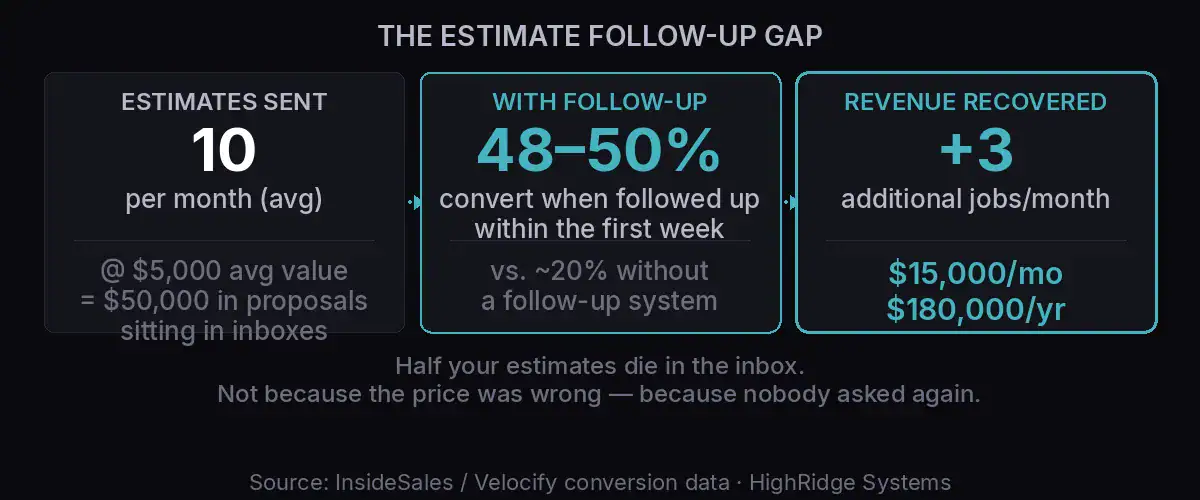
What electrical contractor marketing actually requires.
- Every call answered. Including the homeowner calling at 7pm after they just bought an EV. AI voice agent captures the inquiry and books the estimate. Response System
- Every job reviewed. Automated text within 2 hours — overcomes the “invisible work” review gap that’s unique to electrical. Reputation System
- Every quote followed up. Panel upgrades, EV installs, rewiring — 14-day automated sequence on every quoted job. Revenue System
- Service pages for every work type. Separate pages for panel upgrades, EV charger installation, rewiring, code compliance, generator installs. Each page gives search engines a specific entry point.
- AI visibility tracked. Weekly monitoring, especially for the growth segments where competition is increasing. AI Visibility Tracking
The franchise has a marketing department running this. You need a system that runs it for you.
Common questions about electrician marketing
How do electricians get more Google reviews?
Ask — and ask immediately. Electricians collect fewer reviews than any other trade because the work is invisible when done right. Automated review requests sent within 2 hours of job completion are the most reliable method. The key is timing: ask while the completed panel upgrade or new EV charger is still top of mind.
What type of electrical work should I market most?
The work that’s growing: EV charger installations, panel upgrades, and solar interconnection. These jobs attract homeowners who are actively searching, comparing reviews, and willing to pay for quality. Traditional outlet and switch work comes through reputation and referral. Growth segments come through deliberate marketing.
How much should an electrician spend on marketing?
NECA guidelines and industry benchmarks suggest 5–8% of gross revenue. But the highest-ROI marketing for electricians isn’t paid advertising — it’s reviews and speed-to-answer. A strong Google review profile and an AI voice agent that answers every call cost a fraction of ad spend and generate higher-quality, exclusive leads.
Should electricians invest in service work or stick with construction?
Service work runs roughly twice the gross margin of construction bid work. The contractors with the strongest margins in NECA’s data derive 25–40% of their revenue from service and maintenance. (Simpro, June 2026) Service work isn’t an afterthought — it’s the highest-margin revenue stream in the business.
How do I compete with larger electrical companies?
Speed and specificity. Larger companies have overhead, slower response times, and generic positioning. An independent electrician who answers in two rings, specializes in EV/solar/panel work, and has 150+ reviews mentioning that expertise will outperform a larger competitor in local search — both traditional and AI-generated.
Is your electrical business capturing every opportunity — especially in EV and solar?
Your free Revenue Leak Audit shows the gaps — missed calls, unfollowed quotes, review velocity compared to competitors, and AI search visibility for EV charger and panel upgrade queries in your market.
If the numbers don’t show a clear gap, we’ll tell you — and you’ll have lost nothing but 15 minutes.
Book Your Free Revenue Leak Audit →Or call David directly: 970.508.9555 · Durango, CO