
HVAC Lead Generation — What Works for Independent Contractors
The national chains spend millions on HVAC advertising. You don’t have to outspend them. You have to out-respond, out-review, and out-follow-up them.
Where HVAC leads actually come from depends on your business.
Not every HVAC company runs the same way. A 2-truck service shop has a completely different lead flow than a 15-tech operation running new construction installs. The strategies that fill one pipeline can be irrelevant to the other.
If you’ve been doing this for a decade, a lot of your work comes from word-of-mouth — and it should. Referrals are your highest-converting, highest-LTV lead source. The question isn’t whether to rely on them. It’s what amplifies and extends them when the pipeline thins out.
Industry data from Housecall Pro’s 2026 Trades Pulse report shows that repair revenue as a share of total HVAC revenue has grown from 21.6% in 2021 to 31.3% in 2025 — but that growth isn’t evenly distributed. Larger shops (2–10 techs) captured most of the increase, while single-tech businesses saw relatively flat repair share over the same period.
Here’s what the lead dynamics actually look like by company size:
If you’re a 1–3 truck service-focused shop, emergency and service/repair calls likely constitute the bulk or all of your pipeline. A furnace failure in January, an AC compressor dying in August — these are high-urgency, high-margin calls. Diagnostic and service calls run 50–65% gross margin (Housecall Pro / HVAC Know It All, June 2026). Speed-to-answer is everything.
The customer who gets voicemail calls the next company on the list — usually the franchise, because the franchise has a call center.
The scale of this problem is larger than most contractors realize. Invoca’s analysis of over 70 million home services calls found that only 52% of inbound calls are answered by a person. (Invoca Home Services Lead Conversion Benchmarks, July 2026) Nearly half of every call that comes in goes unanswered. And the behavioral gap compounds it: existing customers who reach voicemail will generally try again — they have a relationship with your shop. New customers have no relationship and no reason to wait. They call the next result. (BDR, 2025)
How much are missed calls costing your HVAC business? → Use the Revenue Leak Calculator
The leak does not stop at unanswered calls. Even when the phone is answered, only 38% of HVAC inbound calls result in a booked job. (ServiceTitan Data Report, 2022; 3,000+ trade businesses) Invoca’s data shows why: 55% of home services businesses never ask the caller to book during the call itself. (Invoca, July 2026) The phone rang. Someone picked up. And then nobody said “can we get you on the schedule?”
For small shops, the after-hours numbers are worse. ServiceTitan’s analysis of more than 3,000 trade businesses found that shops with fewer than five technicians book just 24% of their calls — against 59% for shops with 25 or more techs. And that 24% is the daily average. For small shops, booking rates fall from 26% during the morning peak to 9% after 6pm. (ServiceTitan, 3,000+ businesses, 2022)
Nine percent. For every ten evening calls a small shop takes, fewer than one becomes a booked job.
Worth knowing where that data comes from: it reflects shops already running field service management software. ACCA’s 2025 Contractor of the Future Study, which surveyed more than 1,000 contractors, found that only 31% of shops with fewer than five service vehicles use that software at all — compared to 83% of large contractors. The 24% booking rate describes the best-instrumented third of small shops. The other two-thirds are not measured. (ACCA Contractor of the Future Study, 1,000+ contractors, 2025)
An AI voice agent levels this playing field by answering every call in two rings, qualifying the emergency, and booking or routing — while you are on a job.
If you’re a mid-size shop doing installs and service, residential replacements and retrofits are your big-ticket revenue, but service calls are your highest-margin work. Retrofit and replacement projects account for 62.5% of the U.S. HVAC equipment market, growing faster than new construction at a 7.1% CAGR (AHRI / Leads4Build, 2025).
The critical insight: your service department is likely subsidizing your install department. “A healthy service department quietly subsidizes a bloated install department, and the blended number hides it” (HVAC Know It All, June 2026).
Residential replacement runs 35–50% gross margin. New construction often runs 18–28%. Same trucks, same techs, very different margins.
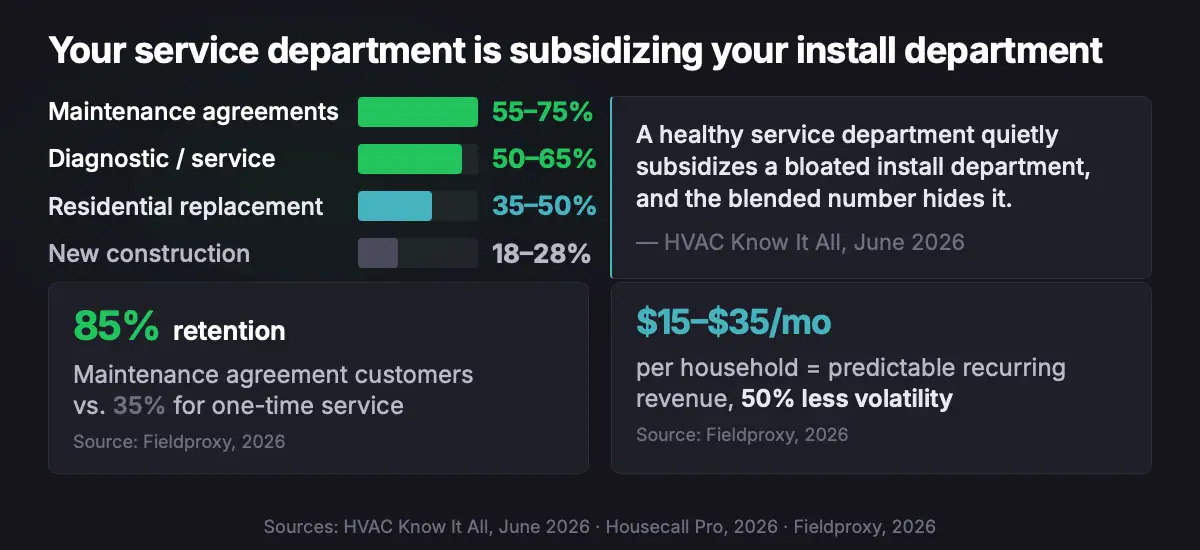
If you run a larger operation with new construction installs, builder relationships and bid processes drive your volume — not inbound marketing. But your service and maintenance side is where the margin lives. Companies that derive 30–40% of annual revenue from recurring maintenance contracts see 50% less revenue volatility than those focused on one-time service calls (Fieldproxy, 2026).
The marketing investment that moves the needle for you is on the service side of the business — the side where reviews, speed-to-answer, and AI visibility make a measurable difference. What that looks like on the reputation side is covered in managing reviews for HVAC companies, and the wider shift is laid out in how AI is changing HVAC lead generation. To see where you stand today, check your HVAC company’s AI visibility.
A note about referrals. If you’ve been in the HVAC business for 10+ years, a significant portion of your work probably comes from word-of-mouth: the neighbor who watched you fix a furnace, the realtor who sends you every buyer with a failing system, the property manager who calls you first. Those relationships are real and valuable — referral customers convert at higher rates and generate 16–25% higher lifetime value than customers from other channels (Journal of Marketing, 2011).
But they took years to build. They come in waves — three referrals in a week, then silence for a month. And they are hard to dial up. When the pipeline gets thin, you can’t call your best customer and ask them to refer harder.
A balanced contractor lead mix in 2026 is roughly 40% paid, 30% organic search and Google Business Profile, and 20% referrals and repeat business (Pipeline On, June 2026).
Referrals should be part of the mix — not the entire strategy. What amplifies them is your review profile: 71–73% of homeowners trust word-of-mouth, but they verify it online before calling (Hook Agency, 2025). Every Google review you collect is a referral that works 24/7 and reaches hundreds of homeowners instead of one.
Cross-trade referrals matter here too — your HVAC techs spot plumbing issues in basements, and plumbers recommend HVAC upgrades when replacing water heaters. If you offer multiple trades, every completed job in one service should feed leads for the others.
The repair economy is real — and it favors independent contractors.
Something shifted in the residential HVAC market that many owners are reading wrong. Homeowners are spending differently in 2026: repair over replace, urgency over planning, financing over cash.
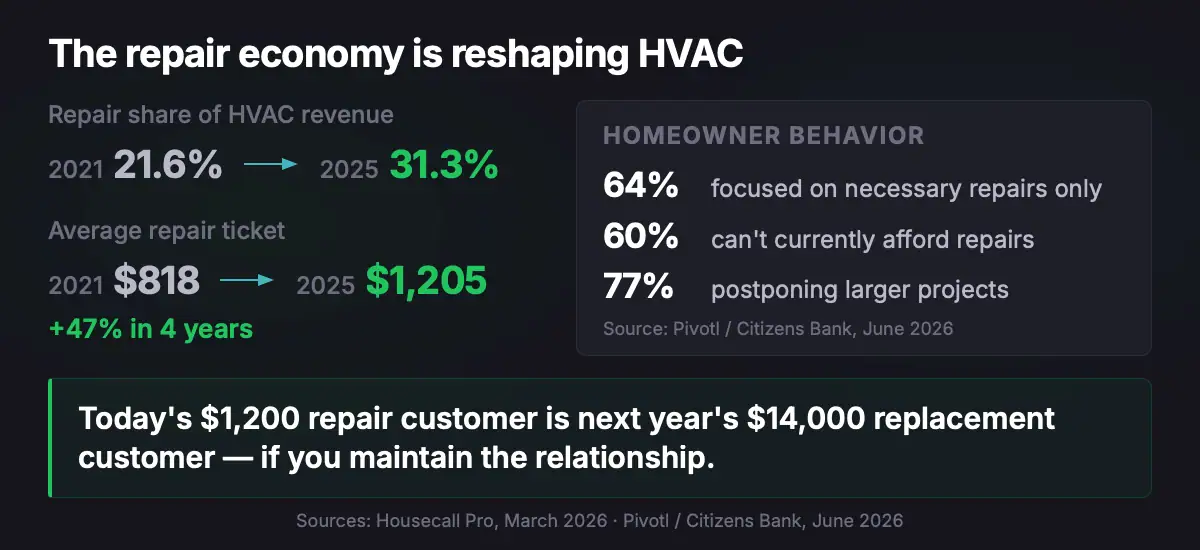
The numbers are clear. Repair now accounts for 31.3% of HVAC revenue, up from 21.6% in 2021, and repairs are 88% of all HVAC jobs by count. The average repair ticket rose 47% over the same period, from $818 to roughly $1,205. (Housecall Pro platform data, approximately 2 million jobs, 2021-2025)
For independent contractors, this is good news. Repair work runs higher gross margins than install work. The customer isn’t price-shopping three bids when the furnace dies — they’re calling until someone answers. The contractor who picks up the phone, sounds professional, has solid reviews, and can schedule within 24 hours usually wins the job.
The repair-over-replace shift also changes the follow-up math. Today’s $1,205 repair customer is the same homeowner who will eventually need a full system replacement — a job averaging $7,500 nationally, ranging from $5,000 to $12,500. (Angi, 2026) Whether that job comes to you depends entirely on what happens between now and then.
A detailed, personalized follow-up sequence after every repair (maintenance agreement offer, system age assessment, seasonal check-in) is what turns a one-time call into a lifetime account.
The relationship is worth about four times the first job.
If it feels like customers come back less than they used to, that is not your imagination.
Decision Analyst’s 2025 American Home Comfort Study — which screened nearly 21,000 homeowners and completed 2,500 full surveys — found that 63% of customers would choose the same brand and contractor again. In 2022, that number was 80%. Seventeen points of loyalty gone in three years, across the whole industry. (Decision Analyst, American Home Comfort Study, 2,500 completed surveys, 2025)
The same study found something else worth sitting with: when homeowners pick an HVAC contractor, prior personal experience is the single most important factor, ahead of reputation and ahead of price.
Put those two findings together and the picture is clear. The relationship is still what decides who gets the job. It is just harder to hold onto than it was.
What a missed call actually costs
You have probably heard that a missed call costs an HVAC company $1,200. It appears on dozens of sites and gets repeated in sales conversations constantly.
We went looking for the source. The trail leads back to a 2024 industry article citing a research page at a call-analytics company. That page is still online. It contains no dollar figure for home services anywhere on it — only answer rates. The $1,200 is very close to the average HVAC repair ticket, which suggests a footnote that got crossed somewhere and then repeated until it looked settled. It happens.
Here is what the arithmetic actually supports, using figures that share a denominator:
- The blended HVAC ticket — repair, maintenance and installation together — runs about $500. (HighRidge benchmark store, blended across four sources)
- About 45% of qualified leads book during the call itself. (Invoca, 70 million calls and 600 million minutes of conversation, 2026)
- We then apply a 0.75 conservative floor for the calls that were never jobs: spam, vendors, existing customers, and callers who simply try again.
Multiply those and a missed call is worth about $169 in expected revenue.
A word on why that is not built from the $1,205 repair figure above, because the difference is the whole point. The $1,205 is repair-only — installs are explicitly excluded from it. The conversion rates are measured across all inbound calls, installs included. Multiplying a repair-only ticket by an all-call rate gives you a bigger number and a broken one. The blended ticket and the all-call rates share a denominator. That is the only reason they can be multiplied at all.
That is not a number that should scare anyone. Most owners would trade a $169 call for an uninterrupted afternoon, and they would be right to.
The number that matters is the second one
Measured lifetime value tells a different story.
- Cornerstone Advertising published actual per-contractor lifetime value analyses in June 2026: one contractor’s customers generated $3,973 over eight years, another’s $5,346 over five. Across the contractors they examined, average multi-trade residential shops landed between $5,000 and $7,000 over an eight-to-ten-year relationship. (Cornerstone Advertising, 2026)
- A second calculation gets to the same place from a completely different direction. The average full system replacement runs $7,500. (Angi, 2026) Decision Analyst found 63% of homeowners would choose the same contractor again. That single future job, on its own, is worth about $4,725 in expected value — before counting a decade of repairs.
Two independent methods, one answer.
The relationship is worth roughly four times the first job. $5,000 against a $1,205 repair ticket is 4.1x. That ratio holds no matter what you assume about booking rates, because the booking rate applies to both numbers and cancels out.
There is a wrinkle worth naming. ServiceTitan’s residential contractor research found that repeat customers drive 58% of the work but only 39% of the revenue — meaning first-time calls carry roughly twice the ticket of repeat calls. That does not weaken the case. It sharpens it. The calls most likely to be a new customer are also the most valuable calls you take, and they are exactly the ones that never call back when nobody answers.
Why the second number is the one at risk
The behavioral asymmetry is the whole problem. An existing customer who reaches voicemail will usually try again — they have a relationship with your shop. A new customer has no relationship and no reason to wait. They call the next result.
So the calls you lose to voicemail are not distributed evenly. They skew toward first-time callers: the higher-ticket jobs, and the only source of new relationships you have.
A one-time $1,205 repair is not what walks out the door when the phone rings unanswered at 7pm. A decade does.
You didn’t lose a service call. You lost a customer for life.
What is this costing your shop specifically? → Run your numbers in the Revenue Leak Calculator
A note on these numbers, because it matters: every figure above traces to a named source with a disclosed sample size. Where a widely repeated industry statistic could not be traced to a primary source, we left it out rather than repeat it.
Reviews are how homeowners choose — and they’re choosing between you and the franchise.
Independent HVAC contractors often do better work than franchise operations. The reviews prove it — when they exist.
The problem: most independent HVAC companies have 30–50 Google reviews. The local franchise has 200+. The homeowner searching “HVAC repair near me” sees the franchise first because review volume is a primary ranking factor in Google Local Services Ads and Google Maps.
How does your review profile compare to the franchise down the road? → Check your score
Review content matters as much as volume. “Fast response, fair price, explained everything” is fine. However, “The technician arrived within an hour, diagnosed the compressor issue, explained repair vs. replacement options, and had us cooling again by evening” gives AI search engines and future customers specific evidence of competence.
The timing of the request determines the quality of the review. Automated review requests sent within 2 hours of job completion — while the relief of having heat or AC restored is still fresh — produce the most detailed, highest-quality reviews. Wait 3 days and you get “Good job” or nothing.
The target for an independent HVAC company competing against franchises: 150+ Google reviews with a 4.7+ average and new reviews arriving every week. That volume, at that quality, overrides brand recognition in both traditional search and AI-generated recommendations.
Maintenance agreements are the most profitable work in HVAC — and the most under-followed-up.
Maintenance agreements ($15–$35/month per household) create predictable monthly recurring revenue, the highest gross margins in the business (55–75% per HVAC Know It All, June 2026), and the strongest customer retention — 85% retention for agreement customers vs. 35% for one-time service customers (Fieldproxy, 2026).
Most HVAC companies sell maintenance agreements at the point of service: the technician finishes the repair and mentions it. Some customers sign up. Most don’t — they’re focused on the immediate problem.
The follow-up gap is massive. How many customers who declined at point of service received a follow-up offer 2 weeks later? 30 days later? Before the next season change?
An automated follow-up sequence — text at 2 weeks, email at 30 days, text before the next season — presents the offer when the customer is more receptive. The immediate repair stress has passed. The value proposition is clearer. Practices that automate this reactivation consistently see 2–3x higher agreement conversion rates.
HVAC, plumbing, and electrical are converging — and the best shops know it.
If you run an HVAC company that also handles plumbing or basic electrical, you’re not unusual — you’re the trend. Private equity firms are actively consolidating “tri-trade platforms” (HVAC + plumbing + electrical) at premium valuations because the customer overlap is natural and the combined service offering creates a defensible market position.
Apex Service Partners reached roughly $10 billion in enterprise value per Apollo’s May 2026 announcement, built largely on acquiring multi-trade home service companies. The playbook works because the same customer who needs a furnace repair also needs a water heater replacement and a panel upgrade for their new EV charger.
For independent HVAC/plumbing shops in SW Colorado, this convergence means your marketing system needs to serve all your service lines — not just HVAC. Reviews that mention plumbing and electrical work alongside HVAC build a broader authority profile. AI search visibility across all your trades matters.
Independent HVAC contractors are invisible in AI search.
The 5W PR HVAC & Plumbing AI Visibility Index (Q1 2026) delivered a stark finding: across 65+ prompts tested on five AI search engines, virtually zero independent HVAC contractors appeared in AI-generated answers. The recommendations were dominated by national networks.
When a homeowner asks ChatGPT “best HVAC company in [city]” or Google’s AI Overview synthesizes an answer for “AC repair near me,” independent contractors — even those with superior reviews and service — aren’t in the answer.
The reason isn’t quality. It’s data structure. National franchises have consistent citations across hundreds of directories, schema markup on every location page, and massive review volume aggregated across locations. Independent contractors typically have inconsistent directory listings, no schema markup, and reviews only on Google.
The contractors who build their AI search presence now will own those recommendations in their local market by the time the majority of homeowners rely on AI for contractor selection.
Check whether your HVAC business appears in AI search →
What an HVAC lead generation system actually looks like.
The independent contractors who consistently outperform franchises in their local market share the same infrastructure:
- Every call answered. Including 2am furnace emergencies and Saturday AC failures. AI voice agent qualifies, captures details, routes emergencies to on-call.
- Every job reviewed. Automated text within 2 hours of job completion — while the customer is still relieved.
- Every estimate followed up. Replacement quotes, system upgrades, add-ons — 14-day automated sequence until they respond or book.
- Maintenance agreements followed up. Automated re-offer 2–4 weeks after completed repairs, seasonal reminders before demand spikes.
- Online presence managed. Consistent citations across directories, complete GBP, schema markup on all service pages.
- AI visibility tracked. Weekly monitoring across ChatGPT, Claude, Perplexity, and Google AI Overviews.
The franchise has a marketing department running this. You need a system that runs it for you.
Common questions about HVAC lead generation
How do I compete with national HVAC franchises on marketing?
You don’t compete on ad spend — you compete on speed, reviews, and follow-through. A franchise might outspend you 50:1 on advertising, but they can’t outperform a local contractor who answers every call in two rings, has 200 Google reviews, and follows up on every estimate. The numbers show how much room exists: across 70 million home services calls, only 52% are answered by a person, and 55% of businesses that do answer never ask the caller to book. (Invoca, July 2026) The franchise wins not because their work is better — it wins because someone picks up and asks for the job. A system that answers every call and asks every caller to book closes the gap that ad budgets cannot.
What does a missed call actually cost an HVAC company?
Less than the number you have heard, and more than you think. The widely quoted $1,200 figure does not trace to a primary source — the research page it is attributed to contains no dollar figure for home services. The defensible math uses figures that share a denominator: a blended HVAC ticket of $500 covering repair, maintenance and installation, a 45% close rate on qualified leads (Invoca, 70 million calls), and a 0.75 conservative floor for the calls that were never jobs. That puts one missed call at about $169 in expected immediate revenue. It is deliberately not built from the $1,205 repair-only ticket, which excludes installs and therefore cannot be multiplied by an all-call conversion rate. The larger cost is the relationship. Measured contractor lifetime value runs $5,000 to $7,000 over eight to ten years (Cornerstone Advertising, 2026), which makes the relationship worth about four times the first job — and new customers, unlike existing ones, do not call back after voicemail.
Should I focus more on service calls or installs?
From a margin perspective, service and repair work generates 2–3x the gross margin of new construction installs. Diagnostic calls run 50–65% gross margin. New construction often runs 18–28%. Most profitable HVAC companies keep new construction below 30% of total revenue and build their business around service, repair, and maintenance agreements. That said, install revenue matters — it’s just not where your marketing dollars produce the highest return.
How important are after-hours calls for HVAC companies?
Critical. HVAC emergencies do not happen during business hours. A furnace failure at 10pm, an AC dying on a Saturday — these are your highest-value, highest-margin calls. And the data shows exactly what happens when small shops try to handle them without a system: ServiceTitan’s analysis of more than 3,000 trade businesses found that shops with fewer than five technicians book just 24% of their calls overall, and that for small shops booking rates fall from 26% during the morning peak to 9% after 6pm. (ServiceTitan, 3,000+ businesses, 2022) That is a two-thirds drop in conversion — the calls come in, but almost none of them turn into booked jobs. An AI voice agent that answers after-hours calls, captures the details, and books or routes the emergency closes that gap entirely.
How do I sell more maintenance agreements?
Don’t rely on the technician selling it at point of service alone. Follow up 2–4 weeks after every completed repair with an automated sequence that explains the value: priority scheduling, no diagnostic fees, extended equipment life. The customer is more receptive once the immediate repair stress has passed. Companies that automate this follow-up consistently see 2–3x higher agreement conversion rates.
Does AI search really matter for HVAC companies?
The 5W PR HVAC & Plumbing AI Visibility Index found that virtually zero independent contractors appeared in AI-generated answers across 65+ prompts. Meanwhile, ChatGPT processes over 800 million queries per week, and Google’s AI Overviews appear on roughly half of all U.S. search queries. The businesses that build their AI presence now — clean citations, schema markup, review velocity — will own those recommendations before competitors arrive.
Is your HVAC company losing leads to the franchise down the road?
Your free Revenue Leak Audit shows exactly where — missed after-hours calls, thin reviews compared to the franchise, unfollowed estimates, and AI search gaps. Specific to your market, your competitors, your numbers.
Book Your Free Revenue Leak Audit →Or call David directly: 970.508.9555 · Durango, CO