
MedSpa Marketing — What Fills Your Schedule Without Filling Your Front Desk
You built a practice around your clinical expertise. The business side — the missed calls, the no-shows, the patients who stopped rebooking — shouldn’t be the thing that holds it back.
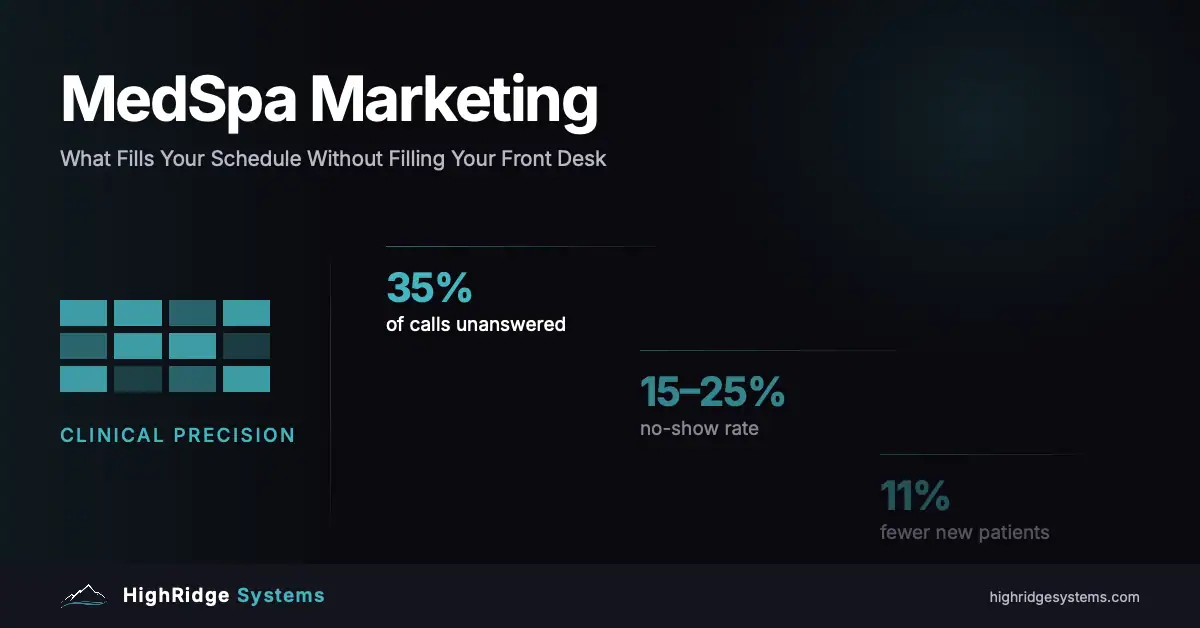
MedSpa marketing is the process of filling and keeping your treatment schedule full — not through more advertising, but through operational systems that capture every inquiry, retain every patient, and turn every visit into a review. The most effective medspa marketing in 2026 isn’t about bigger ad spend — whether you’re focused on Botox marketing, laser hair removal marketing, or body contouring. It’s about the 30-35% of calls going unanswered while you’re in treatment, the 15-25% of appointments lost to no-shows, and the patients who don’t rebook because nobody reminded them.
The average single-location medspa generates $1.4 million in annual revenue. (American Med Spa Association, 2024) The gap between that number and its potential is almost entirely operational.
The $1.4 million practice with a startup’s systems.
The U.S. medspa industry now exceeds $17 billion in annual revenue and is growing by more than $1 billion per year. (American Med Spa Association) There are more than 10,500 medspas operating across the country — and 81% of them are single-location, owner-operated businesses. (AmSpa, 2024) Roughly 70% of medspa owners are women.
These are not small businesses in the traditional sense. The average single-location medspa generated $1,398,833 in revenue in 2024. (AmSpa) Profit margins for well-run practices sit at 20-25%, with top performers reaching 40%.
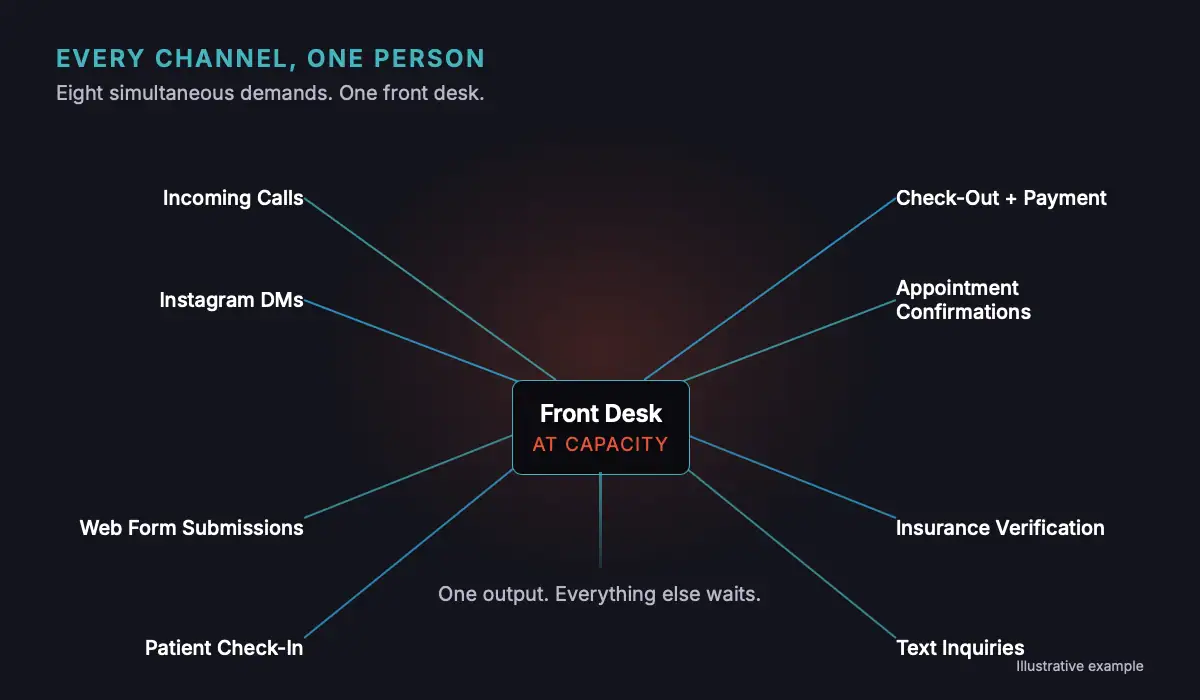
But revenue doesn’t equal operational maturity. Most medspas run with a front desk staff of one — sometimes two. That person handles check-ins, check-outs, scheduling, insurance verification, phone calls, Instagram DMs, web form inquiries, text messages, and payment processing simultaneously. When a new patient calls during a busy treatment block — and new patients almost always call during busy treatment blocks — the call goes to voicemail.
The practitioner can’t answer. They have a needle in someone’s face, or a laser on someone’s skin, or they’re mid-consultation. The front desk is checking out the previous patient while confirming the next one.
This is the operational gap that no amount of advertising can fix. You can spend $3,000 a month on Google Ads and Instagram campaigns driving inquiries to your practice. If 30-35% of those inquiries go unanswered because the front desk is overwhelmed, you’re paying $3,000 to send patients to your competitor.
The medspa industry is dominated by practitioners who became business owners — nurse practitioners, physician assistants, aestheticians, and physicians who built practices around their clinical skills. Clinical excellence is the foundation. But clinical excellence doesn’t come with a call center, a CRM, a follow-up engine, or a retention system. Those are the systems that turn a $1.4 million practice into a $2 million practice — from the same patient base.
The missed call problem costs more in medspas than any other service business.
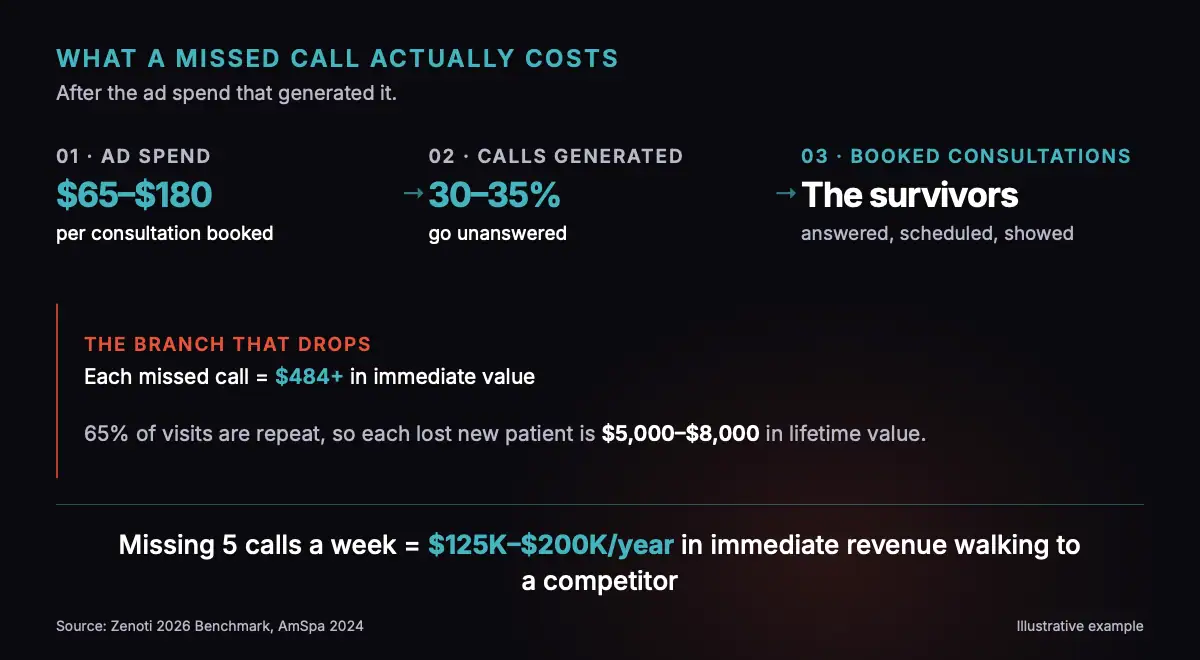
Zenoti’s 2026 benchmark data shows 30-35% of inbound calls to medspas go unanswered. Each unanswered call is a warm lead that went to a competitor.
The math is straightforward. The average medspa visit generates $484-$530 in revenue. (Zenoti 2026 Benchmark; AmSpa 2024) But a missed new patient call doesn’t lose one visit — it loses a relationship. 65% of all medspa visits are repeat visits. (AmSpa, 2024) A new patient who books Botox today returns every 3-4 months. A new patient who starts a membership generates $1,788-$2,388 per year in membership revenue alone, plus treatment revenue on top.
How much are missed calls costing your medspa? Use the Revenue Leak Calculator →
The timing dimension makes this worse. The highest-intent medspa searches happen in the evenings and on weekends — when practices are closed. A potential patient researching “Botox near me” at 8pm on a Tuesday is ready to book. If your practice doesn’t capture that inquiry until the front desk opens at 9am Wednesday, the lead is cold. Research shows leads contacted within 5 minutes are 21 times more likely to convert than those contacted after 30 minutes. (Lead Response Management Study)
An AI voice agent changes this equation. It answers every call within two rings — during treatment hours, after hours, weekends. It captures the patient’s interest, answers basic questions about services and pricing, confirms scheduling availability, and books the consultation. The practitioner reviews lead summaries between patients instead of returning missed calls at 7pm.
The cost of missing calls isn’t just the immediate revenue. Each lost new patient represents $5,000-$8,000 in lifetime value over three years of retained visits — walking to the next practice on the list.
No-shows are the silent margin killer — and the easiest problem to fix.
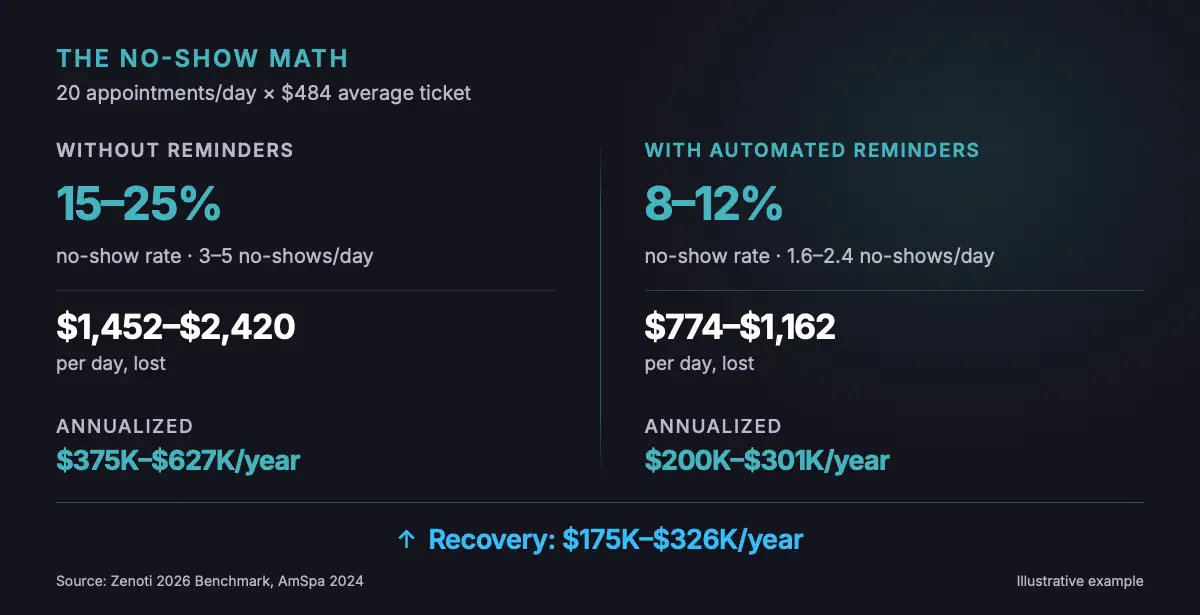
The average medspa no-show rate is 15-25% without automated reminders. With SMS reminders, it drops to 8-12%. (industry benchmarks)
Here’s what that costs. A practice running 20 appointments per day at $484 average ticket with a 15% no-show rate loses 3 appointments daily — $1,452 per day, roughly $375,000 per year. Drop that no-show rate to 8% with automated confirmation sequences and you recover $175,000-$326,000 annually. From a system that costs a fraction of one month’s recovered revenue.
The confirmation sequence that works: automated text at 48 hours before the appointment, a second text the morning of (or one hour before, based on the appointment time). Each message includes a one-tap confirm or reschedule link. When a patient cancels, the system automatically offers the slot to the next patient on the waitlist.
No-shows cost more than the lost appointment revenue. They waste provider time, disrupt scheduling flow, and create gaps that can’t be backfilled on short notice. For a practitioner-owner whose time IS the product, an empty 30-minute slot is unrecoverable margin.
The medspa practices that maintain single-digit no-show rates aren’t doing anything exotic. They’re running automated confirmation sequences that the front desk doesn’t have to manage manually. The system handles it. The front desk handles the patients in the room.
Your next 50 patients are already in your database. They just haven’t been reminded to come back.
This is the single most important number in medspa marketing: 65% of all visits are repeat visits. (AmSpa, 2024) Two-thirds of your revenue comes from patients who already trust you, already know where you are, and already experienced your work.
Meanwhile, new client visits declined 11% on a same-store basis in 2025. (Zenoti 2026 Benchmark Report) Acquisition is getting harder and more expensive. The average cost per booked medspa consultation from paid advertising runs $65-$180. (aggregated campaign data) Patient acquisition cost in medical aesthetics has more than doubled since 2023. (American Med Spa Association)
Retention isn’t a nice-to-have. It’s the primary revenue lever.
The biggest retention gap: patients who finish their initial treatment series and don’t rebook. They’re not dissatisfied — they got busy. They feel better about their appearance. They forgot it’s been four months since their last Botox appointment. Without a system reminding them, 30-40% of patients fall off within 60 days.
Automated reactivation sequences change this: a text at 2 weeks after the last visit, an email at 30 days, a text at 60 days. Each message includes a direct booking link. Simple, consistent, effective. Practices that automate reactivation maintain significantly higher active patient counts than practices that rely on the front desk to manually call lapsed patients.
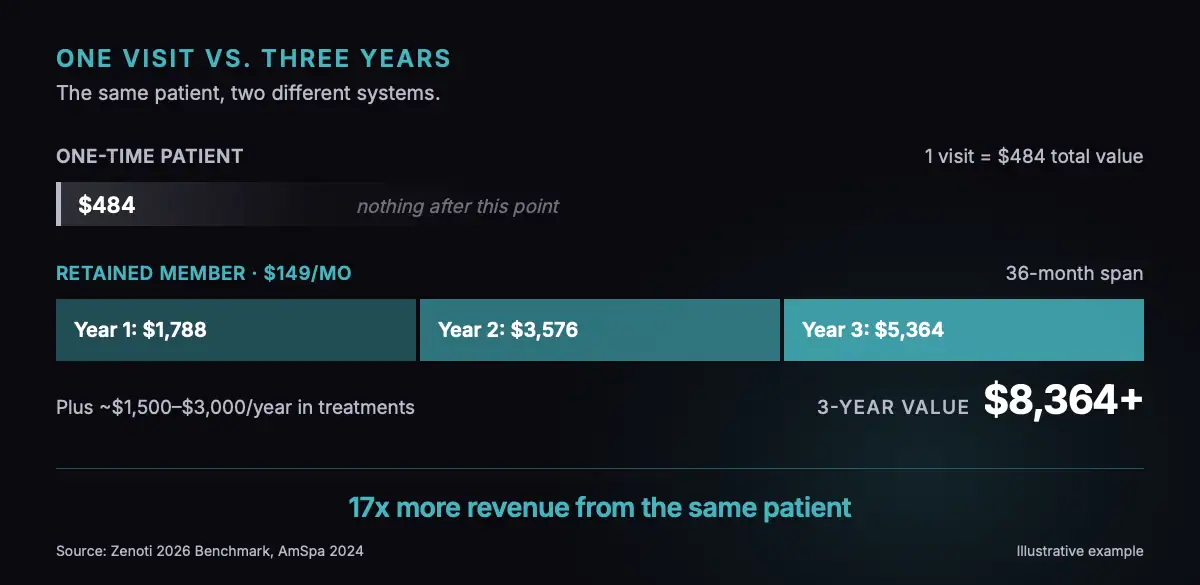
Memberships are the structural solution. Medspa membership sales grew 13% year over year. (Zenoti, 2026) A $149/month membership that includes a monthly treatment plus discounts on add-ons creates predictable recurring revenue, reduces reliance on constant promotion cycles, and locks in the patient relationship. 100 members at $149/month is $14,900 in monthly recurring revenue before any additional treatment bookings.
The membership conversion moment matters. The optimal time to offer a membership transition is at the end of a corrective treatment series — when the patient has seen results and is deciding whether to continue maintenance. An automated offer at that clinical milestone converts at significantly higher rates than a generic membership pitch at check-out.
Practices with strong membership programs — where 35-55% of revenue comes from pre-paid plans — trade at the highest valuation multiples in the industry. (CT Acquisitions, June 2026) Whether or not you plan to sell, the same principle applies: predictable recurring revenue is worth more than transactional revenue, to buyers and to your cash flow.
Reviews in medical aesthetics work differently — and most medspas don’t adapt.
Trust is the entire purchase decision for a $2,000 aesthetic procedure. The patient is choosing someone to inject material into their face or apply a laser to their skin. Before they book, they research extensively — and reviews are where they make the decision.
But medspa reviews work differently than reviews for trades or restaurants. Multiple platforms matter: Google (primary for local search ranking), Yelp (still significant for medspas), RealSelf (industry-specific, high-intent audience), and Healthgrades (for medically supervised practices). A strong review profile needs presence across platforms, not just Google.
The reviews that convert new patients are specific and outcome-focused: “Natural-looking lip filler, answered all my questions about the process, no pressure to add services” is worth ten generic “great experience” reviews. These detailed reviews address the specific anxieties prospective patients have — will it look natural, will I be pressured into more treatments, does the provider explain what they’re doing.
How does your medspa’s review profile compare to the competition? Check your score →
Timing matters more in medspas than any other vertical. For injectable treatments, the optimal review request window is 7-14 days after the procedure — when swelling has resolved and results are visible. Requesting a review the day of treatment, when the patient is still swollen or bruised, produces low-quality reviews or no review at all. Requesting at the follow-up visit, when the patient can see and appreciate the final result, produces the detailed, enthusiastic reviews that convert future patients.
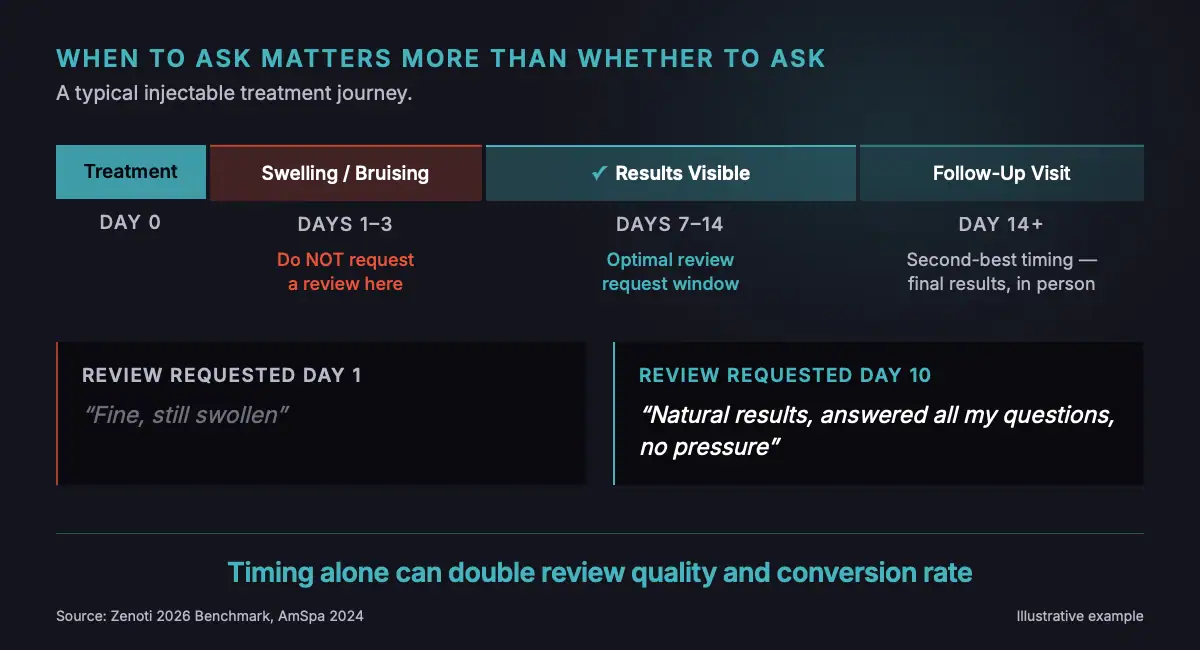
Without a prompt, fewer than 5% of satisfied medspa patients will leave a review on their own. Automated review requests — timed to the treatment type and sent via text with a direct link — convert 15-30% of patients into reviewers. That’s the difference between 30 reviews and 300.
Target: 150+ Google reviews with treatment-specific detail and new reviews arriving weekly. At that volume and velocity, your practice dominates local search results and provides AI search engines with enough specific evidence to recommend you for treatment-related queries.
AI search is reshaping how patients find medspas — and most independent practices aren’t visible.
When a prospective patient asks ChatGPT “best medspa near me” or Google’s AI Overview synthesizes a recommendation for Botox in their city, the answer is increasingly generated by AI — not a list of ten blue links.
Right now, those AI-generated answers are dominated by national platforms, PE-backed medspa chains, and aggregator websites. Independent, owner-operated medspas — even those with superior clinical results, better reviews, and more personalized care — are invisible in AI search because their online data isn’t structured for AI consumption.
The fix is structural, not expensive: consistent business citations across all directories, schema markup on your website, a complete and active Google Business Profile, and steady review velocity. These are the same foundations that drive traditional SEO and Google Maps rankings. AI search visibility compounds on top of that foundation.
The medspas that build their AI search presence now will own those recommendations in their local market by the time the majority of patients rely on AI for provider selection. The window for early-mover advantage is open but closing.
Check whether your medspa appears in AI search →
What a medspa growth system actually looks like.
The medspas that grow without proportionally increasing their ad spend share the same operational infrastructure:
- Every inquiry captured. Calls, DMs, web forms, text messages — not just phone calls. AI voice agent handles overflow and after-hours. No new patient inquiry goes unanswered. Response System
- No-shows reduced. Automated confirmation sequence — 48 hours, morning-of, 1 hour before. Cancellations trigger waitlist backfill.
- Every visit reviewed. Automated review request timed to the treatment type — 7-14 days post-injectable, same-day for facials and non-invasive treatments. Reputation System
- Lapsed patients reactivated. Automated recall sequences at 30, 60, and 90 days after last visit with direct booking links. Revenue System
- Memberships promoted. Automated transition offer at the end of corrective treatment series.
- Online presence managed. Consistent citations across directories, complete Google Business Profile, schema markup on all service pages.
- AI visibility tracked. Weekly monitoring across ChatGPT, Claude, Perplexity, and Google AI Overviews. AI Visibility Tracking
The marketing agencies selling to medspas focus on the top of the funnel — more ads, more clicks, more impressions. The practices that actually grow focus on what happens after the lead arrives. Capturing every inquiry. Converting every consultation. Retaining every patient.
Common questions about medspa marketing
How do I get more medspa clients without spending more on ads?
Start with the patients you already have. 65% of medspa visits are repeat visits — your existing patient database is your largest untapped revenue source. Automated reactivation sequences, membership conversion offers, and review requests generate more revenue from your current patients than increasing your ad budget generates from new ones. Then fix the operational leaks: if 30-35% of your inbound calls go unanswered, you’re already generating leads you aren’t capturing.
What’s the biggest revenue leak in most medspas?
No-shows and lapsed patients — not lead generation. A 15% no-show rate at $484 average ticket costs roughly $375,000 per year. Patients who don’t rebook after their initial series represent thousands in lost lifetime value each. Both problems are solved with automated systems that cost a fraction of the revenue they recover.
How many Google reviews does a medspa need?
More than the competing practices in your area. In most markets, 150+ Google reviews with a 4.7+ average and new reviews arriving weekly puts you at the top of local search. Review velocity — how many new reviews you earn per month — matters as much as total count. For medspas, timing the review request to when treatment results are visible (not the day of treatment) produces dramatically higher-quality reviews.
Should medspas invest in social media marketing?
Social media — especially Instagram — builds awareness and showcases results. Before and after content, provider introductions, and educational posts about treatments work well for medspas. But social media generates awareness, not appointments. Your Google review profile, phone answering, and follow-up systems generate appointments. Build the conversion infrastructure first, then use social to fill the top of the funnel.
How do I reduce no-shows at my medspa?
Automated SMS confirmation sequences reduce no-show rates from 15-25% to 8-12%. The sequence that works: text at 48 hours, text the morning of, text one hour before. Each message includes a one-tap confirm or reschedule link. When a cancellation comes in, the system automatically offers the open slot to the next patient on the waitlist. This recovers $175,000-$326,000 per year for a typical medspa — from a system that runs without any front desk involvement.
Your next 50 patients are already in your database.
They stopped rebooking because nobody reminded them.
Your free Revenue Leak Audit shows exactly where the revenue is leaking: calls going unanswered during treatment hours, no-shows eating your schedule, patients who haven’t been back in 90 days, and whether AI search knows your medspa exists. Your practice. Your numbers. About 15 minutes of your time.
Book Your Free Revenue Leak Audit →Or call David directly: 970.508.9555 · Durango, CO