
Outdoor Recreation & Tourism Marketing — What Gets Guides, Outfitters, and Hosts More Bookings
Your guests had the experience of a lifetime. They’ll tell their friends at dinner — but will they tell Google?
Tourism business marketing is the process of making sure visitors find your outfitting operation, guide service, vacation rental, or lodge — and book directly with you instead of through a platform that takes 20-30% of every reservation. The most effective tourism marketing in 2026 doesn’t start with ads or social media. It starts with answering every inquiry immediately, capturing reviews while the experience is still vivid, and building an online presence that shows up when a traveler asks AI “what should I do in Durango” the night before their trip.
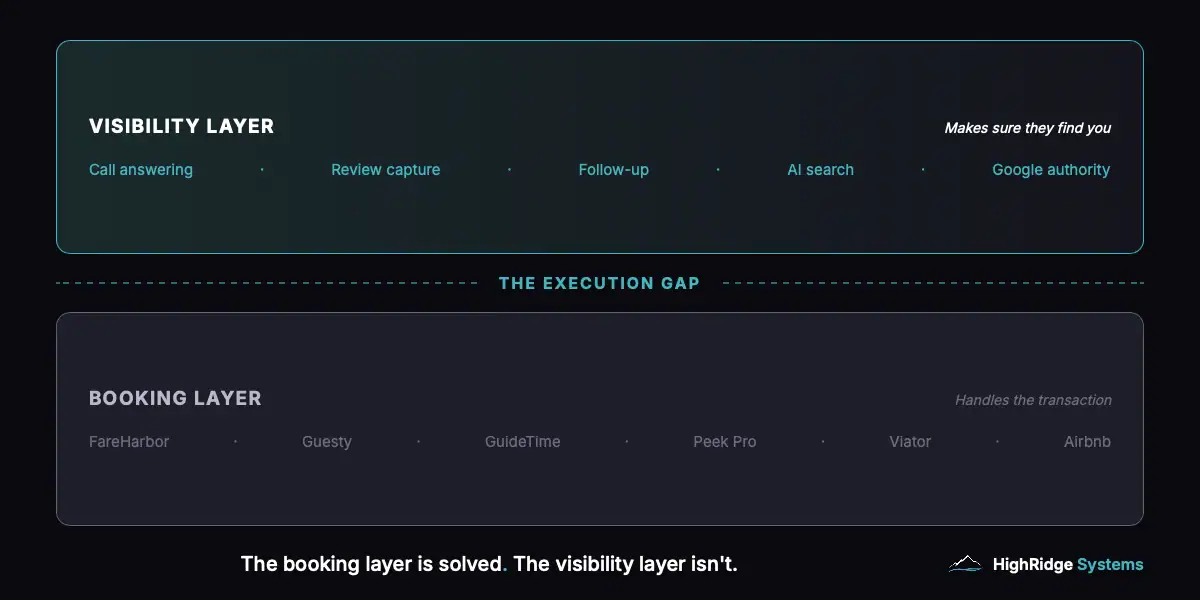
Tourism operators are saturated with booking tools — FareHarbor, Guesty, GuideTime, Peek Pro, Viator — and starving for the layer that sits on top: the response, reputation, and visibility layer that turns bookings into reviews, reviews into rankings, and rankings into direct bookings that bypass OTA commissions.
The booking layer is solved. The visibility layer isn’t.
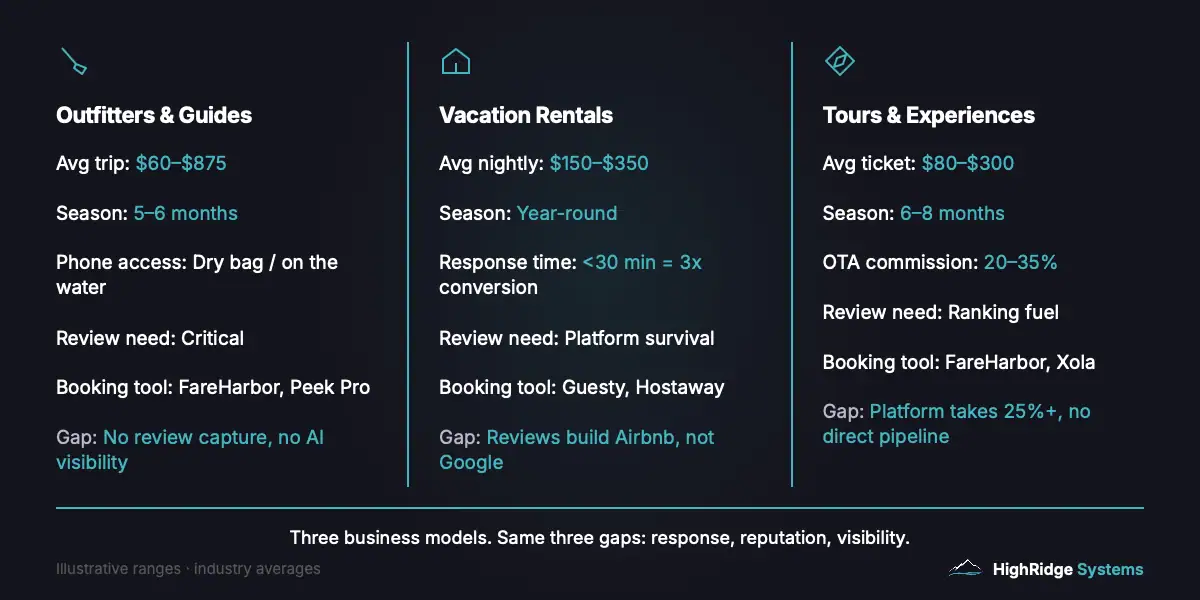
Five tourism business models — same economy, same system gaps.
Durango and La Plata County’s tourism economy generated nearly $117 million in visitor spending in Q1 2026 alone, supporting approximately 22,000 jobs and $342 million in annual wages. (Durango Herald, May 2026) Tourism accounts for roughly 30% of local revenue. (Region 9 Economic Development) Colorado’s broader outdoor recreation economy generates more than $18.1 billion annually, with the state ranking in the top 10 nationally. (Colorado Sun, March 2026)
This guide covers the five business models that drive that economy at the operator level. Each one runs differently. Each one has the same three gaps.
If you run a rafting company, a fly fishing guide service, a hunting outfitting operation, a vacation rental portfolio, or a B&B, you share these problems with every other tourism operator in SW Colorado:
- You can’t answer the phone when you’re doing the work. You’re on the river, in a wilderness camp, cleaning a property, or checking in guests. The phone rings. The caller — a new prospect with zero loyalty and three other options one tap away — gets voicemail. They don’t leave a message. They call the next business on the list.
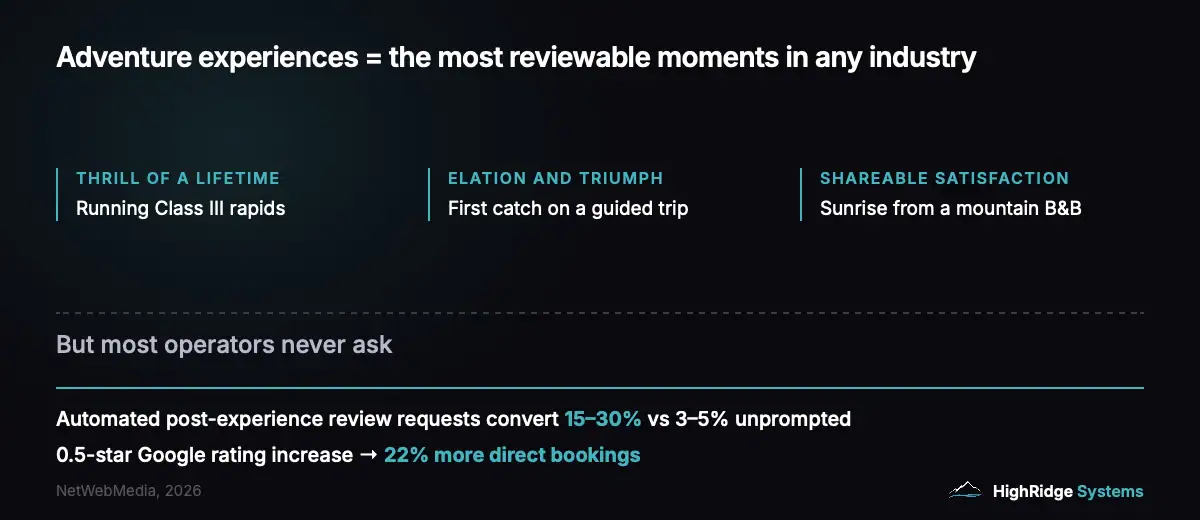
- You generate the most reviewable experiences in any industry — and rarely capture them. A family running Class III rapids. A first-timer landing a 20-inch brown trout on Gold Medal water. A hunter who drew a trophy unit tag after five years of accumulating preference points. A guest waking up to a San Juan Mountain sunrise from your deck. These are peak emotional moments — the kind that produce specific, detailed, compelling reviews. But nobody texts the review link while the adrenaline is still pumping. By the next day, the moment has passed.
- You’re building equity in someone else’s house. Every review on Viator strengthens Viator’s listing. Every review on Airbnb strengthens Airbnb’s algorithm. Every review on TripAdvisor strengthens TripAdvisor’s page rank. None of those reviews strengthen YOUR Google profile, YOUR direct booking pipeline, or YOUR ability to show up when the next visitor asks an AI assistant what to do in your town.
Reviews on OTA platforms have value — travelers use those platforms, and your presence there matters. But the strategic priority in 2026 is building the asset you own first and letting the platforms supplement it. Your Google Business Profile — with its reviews, photos, and direct booking link — costs you nothing per booking. Viator costs you 20-30%.
Rafting and adventure outfitters — the booking layer is solved. The visibility layer isn’t.
The global whitewater rafting tourism market reached $7.8 billion in 2025, with North America accounting for $2.71 billion — roughly 35% of global revenue. (DataIntelo, April 2026) Adventure tourism is projected to grow at 15.7% annually through 2030. (TicketingHub, March 2026) In Durango alone, multiple outfitters have operated for 35-40+ years on the Animas River, building businesses around Class II-III rapids that flow directly through town.
The software stack reflects that maturity. Booking platforms such as FareHarbor, Peek Pro, and Xola handle online booking, calendar management, OTA distribution, and waivers. Durango outfitters like Mild to Wild, Mountain Waters Rafting, and Durango Rivertrippers all offer full online booking. These are sophisticated reservation tools — and they work.
What they don’t do is answer the phone at 8pm when a family driving into town tomorrow searches “Durango rafting” and calls the first outfitter with good reviews. What they don’t do is text a review request to every guest 2 hours after a trip — while the parents are still telling their kids how brave they were in Smelter Rapid. What they don’t do is monitor whether ChatGPT, Claude, or Google AI mentions your company when someone asks “best things to do in Durango.”
The outfitter’s revenue problem isn’t booking software. It’s the space between the booking and the next booking.
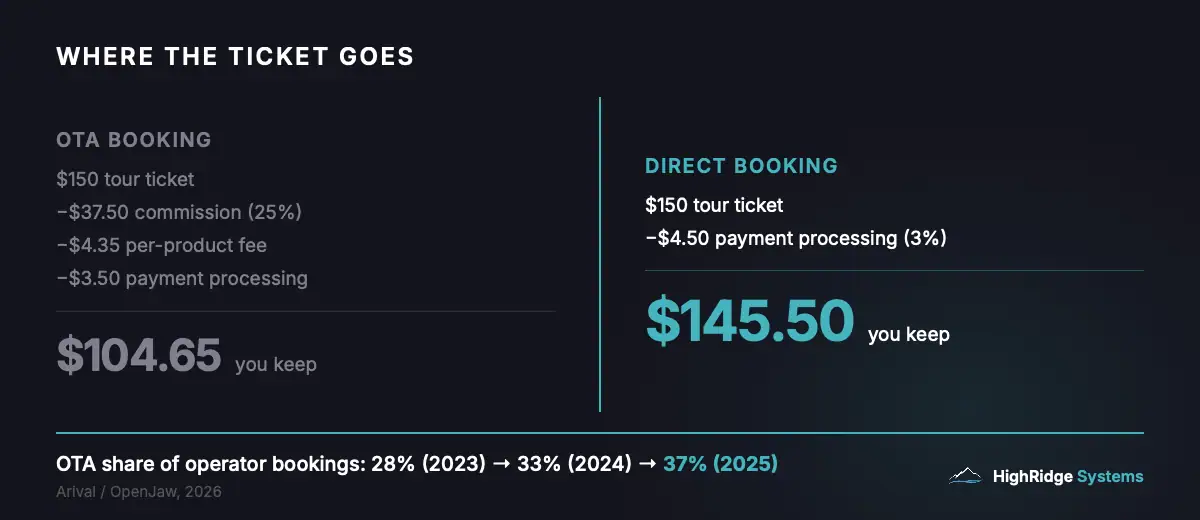
The OTA commission trap. OTA share of tour and activity bookings surged from 28% in 2023 to 37% in 2025, while direct bookings through operators’ own websites fell from 29% to 25% in a single year. (Arival 4th Edition survey, via OpenJaw, 2026) For every $100 OTA booking, the operator keeps $70-75 after commission. For every $100 direct booking, the operator keeps $97. A Durango outfitter doing $500,000 through OTAs at 25% commission pays $125,000 a year in platform fees — a permanent tax on every booking.
Viator introduced a $29 per-product submission fee in August 2025 on top of its standard 20-25% commission. Its paid placement program adds another 5-10 commission points for better search positioning within the platform — pushing effective rates to 30-35% on some bookings. (SambaHQ, April 2026) For a $150 rafting trip, that’s $45-$52 gone per seat. Permanently.
The review redirection play. The operators who are reducing their OTA dependency aren’t doing it through ad spend. They’re doing it through Google reviews. One case study tracked a kayak tour operator whose Google Business Profile rating increased from 4.1 to 4.6 stars over six months through targeted post-trip review requests directed specifically to Google. That half-star increase correlated with a 22% increase in direct bookings from Google Search. (NetWebMedia, May 2026) That’s not theoretical — that’s margin recovery.
95% of travelers read reviews before booking an experience, and 89% call reviews an important factor in their booking decision. (Viator / TripAdvisor study) The question isn’t whether reviews matter. The question is whether those reviews are building YOUR asset on Google or building Viator’s asset on Viator.
The AI search shift. In 2023, a visitor planning a Durango trip would go to TripAdvisor, browse things to do, read reviews, and book through Viator. Linear path, platform-contained. In 2026, that same visitor increasingly asks ChatGPT or Google’s AI Overview “what should I do in Durango with my family” and gets a synthesized recommendation. That recommendation pulls from multiple sources — but Google Business Profile data, review count, recency, and structured business information are primary signals. The operator with 200 Google reviews shows up in the AI answer. The operator with 200 TripAdvisor reviews and 30 Google reviews doesn’t — because the AI engine treats Google as structured, authoritative local data and TripAdvisor as one content source among many.
The outfitters who build their Google review profile now will own those AI recommendations. The ones who rely on OTA platform reviews are building equity in someone else’s house.
Is your outfitting operation showing up in AI search? Check with the AI Visibility Checker →
Fly fishing guides and hunting outfitters — where reviews drive the highest-value bookings in any market.
Fly fishing guides and hunting outfitters share a common trait: their clients invest significant time and money into the decision, and reviews are the primary factor that determines who gets booked.
For fly fishing guides, there’s also a structural phone problem — the guide literally cannot answer during service delivery, with their phone in a dry bag while wading Gold Medal water on the Animas. For hunting outfitters, the competitive edge isn’t speed-to-answer — it’s the depth and quality of the review profile that a hunter has been reading for months while researching outfitters and waiting on draw results, OTC availability, or landowner voucher access.
Fly fishing guides
Durango sits at the hub of some of the most productive trout water in the American West. The Animas River flows directly through town with a Gold Medal Water designation — requiring a minimum of 60 pounds of trout per acre and at least 12 trout measuring 14 inches or longer. (Colorado Parks & Wildlife) The San Juan River below Navajo Dam, about an hour south, holds an estimated 15,000 trout per mile — one of the most productive tailwaters in the West. (RiverReports) The Piedra, Dolores, Los Pinos, and multiple high-country streams and lakes extend the fishery across the entire Four Corners region.
“To be able to market the Gold Medal status… is pretty key for us,” said Cole Glenn, manager at San Juan Anglers. (Durango Herald) That status draws anglers nationally and internationally — and those anglers search for guides online before they arrive.
The U.S. sportfishing industry generates $230.5 billion in annual economic output and supports 1.1 million jobs nationally. (American Sportfishing Association, 2025) Guided trips represent approximately 13% of the fly fishing industry’s gross sales. (American Fly Fishing Trade Association) In Durango’s market alone, 15-25 guide services and fly shops with guide programs serve anglers on multiple rivers year-round.
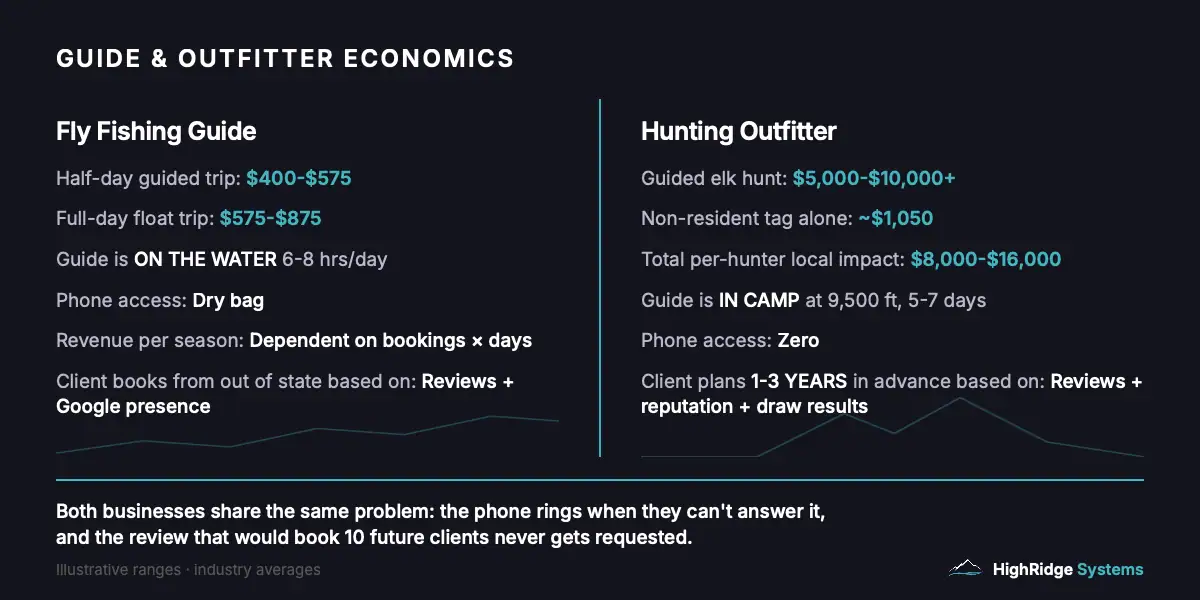
A guided fly fishing trip runs $400-$875 depending on duration, water type, and party size. Guides are almost universally independent contractors on outfitter rosters — the trip rate covers operational overhead, and the guide’s income depends on tips and volume.
The phone problem is absolute. A fly fishing guide is wading the Animas at 7am with a client. Their phone is in a dry bag. A couple from Dallas planning their anniversary trip to Durango just searched “fly fishing guide Durango” and called the first outfitter with strong reviews. Voicemail. They don’t leave a message — they don’t know this guide, they have no relationship, and three other outfitters are one tap away. They call the next one. Someone picks up, walks them through trip options, and books a $600 float trip for October. The first guide lost a booking and a potential multi-year client and never knew the call happened.
A fly fishing client who has a great experience becomes a repeat client. Annual trip x 10 years x $600 = $6,000 in lifetime value. From one answered call. From one review that costs nothing to request.
The review timing problem. “Most outfitters ask for a review at the worst possible moment: right at the truck, gear half-loaded.” (Timber & Tackle, 2026) The client is tired, sunburned, and focused on getting back to the hotel. The guide mentions reviews while rinsing waders. Nothing happens.
The review request that works is the one sent 2 hours later — while the client is at dinner, showing their spouse photos of the 20-inch brown, reliving the moment the fish ate the dry fly. That’s when the review writes itself in 200 specific, emotional, searcher-convincing words. That review sells the next 30 trips. But it requires a system, not a reminder scribbled on a business card.
The invisible expertise problem. Fly fishing guides share the same challenge as electricians — when the work goes right, the client thinks they did it themselves. The guide read the water, chose the fly pattern, positioned the angler, coached the cast, and managed the net. The client thinks they caught a fish. The guide’s 20 years of craft is invisible in the experience. The review is the ONLY place that expertise becomes visible and sellable to the next client.
The software isn’t the gap — the layer on top of it is. Durango’s fly fishing outfitters are digitally mature. Heads Up Fly Fishing operates a full online reservation system where clients select trip type, river, duration, and date. Durango Fly Fishing offers online booking across the San Juan and Animas rivers. Duranglers — the region’s longest-operating outfitter since 1983 — handles booking through their shop, phone, and web forms. These aren’t businesses lacking booking technology.
What’s missing is the layer that sits on top of the booking: automated review capture timed to 2 hours post-trip, follow-up sequences that turn one-time visitors into annual repeat clients, AI visibility monitoring for queries like “best fly fishing guide Durango,” and phone coverage when every guide is on the water. The booking system handles the transaction. Nothing handles what happens after.
Hunting outfitters
Colorado has the largest elk herd in the world — an estimated 303,390 animals across 100+ Game Management Units. (Colorado Parks & Wildlife, October 2024 census) The San Juan Mountains in SW Colorado back up to some of the most productive elk habitat in the state, including units that consistently produce trophy-class bulls.
The economics of a guided hunt make this the highest per-client revenue in any segment HighRidge serves:
- Non-resident elk tag: ~$845-$1,050 (elk license ~$825 + qualifying small game ~$110 + habitat stamp ~$12.76 + application fee)
- Guided hunt fee: $5,000-$10,000+ (1×1 guide ratio, 5-7 days)
- Travel, lodging, meat processing, gear, tip: $1,500-$4,000+
- Total per-hunter local economic impact: $8,000-$16,000+
(CPW 2026 fee schedule; Western Obsession TV, March 2026; Rocky Mountain Elk Foundation survey data)
A hunting outfitter running 20-40 clients per season generates $100,000-$400,000 in direct booking revenue — before the multiplier effect on lodging, restaurants, gas stations, and gear shops.
The longest purchase cycle — and the most review-dependent decision — in any industry. Colorado operates three paths to an elk tag, and outfitters play a direct role in two of them:
The limited draw requires an application by early April with results posted in late May or June — hunters accumulate preference points for 3-8 years for premium trophy units. OTC (over-the-counter) rifle elk tags remain available in many units for 2nd and 3rd rifle seasons with no draw required — these can be purchased right up to opening day. (CPW 2026 Big Game Brochure; HuntWise, July 2026) And through Colorado’s Landowner Preference Program, up to 10-15% of elk tags in qualifying units are issued as landowner vouchers that can be transferred to hunters — many outfitters secure these vouchers through their private land relationships, effectively procuring the tag for their client. (Huntin’ Fool; BookYourHunt, April 2026)
This last path is a major competitive differentiator. An outfitter with strong landowner relationships and documented voucher access can offer hunts that eliminate the draw lottery entirely. That capability is communicated through reviews, website content, and reputation — the hunter who reads 15 reviews confirming “they had my tag waiting when I arrived” books with confidence at a premium price.
Whether a hunter enters the draw, buys OTC, or books through an outfitter with landowner access, the research process starts months or years before the hunt. They’re reading every review, studying success rates, examining camp photos, calling references, and narrowing their outfitter list.
This isn’t an impulse call. A hunter who’s invested years of preference points and $10,000+ in total trip cost will leave a message, send an email, and follow up. Speed-to-answer isn’t the competitive edge here the way it is for a rafting company or a fishing guide. What IS the competitive edge is the depth and quality of your review profile — because that’s what the hunter has been reading for the past 18 months while waiting for draw results.
One review describing the guide’s knowledge of the unit, the pack-out service, the quality of camp, the food, and the shot opportunity percentage influences a $10,000 decision made across a multi-year timeline. An outfitter with 80+ detailed Google reviews commands a $2,000-$3,000 price premium over one with 15 generic reviews — because the reviews provide evidence that justifies the investment. No other industry has that review-to-revenue ratio.
The post-hunt review window is where outfitters leave the most value on the table. The client just had a once-in-a-lifetime experience on a tag they waited five years to draw. They’ll tell every hunter they know for a decade. They’ll show the photos at every deer camp and elk camp for the rest of their life. But they won’t leave a Google review unless someone asks within 48 hours, while the experience is still vivid — while they’re still in camp or driving home through the San Juans with an elk in the truck. By the time they’re home, unpacked, back at work, and processing meat, the moment has passed. The story lives on at hunting camp. It never makes it to Google.
That review — the one that describes five days at 9,500 feet, the bugle at dawn, the 350-yard shot, the guide who knew exactly where the herd would be — books the next three seasons of clients. But only if someone sends a review request while the hunter is still living the experience.
The rebooking follow-up is equally valuable. A satisfied client who drew a tag in your unit will apply again. They’ll recommend you to their hunting partners. An automated follow-up in January — “Applying for preference points this season? We’re booking the same unit for next fall” — keeps the relationship alive through the 12-18 month gap between hunts. Most outfitters handle this manually, inconsistently, or not at all.
AI search is reshaping how hunters choose outfitters. When a hunter with a freshly drawn tag asks ChatGPT “best guided elk hunt in the San Juan Mountains” or searches Google for “Colorado elk hunting outfitter reviews,” the outfitter with 80+ detailed Google reviews appears in the answer. The outfitter with 12 reviews doesn’t. The hunt quality may be identical. The difference is who asked for the review — and where that review lives. Reviews on hunting-specific forums and social media groups have value. But Google reviews are what AI engines synthesize into recommendations, and what shows up when a hunter’s spouse searches whether an outfitter is legitimate before approving a $10,000 trip.
How does your outfitter’s review profile compare to competitors in your unit? Check your score →
Vacation rental managers — the response time cliff and the platform dependency trap.
Vacation rental management is the most technology-sophisticated segment in tourism. Property managers in the Durango and Pagosa Springs market use platforms like Guesty, Hostaway, Lodgify, OwnerRez, and Hospitable for channel management, dynamic pricing, and guest messaging. PriceLabs and Wheelhouse optimize nightly rates. These are mature, capable tools.
What they don’t do is build your Google review profile. And in 2026, that’s the asset that determines whether you own your booking pipeline or rent it from Airbnb.
The response time cliff. Vacation rental inquiry-to-booking conversion drops steeply with every minute of delay: approximately 68% conversion when hosts respond within 30 minutes, 58% at 30-60 minutes, 41% at 1-3 hours, and just 24% after 3 hours. (Houfy / Cornell School of Hotel Administration, 2026) That’s not a gradual decline — it’s a cliff. Most inquirers have already decided to take the trip. They’re choosing between properties. The host who answers first wins the booking.
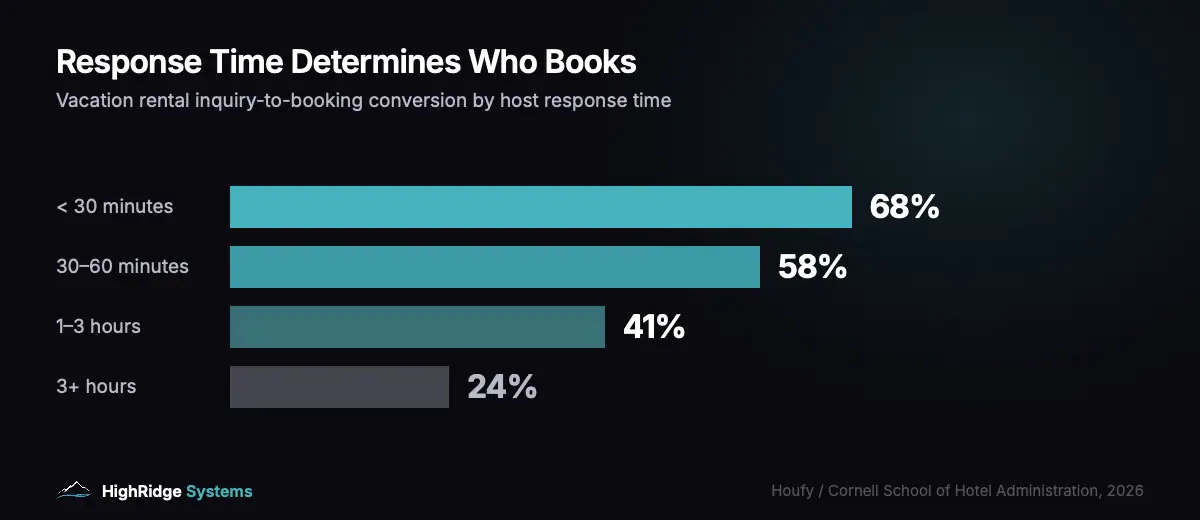
Sub-30-minute responses convert at nearly 3x the rate of responses after 3 hours. For a property generating $60,000-$100,000 in annual revenue, the difference between a 30-minute average response time and a 3-hour average can mean $15,000-$25,000 in lost bookings per year.
Airbnb Superhosts — who must maintain a 90%+ response rate — earn a national average of $61,793 per year per property compared to $51,193 for non-Superhosts, a 21% revenue premium. Superhosts achieve 58% occupancy versus 51% for non-Superhosts. (AirDNA via BuildUp Bookings; national averages — mountain market properties may differ) The difference isn’t the property. It’s the system behind it.
The platform dependency problem. 70% of vacation rental companies are small businesses managing fewer than 20 units. (Comparent) Most of these operators built their business on Airbnb and VRBO. Those platforms control their visibility, their pricing power, and increasingly their guest relationships.
Every review on Airbnb strengthens Airbnb’s algorithm and Airbnb’s ability to charge commission. Every review on Google strengthens YOUR Google Maps ranking, YOUR direct booking website traffic, and YOUR ability to build a pipeline you own. The economics are clear: direct bookings generate 62% more revenue per stay than OTA bookings in comparable lodging, because there’s no 15-25% commission extracted. (Whitehat SEO, June 2026)
A post-stay message that references something specific about the guest’s experience — “Hope you enjoyed the sunrise from the deck this morning” — generates review responses at 35-50%, compared to 8-12% for generic automated requests. (Houfy, 2026) That personalized follow-up is the difference between a thin Google profile and a dominant one.
The AI search opportunity. When a traveler asks Google AI or ChatGPT “best places to stay in Durango” or “mountain cabin near Purgatory Resort,” the answer increasingly comes from synthesized data — and Google Business Profile reviews are a primary signal. A property manager with 80+ Google reviews describing specific properties, responsive communication, and standout amenities appears in the recommendation. A manager with 200 Airbnb reviews and 15 Google reviews doesn’t — because the AI engine treats Google as authoritative local data.
The property managers who build their Google review portfolio now — while directing post-stay review requests to Google first, not relying solely on in-platform reviews — are building the direct booking channel that reduces OTA dependency over time. Google boosts business profiles with 15+ reviews from the past 90 days. (Whitehat SEO, June 2026) Review velocity matters as much as total volume.
How many booking inquiries is your response time costing you? Use the Revenue Leak Calculator →
Jeep tours, experiential operators, and B&Bs — the commission squeeze and the personal touch advantage.
The global tours, activities, and attractions market is projected to grow from $271 billion in 2025 to $342 billion by 2029 — but only 33% of those bookings happen online, compared to 64% for travel overall. (PhocusWire / Arival, 2026) That under-digitization is both a challenge and an opportunity for independent operators who build their own online presence now.
Experiential tour operators
Jeep tours, ATV/UTV experiences, Mesa Verde heritage tours, zip line adventures — these operations run on peak-season volume and off-season planning. The software stack mirrors rafting outfitters: FareHarbor and Peek Pro dominate, handling booking, waivers, and OTA distribution.
The OTA commission problem is acute here. Viator generated approximately $750 million in revenue from tours and experiences in 2024 alone. (TripAdvisor financials) Its paid placement program effectively pushes commission rates to 30-35% for operators who want visibility within the platform. For a $150 Jeep tour, that’s $45-52 gone per seat. On every booking. Permanently.
68% of travelers say they’re more likely to book after reading a detailed review, and 75% say reviews are extremely or very important in their travel booking decisions. (TripAdvisor / Ipsos MORI study) The operators who capture those reviews on Google — not just on Viator — build the direct booking pipeline that compounds over time.
The practical benchmark: tour operators running 20+ trips per week should be generating at least 5 Google reviews per week with a functional review request system. If you’re generating fewer than that, the system needs attention — not your marketing budget. (Basecamp Advertising, May 2026)
B&Bs and boutique lodging
The global bed and breakfast market is valued at $32.16 billion in 2025, projected to reach $42.99 billion by 2031. (Mordor Intelligence, 2026) But the market reality for small operators is dominated by one fact: OTAs control 60% of lodging bookings, pushing smaller B&Bs to page two of search results. (SERPs Growth, March 2026)
For owner-operated B&Bs and boutique lodges, the competitive advantage over chain hotels isn’t price or amenities — it’s the personal touch. The owner who remembers your anniversary, leaves a bottle of local wine, recommends the hidden trailhead nobody else knows about. That experience is the moat. But it only works as a competitive advantage if future guests can see it before they book.
76% of travelers are willing to pay more for lodging with higher review scores. (TrustYou / TripAdvisor study) Hotels and lodging with 4.8-star Google ratings see measurably stronger direct-booking performance. (Marketing LTB, May 2026) Google boosts profiles with 15+ reviews from the past 90 days.
B&B owners already create the experience worth reviewing. The gap is the system that captures it — the automated post-stay message with a Google review link sent while the guest is still thinking about that breakfast, that view, that conversation with the host.
Every direct booking a B&B captures instead of routing through an OTA generates substantially more revenue per stay — in comparable UK lodging studies, the difference was 62%. (Whitehat SEO, June 2026) For a 6-room B&B averaging $180/night at 55% occupancy, shifting 20% of bookings from OTA to direct recovers approximately $14,000-$18,000 per year in commission savings — the exact number depends on your OTA commission rate, but the direction is consistent across markets.
The search landscape is shifting — and it favors operators who build their own presence.
In 2023, a visitor planning a Durango trip followed a predictable path: search Google, land on TripAdvisor or Viator, browse listings, read reviews, and book through the platform. The platform controlled discovery, decision, and transaction. The operator paid 20-30% for that convenience.
In 2026, the path is fragmenting. An increasing number of travelers start with an AI assistant: “What should we do in Durango with two teenagers?” “Best fly fishing near Durango.” “Mountain cabin with hot tub near Purgatory.” The AI synthesizes a recommendation from multiple sources — Google Business Profile data, website content, review signals, blog posts, directory listings — and presents an answer. The traveler clicks through to the operator’s website or calls directly.
The operators who show up in those AI-generated answers share three characteristics:
- Strong Google Business Profile with 100+ recent reviews containing specific, detailed descriptions of the experience.
- Structured data on their website — schema markup that tells search engines and AI systems exactly what services they offer, where they operate, and what customers say about them.
- Consistent business citations across directories — the same name, address, phone number, and service descriptions everywhere.
The operators who DON’T show up have their reviews scattered across OTA platforms where AI engines give them less weight, websites with no structured data, and inconsistent or outdated directory listings.
Colorado’s tourism industry contributed $29.2 billion to the state economy in 2025, welcoming 96.8 million visitors. (Colorado Tourism Office / OEDIT, July 2026) Adventure tourism is growing at 15.7% annually. The market is expanding — the question is which operators capture the growth.
Independent operators in Durango don’t need to outspend the platforms. They need to outpresent them in the channels that AI engines trust: Google Business Profile, their own website, and the structured data that makes their business citable.
Check whether your tourism business appears in AI search →
What tourism marketing actually looks like as a system.
The tourism operators who consistently grow direct bookings and reduce OTA dependency share the same infrastructure:
- Every call and inquiry answered. Including the 8pm call from a family driving into town tomorrow, and the offseason inquiry from a hunter planning 18 months ahead. AI voice agent captures the inquiry, qualifies the need, and routes or books — while the guide is on the water, the outfitter is in camp, and the property manager is handling a guest checkout. Response System
- Every experience reviewed — on Google first. Automated review request sent within 2 hours of trip completion, checkout, or hunt wrap. Directed to Google, not left to the OTA platform. The guest who just ran rapids, landed their first trout, or woke up to a mountain sunrise will write a detailed, emotional, searcher-convincing review — but only if someone asks while the feeling is still fresh. Reputation System
- Reviews on other platforms still valued — but Google gets priority. TripAdvisor, Viator, and Airbnb reviews matter. Travelers use those platforms. But every review on an OTA platform strengthens that platform’s asset. Every review on Google strengthens yours. Build the asset you own first. Let the platforms supplement it.
- Post-experience follow-up runs automatically. The fishing guide client who came for a half-day float gets a follow-up at 30 days. The hunting outfitter client gets a follow-up in January, before preference point applications. The vacation rental guest gets a direct booking offer for next season. Revenue System
- Online presence managed for AI discovery. Consistent citations across all directories, complete Google Business Profile, schema markup on the website, and steady review velocity that gives AI search engines the confidence to recommend.
- AI visibility tracked. Weekly monitoring across ChatGPT, Claude, Perplexity, and Google AI Overviews — so you know whether travelers are finding you or finding the aggregator that takes 25%. AI Visibility Tracking
Common questions about tourism business marketing
Don’t booking platforms like FareHarbor and Guesty already handle marketing?
They handle the transaction — online booking, calendar management, OTA distribution. They don’t handle discovery. FareHarbor takes the booking. Viator takes 25%. Neither one helps you show up when a tourist asks ChatGPT “what should I do in Durango” the night before their trip. The booking layer is solved. The visibility layer — AI search presence, Google review authority, phone answering, post-experience follow-up — is where most operators have gaps.
Are TripAdvisor and Viator reviews still worth pursuing?
Yes — but they shouldn’t be your only review strategy. Reviews on OTA platforms help your ranking within those platforms and give travelers confidence when browsing listings. But they don’t strengthen your Google profile, don’t improve your local search ranking, and carry less weight in AI-generated recommendations. The priority in 2026 is Google reviews first, with OTA reviews as a supplement. Every Google review you earn builds an asset you own — permanently, at zero commission.
How do fly fishing guides handle calls when they’re on the water?
An AI voice agent answers every call within two rings in a natural, conversational voice — not a phone tree. It captures the caller’s details, understands what they’re looking for (a guided float trip, wade trip, availability for a specific date), and either books directly or routes the inquiry for follow-up. The guide reviews a summary between trips instead of returning missed calls at 8pm when the prospect has already booked with someone else. For hunting outfitters, the value is different — speed-to-answer matters less because hunters research deliberately over months. The system value for outfitters is automated post-hunt review capture and off-season rebooking follow-up, which most outfitters handle manually or not at all.
How important are reviews for high-ticket tourism experiences like guided hunts?
More important than in any other segment. A nonresident elk hunter spends 3-8 years accumulating preference points and invests $8,000-$16,000 total on a guided hunt. That decision is researched for months and driven almost entirely by outfitter reviews — success rates, guide quality, camp conditions, pack-out service. An outfitter with 80+ detailed Google reviews commands a $2,000-$3,000 price premium over one with 15 generic reviews, because the reviews provide evidence that justifies the investment.
What’s the single highest-ROI marketing investment for a tourism operator?
Automated Google review capture after every experience. The math: a 0.5-star increase in Google rating has been shown to correlate with a 22% increase in direct bookings for adventure operators. Every direct booking saves 20-30% in OTA commission. A Durango outfitter doing $500,000 annually who shifts 15% of bookings from OTA to direct through improved Google presence recovers approximately $18,750 per year in commission savings — from reviews that cost nothing to request.
Durango’s tourism economy generates $117 million a quarter. Is your operation capturing its share — or is the OTA?
Your guests had the experience. They’ll remember it for years. But the review that books your next season? That has a 48-hour window.
Your free Revenue Leak Audit shows the specific gaps: calls that go unanswered while you’re on the water or in camp, reviews that never get requested after peak experiences, AI search queries where aggregators appear and you don’t — and the commission math on what it’s costing you. Your business. Your market. About 15 minutes of your time.
Book Your Free Revenue Leak Audit →Or call David directly: 970.508.9555 · Durango, CO