
Restoration Marketing — What Gets Independent Restorers More Jobs
SERVPRO has a call center, adjuster relationships in every zip code, and preferred vendor contracts.
You have better work, faster local response, and higher margins on every job. But only if the phone rings and your company books that job.
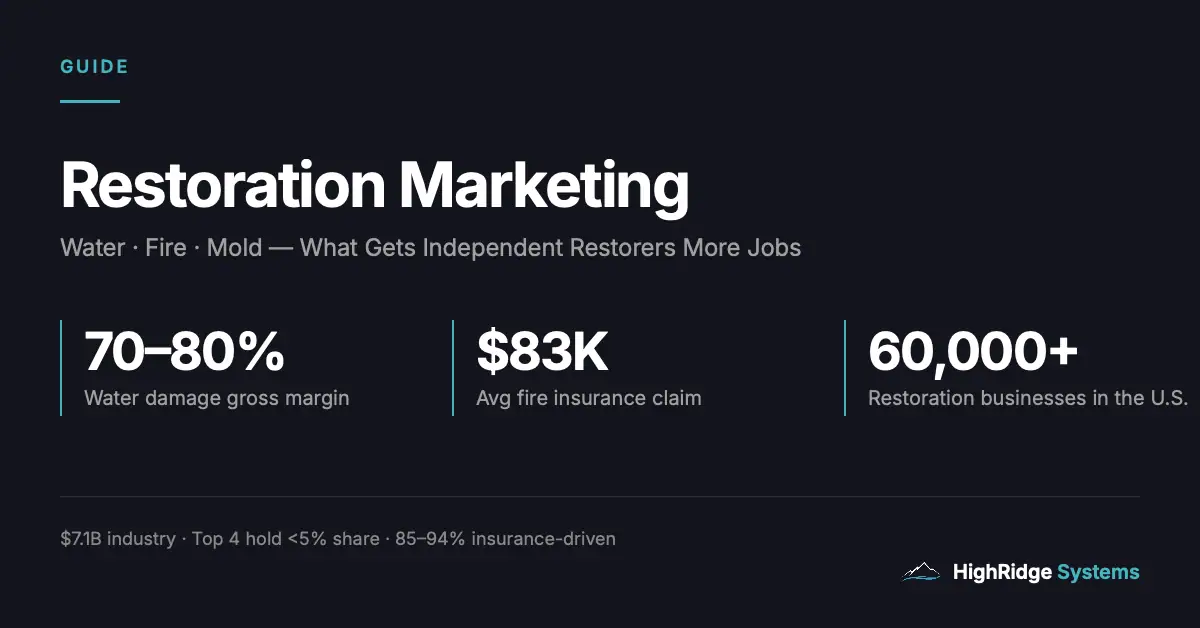
Restoration marketing is the combination of strategies that get property owners and insurance adjusters to call your restoration business — not the franchise — when water, fire, or mold damage strikes. The restoration industry generates $7.2 billion in U.S. revenue across 62,582 businesses (IBISWorld, 2025). Units of the five largest franchise brands account for roughly 6% of that business count, so the overwhelming majority of the market is independent. That fragmentation is your opportunity. The most effective restoration marketing in 2026 isn’t about ad spend — it’s about answering every emergency call in two rings, building the review profile that adjusters and homeowners trust, and following up on every mitigation job before the revenue stops at the water extraction.
Restoration has three revenue engines — and they have different marketing needs.
Not every restoration company runs the same way. A two-truck shop answering water calls and a 12-tech operation running fire restoration with full reconstruction are fundamentally different businesses. The marketing strategies that fill one pipeline can be irrelevant to the other.
If you’ve been doing this for a decade or more, your adjuster relationships and insurance referral network probably account for a significant share of your work, along with the realtors and property managers who call you when a listing, a closing, or a rental turns up water or mold. Those relationships are real and valuable — they took years of on-site credibility to build. What follows isn’t a replacement for that pipeline. It’s what extends its reach, fills the gaps between insurance referrals, and captures the direct-to-homeowner calls that adjusters and agents never touch.
Here’s how the revenue and margin dynamics actually break down across restoration services:
| What drives the margin | What it costs you | |
|---|---|---|
| Water damage mitigation | Equipment does most of the labor. Highest job volume of the four. | Nothing structural. This is the one to protect. |
| Mold remediation | Labor-intensive. Demand is health-driven and growing. | Crew hours scale with the job rather than the equipment. |
| Fire and smoke | Highest ticket of the four, and the most adjuster-dependent. | Weeks rather than days. Specialised certification. |
| Reconstruction | Frequently subcontracted, so the margin passes through. | Ties up crews longest of any service line. |
Water damage mitigation is the service restoration contractors most often name their most profitable – 52% of respondents in the 2026 Cleanfax Restoration Benchmarking Survey, up from 47% in 2025. The survey reports which service is named most profitable, not a margin percentage.
Water damage mitigation is the industry’s profit engine. 52% of respondents in the 2026 Cleanfax Restoration Benchmarking Survey named it their most profitable service, up from 47% in 2025. (Cleanfax, 2026) Published gross-margin figures for water mitigation vary widely and we do not have a defensible single number, so we are not going to invent one. Equipment does most of the labor: set up extractors, dehumidifiers, and air movers, monitor moisture levels, and let the machines run. Water damage accounts for 50-70% of most restoration companies’ revenue and was cited as the most profitable service by 52% of respondents in the 2026 Cleanfax Benchmarking Survey — up from 47% in 2025.
Mold remediation is more labor-intensive than water — containment, removal, and clearance testing add crew hours and material costs. But mold is a growing segment, driven by health awareness and tightening indoor air quality regulations. The critical insight: most mold work is a follow-on from water damage, which makes your post-mitigation follow-up sequence a direct revenue pipeline.
Fire and smoke restoration is the highest-ticket work in restoration. But fire restoration is labor-intensive, complex, and typically runs weeks rather than days. It requires specialized certification (IICRC FSRT), detailed insurance documentation, and coordination with adjusters and sometimes public adjusters.
Reconstruction and rebuild is where many independents subcontract rather than tying up their own crews for extended periods. The margin is lower, the timelines are longer, and the capital requirements are higher. Some companies deliberately keep reconstruction supplemental and focus their marketing on mitigation — the work where margins are 2-3x higher.
The residential-versus-commercial split leans heavily residential for most independent restorers: the most common profile is around 90% residential and 10% commercial (Cleanfax 2026 Benchmarking Survey). Commercial restoration carries higher average tickets — 3.5x the residential average — but requires different sales channels, primarily property management relationships and commercial insurance networks.
Speed-to-lead matters more in restoration than any other trade.
Every trade guide in this series talks about the cost of missed calls. In restoration, the dynamic is more extreme than anywhere else.
A burst pipe at 2am. A kitchen fire at 6pm. Visible mold during a home inspection. The property owner isn’t researching options — they’re in crisis. They call the first credible company they find. If that call goes to voicemail, they don’t leave a message. They call the next number. In restoration, the caller moves on in under 60 seconds.
The data is unambiguous: firms that responded to an online enquiry within an hour were about seven times as likely to qualify the lead as those that waited longer, and sixty times as likely as those that waited a day or more (Oldroyd, McElheran and Elkington, Harvard Business Review, March 2011, 2,241 US firms). In restoration, speed alone can win the job before pricing or reputation come into play.
How much are missed calls costing your restoration business? → Use the Revenue Leak Calculator
The franchise has a national call center answering 24/7. SERVPRO, BELFOR, ServiceMaster — their phones never go to voicemail. That’s not because they have better technicians. It’s because they have infrastructure that answers every call.
An AI voice agent gives an independent restorer the same capability. It answers every call within two rings — including the 2am pipe burst and the Sunday kitchen fire. It captures the emergency type, damage scope, property address, and insurance information. It routes genuine emergencies to your on-call technician with full context. The property owner gets immediate response. You get the job.
The cost of missing one emergency water call isn’t just the $3,000-$12,000 mitigation ticket. It’s the mold remediation that follows, the reconstruction referral, and the adjuster relationship that one great job would have built. A single missed call in restoration is rarely one job. It is the sequence that job would have started.
The insurance ecosystem is your pipeline — and your constraint.
This is the structural reality that makes restoration marketing fundamentally different from every other trade: the overwhelming majority of the work is paid by a carrier, not the homeowner.
In HVAC, plumbing, and electrical, the homeowner decides, pays, and moves on. In restoration, the homeowner reports the claim, the insurance company approves the scope, the adjuster oversees the work, and the insurance company pays the invoice — often weeks or months later. The marketing implications are significant.
Your restoration business has three distinct lead channels, and each requires different marketing:
Direct homeowner calls — the property owner searches Google, sees your GBP listing, reads your reviews, and calls you directly. This is the channel most affected by SEO, review velocity, and AI search visibility. It’s also the channel where speed-to-lead matters most. The homeowner in crisis calls whoever appears first and answers first.
Insurance adjuster referrals — adjusters assess damage on-site and work directly with your team throughout the claim. Their experience with your documentation quality, estimate accuracy, response time, and communication style determines whether they recommend you on the next job. This is the highest-value B2B referral channel in restoration — zero marketing cost per lead, consistent volume, and a flywheel effect where one great job produces the next referral. Building adjuster relationships requires consistently excellent on-site work, clean Xactimate documentation, and responsive communication — but it also requires the reviews and response infrastructure that gives adjusters confidence in recommending you.
TPA and preferred vendor programs — third-party administrators like Contractor Connection, Crawford & Company, and managed repair programs handle thousands of claims annually. Getting into these networks requires meeting specific benchmarks for response time, documentation, pricing, and customer satisfaction. Program work arrives as direct dispatches with no marketing cost per lead, though margins are typically 10-15% lower than direct work.
A note about referrals. Restoration referrals come from two fundamentally different worlds: homeowner word-of-mouth and insurance professional networks. Both are valuable. Both have structural ceilings.
Homeowner referrals work the same as every other trade — the neighbor whose basement you saved tells three people. But those referrals come in waves and can’t be scaled on demand.
Adjuster and agent referrals are higher-value and more consistent — but they took years to build, they’re relationship-dependent, and they don’t help when you need to grow into a new service area or capture direct-to-homeowner emergency calls that bypass the insurance channel entirely.
What amplifies both types of referrals is your online presence. When an adjuster considers adding you to their recommendation list, they check your Google reviews. When a homeowner gets a recommendation from their neighbor, they verify online before calling — 71-73% of home service customers verify word-of-mouth online before making contact (Hook Agency, 2025).
Reviews, response speed, and AI visibility extend the reach and conversion rate of every referral — whether it comes from a neighbor or an adjuster.
Want to see how your restoration company’s reviews compare to SERVPRO’s?
Water damage is your most consistent lead source.
Water damage is the foundation of most restoration businesses for good reason: it’s the most frequent and most consistent service category in the industry.
Water damage mitigation – the extraction, drying, and monitoring phase – is the service respondents most often name as their most profitable, because equipment does most of the labor.
In SW Colorado specifically, the climate creates multiple water damage vectors: spring snowmelt flooding, monsoon season water intrusion in July and August, and frozen pipe bursts during winter cold snaps. The seasonal pattern means water damage calls aren’t limited to a single surge — they cycle throughout the year with different causes.
Water damage also creates the most valuable follow-on revenue in restoration: the water-to-mold pipeline.
EPA guidance is to dry water-damaged materials within 24 to 48 hours to avoid mold growth. A $3,000-$12,000 water mitigation job, followed up with a mold assessment at 48-72 hours, can lead to $1,500-$6,000 in mold remediation and $5,000-$25,000+ in reconstruction. Add those together and one water call, followed up properly, is worth several times the mitigation ticket that started it. Those component figures are illustrative rather than benchmarks – use your own.
This pipeline only works with systematic follow-up. Most restoration companies complete the water mitigation, close the job, and move on. The follow-up sequence that converts a water customer into a mold assessment and potentially a full reconstruction project is the single most underutilized revenue lever in restoration — structurally identical to the drain-to-sewer-scope pipeline in plumbing.
Fire restoration is low volume, high stakes — and the adjuster relationship is everything.
Fire and smoke damage is the highest-ticket work in restoration — and the most relationship-dependent. Complex structural restoration jobs can run into the hundreds of thousands.
But fire restoration operates on a fundamentally different lead dynamic than water damage. Water calls come from homeowners in crisis — direct, urgent, search-driven. Fire leads come primarily through insurance channels: the adjuster who assessed the damage, the agent who handles the homeowner’s policy, the TPA program that dispatches preferred vendors.
The adjuster relationship matters more in fire than anywhere else in restoration. Fire claims are complex, documentation-heavy, and the adjuster’s confidence in your team’s ability to handle a large, multi-week project determines whether they make the referral. One excellent fire job — with clean documentation, thorough odor elimination, professional communication — can produce a stream of adjuster referrals worth hundreds of thousands in annual revenue.
Reviews mentioning fire-specific competence are rare and extremely valuable: “Handled the insurance documentation start to finish,” “Smoke odor completely eliminated,” “Coordinated the pack-out and contents cleaning seamlessly.” These specific reviews give both adjusters and AI systems evidence of fire restoration capability that generic “great service” reviews don’t provide.
Fire restoration runs lower margins due to labor intensity, specialized materials, and frequent subcontracting for odor removal, duct cleaning, or reconstruction. Top-performing fire restoration companies bring capabilities in-house — hydroxyl generators, ozone equipment, contents cleaning facilities — rather than renting or subcontracting.
Mold remediation is growing — and it connects you to every other trade.
Mold remediation is the bridge service in restoration. It connects water damage to ongoing revenue, and it connects your restoration business to every other trade in the home service ecosystem.
The U.S. mold remediation market is growing. Growth is driven by three factors: increasing health awareness around indoor air quality, tightening state regulatory requirements for mold assessment and remediation, and the simple reality that every water damage event creates a mold risk window.
The marketing insight for mold is the cross-trade referral opportunity. A plumber finds mold behind a wall during a repair. An HVAC tech discovers mold in ductwork during a maintenance visit. A roofer identifies mold in attic sheathing during an inspection. Each of these is a qualified mold remediation lead generated by a trade professional who isn’t your competitor — they’re a potential referral partner.
Mold remediation is labor-intensive: containment setup, removal, HEPA vacuuming, and clearance testing add crew hours. But materials costs are moderate and the work is repeatable — once you have the certifications and equipment, the process is consistent job to job.
Reviews carry triple weight in restoration — homeowners, adjusters, and AI all read them.
In every other trade guide in this series, reviews serve one primary audience: the homeowner deciding who to call. In restoration, reviews serve three distinct audiences simultaneously.
Homeowners in crisis — the property owner with water pouring through their ceiling at midnight isn’t comparison-shopping. They’re scanning Google for the first company that looks credible and available. At that moment, review volume and recency are the only trust signals available. A restoration company with 200 reviews and a 4.8 average gets the call. One with 40 reviews and a 4.2 doesn’t. The decision happens in under 30 seconds.
Insurance adjusters — before adding a company to their informal recommendation list, adjusters check the online presence. A restoration company with consistent 5-star reviews mentioning documentation quality, communication, and thoroughness gives adjusters confidence in the referral. Reviews are part of your B2B credibility, not just your consumer marketing.
AI search systems — when ChatGPT, Claude, or Google’s AI Overview synthesizes an answer for “best restoration company near me,” the systems draw confidence from review volume, recency, and specificity. A company with reviews mentioning “water damage,” “fire restoration,” and “mold remediation” gives AI systems specific service-type data to match against queries. Generic reviews don’t trigger AI recommendations.
How does your review profile compare to the franchise down the road? → Check your score
Automated review requests in restoration require different timing than other trades. A plumber finishes a drain clearing in an hour — request the review immediately. A restoration mitigation job runs 3-5 days. The optimal timing is at mitigation completion — when the drying equipment comes out, the moisture readings are normal, and the property owner feels the relief of their home returning to normal. Wait until reconstruction finishes (weeks later) and the emotional peak has passed.
The target for an independent restoration company competing against SERVPRO and ServiceMaster: 150+ Google reviews with new reviews arriving weekly. Reviews that mention specific damage types — water extraction, smoke odor removal, mold clearance testing — give AI systems and future customers specific evidence of competence across your full service range.
Independent restorers are invisible in AI search — and the franchises own every recommendation.
The AI search visibility gap in restoration is wider than in any other trade we’ve analyzed. SERVPRO, BELFOR, ServiceMaster, PuroClean, and Paul Davis have massive citation networks, schema markup on every franchise location page, and hundreds of aggregated reviews per market. When a property owner asks ChatGPT “best water damage restoration company in Durango” or Google’s AI Overview synthesizes a recommendation for “emergency mold remediation near me,” the franchise appears. The independent restorer with better response times, better margins, and better local reviews does not.
The reason isn’t quality. It’s data structure. National franchises have consistent NAP (name, address, phone) across hundreds of directories, structured schema markup, and review volume aggregated across their franchise network. Independent restorers typically have inconsistent directory listings, no schema markup, and reviews only on Google — if they have reviews at all.
The fix is structural and the same across all trades: consistent citations across all directories, schema markup on your website, a complete Google Business Profile, and steady review velocity. But restoration has an additional lever: service-specific pages. Separate pages on your own website for water damage restoration, fire damage restoration, mold remediation, and storm damage give AI systems targeted content to match against service-specific queries. One generic “our services” page gives AI nothing to work with.
Check whether your restoration business appears in AI search →
What restoration marketing actually looks like as a system.
The independent restoration companies that consistently outperform franchises in their local market share the same infrastructure:
- Every call answered. 24/7/365 — including the 2am pipe burst and the Sunday kitchen fire. AI voice agent captures emergency type, damage scope, property address, insurance information, and routes to on-call. Response System
- Every job reviewed. Automated request at mitigation completion — when the equipment comes out and the property owner feels relief. Reviews that mention specific damage types build AI visibility and adjuster confidence. Reputation System
- Every estimate and claim followed up. Reconstruction quotes, supplemental claims, mold assessments from completed water jobs — automated sequence until they respond or book. Revenue System
- Water-to-mold pipeline active. 48-72 hour post-mitigation follow-up converts water jobs into mold assessments and remediation revenue.
- Service pages for each damage type. Water, fire, mold, storm — each with its own optimized page on your website. Each page gives search engines and AI systems a specific entry point.
- AI visibility tracked. Weekly monitoring across ChatGPT, Claude, Perplexity, and Google AI Overviews. AI Visibility Tracking
The franchise has a marketing department and a national call center running this. You need a system that runs it for you.
Common questions about restoration marketing
How do independent restoration companies compete with SERVPRO and ServiceMaster?
Speed and trust — the same advantages independent contractors have in every trade, amplified by the emergency nature of restoration. The franchise has brand recognition and a call center. An independent restorer who answers every call in two rings, has more local reviews than the franchise location, and builds adjuster relationships through consistent on-site excellence wins the local market. Units of the five largest franchise brands account for roughly 6% of US damage restoration businesses, so the industry is overwhelmingly local and independent.
What’s the most profitable service in restoration?
Water damage mitigation — by a significant margin. 52% of respondents in the 2026 Cleanfax Restoration Benchmarking Survey named it their most profitable service, up from 47% in 2025, because equipment does most of the labor. It’s also the most consistent lead source. Fire restoration carries the highest ticket of any restoration category, but it also runs the thinnest margin and demands the most complex project management. Mold remediation sits between the two. The most profitable restoration companies generate 50-70% of revenue from water mitigation.
How important are insurance adjuster relationships compared to direct marketing?
Both matter, and they reinforce each other. Adjuster referrals are the highest-value lead channel in restoration — zero marketing cost, consistent volume, and a flywheel effect where great work produces more referrals. Direct marketing through SEO, reviews, and AI visibility captures the homeowner calls that bypass the insurance channel entirely. The strongest restoration businesses build both: adjuster relationships for consistent baseline revenue and direct digital presence for growth beyond the referral network’s ceiling.
How many Google reviews does a restoration company need?
More than the franchise location in your market. In most markets, 150+ reviews with new ones arriving weekly puts you at the top of local search and AI-generated recommendations. Review velocity — how many new reviews you earn per month — matters as much as total volume. For restoration specifically, reviews mentioning specific damage types (water extraction, smoke odor, mold remediation) carry more weight than generic reviews because they help AI systems match your business to service-specific queries.
Does AI search really matter for restoration companies?
The franchise networks dominate AI-generated answers today because they have the citation networks, schema markup, and review aggregation that AI systems rely on. Independent restorers are almost entirely invisible. That gap is the opportunity — the independent company that builds AI visibility now will own those local recommendations before competitors arrive. ChatGPT processes over 800 million queries per week, and Google’s AI Overviews appear on roughly half of all U.S. search queries. The businesses that show up in those answers capture the calls. The ones that don’t, don’t.
The pipe burst at 2am. The franchise answered. Did you?
Your free Revenue Leak Audit shows exactly where emergency calls, insurance referrals, and estimate follow-ups are leaking: missed after-hours calls, review profile gaps against the franchise, unfollowed reconstruction quotes, and whether AI search knows your company exists when the next property owner searches for help.
Your market. Your numbers. About 15 minutes of your time.
If the numbers don’t show a clear gap, we’ll tell you — and you’ll have lost nothing but 15 minutes.
Book Your Free Revenue Leak Audit →Or call David directly: 970.508.9555 · Durango, CO