
Roofing Lead Generation — What Actually Works
Most roofing companies spend thousands on shared leads and bloated ad campaigns. The ones that control their own pipeline spend less and close more.
Two roofing business models — same trade, different lead dynamics.
Roofing companies look similar from the outside but run on fundamentally different revenue engines.
Roofing is a referral-heavy trade, and that’s a strength — yard signs, neighbor recommendations, and realtor relationships are how most roofers built their business. What follows isn’t a replacement for that. It’s what makes every referral convert at a higher rate and reaches homeowners your yard sign can’t.
| Storm-drivenInsurance restoration | Planned replacementRe-roof specialists | |
|---|---|---|
| Demand | Episodic, triggered by weather | Steady, driven by roof age and insurance renewal |
| Who wins the job | Whoever answers first | Whoever follows up |
| Where revenue leaks | Calls missed while you’re on a roof | Estimates that never get a second touch |
| What fixes it | Response System → | Revenue System → |
Storm-driven / insurance restoration roofers live on weather events. A hailstorm, a hurricane, a heavy snow load — and the phone does not stop. The entire business model depends on mobilizing fast: first to inspect, first to document damage, first to file with the insurance adjuster. For storm-driven roofers, speed-to-lead is the entire competitive advantage. Every call that goes to voicemail during a surge is a $15,000–$25,000 job walking to a competitor.
Only 41 percent of roofing companies respond to a new lead within thirty minutes. Nearly half take between one and twelve hours, and one in ten takes more than a day. The companies that answer inside an hour are up to seven times more likely to qualify the lead. (JobNimbus, Peak Performance 2026)
And calling them back later does not recover it. Eighty-six percent of people do not answer calls from a number they do not recognize. (Hiya, State of the Call 2026, 12,000+ consumers across six countries)
The callback is not a safety net. It is a second missed call.
How much are missed calls costing your roofing business? → Use the Revenue Leak Calculator
Storm work carries better margins than steady retail replacement, and a major event can support that lift for a year or more. Industry-wide, most roofers run 21 to 40 percent gross profit1, and the ones who hold the top of that range are the ones tracking job costs weekly rather than at year end. (JobNimbus, Peak Performance 2026) But they’re episodic.
Between events, the pipeline can go quiet, which is why many storm roofers are adding planned replacement and maintenance inspection services to stabilize revenue.
Planned replacement / re-roof specialists run a steadier operation. The homeowner’s roof is 18 years old. They’re getting estimates. They’ll make a decision in 4–8 weeks. These roofers compete on trust, reviews, and follow-up — not speed to a damage site. Building that trust signal is the subject of review management for roofing companies, the broader technology shift is covered in how AI is reshaping roofing lead generation, and why AI search visibility matters for roofers explains where those homeowners increasingly start looking. The median roof age in the U.S. exceeded 17 years in 2025, and more than a third of owner-occupied homes were built before 2000 (Mordor Intelligence, May 2026). The planned replacement market is growing and reliable.
For planned replacement roofers, the revenue leak isn’t missed calls — it’s missed follow-up. Most estimates that never convert are not lost to a competitor. They are lost to inaction. The homeowner got busy. The estimate sat on the counter. Nobody followed up.
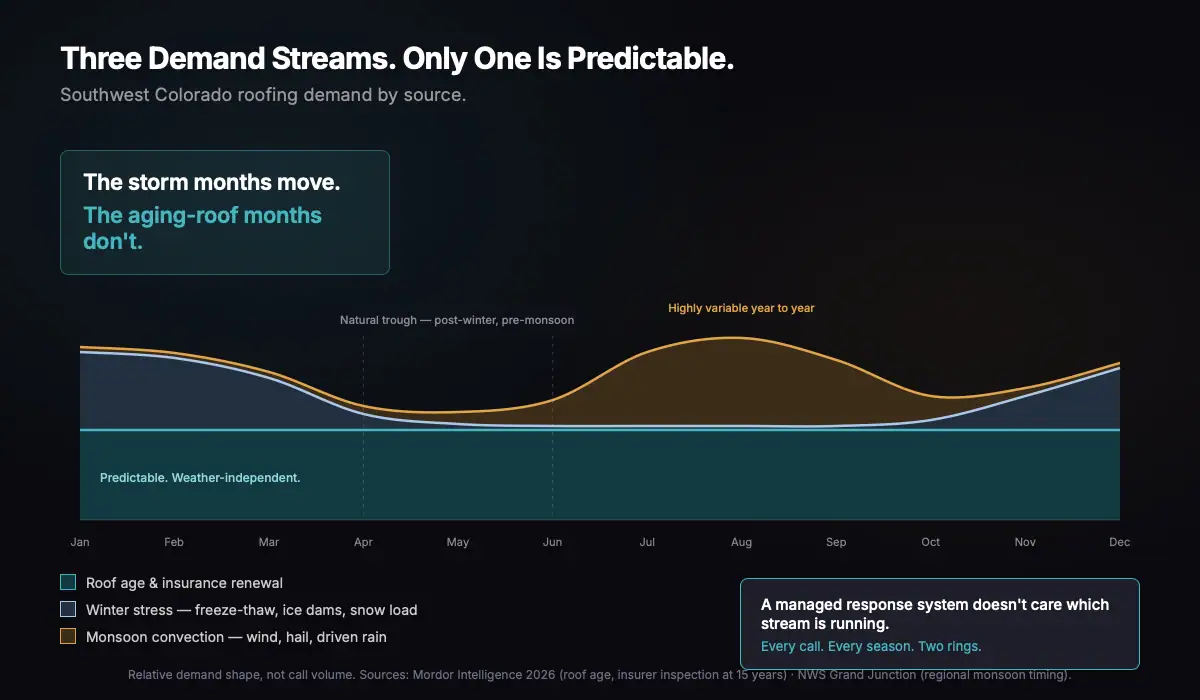
Three demand streams. Only one is predictable.
Most roofing marketing assumes the phone rings because something broke. In southwest Colorado, that is only one of three reasons, and it is the least dependable of them.
Roof age is the steady one. More than a third of American owner-occupied homes were built before 2000, and the median roof age passed 17 years in 2025. Insurers have noticed. Carriers now request a roof inspection when a policy renews on a home older than fifteen years, and the acceptable roof age is being shortened toward the fifteen-to-twenty-year band. That produces a stream of calls tied to renewal dates and underwriting rules rather than weather. It arrives all twelve months. Almost nobody in this market is capturing it deliberately. (Mordor Intelligence, US Roofing Market, May 2026)
Winter is the reliable one. Freeze-thaw cycling, snow load, and ice damming at elevation are the most consistent roof stressors this region produces. They do not make the news. They make the call list.
Summer convection is the loud one. The monsoon brings afternoon storms, microbursts, and driven rain from early July into September. When it delivers, it delivers. It is also the stream every roofer plans around and the one that most often does not show up.
What a quiet season actually costs you
Roofers in this region have spent the last few seasons watching a summer that never really arrived. No hail worth chasing. No wind event that filled the schedule for a month. It is easy to read that as a slow market and wait for the weather to turn.
The arithmetic runs the other way.
When the phone rings sixty times in a month, missing twenty of them hurts and you survive it. When it rings twelve, missing three does not hurt — it decides the quarter. A quiet season does not lower the value of an individual call. It raises it, because there are fewer of them and the ones that come in are the only revenue on offer.
This is the season when a roofing business finds out whether it has a system or a weather forecast.
A major hail event changes the math for a year or more, and when one lands you want to be the company that answers. But a storm is not a plan. The roofers who are still busy in a dry year are the ones who built something that does not depend on the sky.
Not every missed call is a lost job. But in a quiet season, the ones that are cannot be made up anywhere else.
An AI voice agent doesn’t care about seasons. It picks up within two rings whether it’s a Tuesday hailstorm in May or an ice dam leak on Christmas Eve. The calls that used to bounce to voicemail get captured, qualified, and booked — while you are still on a roof.
The insurance math is changing, and it is changing in your favor.
Carriers have responded to rising hail losses the way carriers do. Insurers now request a roof inspection when a policy renews on a home older than fifteen years, and the acceptable roof age is being shortened toward the fifteen-to-twenty-year band. (Mordor Intelligence, US Roofing Market, May 2026) Roof age has become a gating item at renewal, and homeowners are increasingly finding that an older roof changes what a policy will actually pay on a claim. Ask your customers what their carrier told them at their last renewal — the answers have changed in the last two years.
For a homeowner, that is bad news delivered mid-claim.
For a roofer, it changes the job. More of the work is now partly or entirely out of pocket. A homeowner writing a personal check for twelve thousand dollars deliberates far longer than one paying a deductible — which means the estimate that goes unanswered for two weeks is not a lost cause, it is a decision still being made. And the renewal inspections generate a steady stream of inbound calls from homeowners who have just been told their roof is a problem.
That is a pipeline. It runs on a schedule the weather has no say in. It rewards follow-up over speed, and reputation over reach.
The shared-lead trap is worse in roofing than any other trade.
Across 3,211 home services search campaigns, the average cost per lead was $66. Roofing came in at $187. Roofing also carries the highest cost per click of any home services category at $11.13, ahead of HVAC at $9.49 and plumbing at $9.39 — which is the more durable way to say the same thing. Roofing is the most expensive trade in America to buy attention in. (LocaliQ Home Services Search Advertising Benchmarks)
Paid lead services can run $30–$300 per lead, depending on if it is shared, or cross-sold to multiple roofers.
If that lead is also being sold to 3–4 other roofers through a lead-buying service, the closing rate is typically lower and your effective cost per booked job can exceed $800–$1,200.
For a $15,000 roof replacement, that’s an 8% marketing cost — manageable. For a $3,000 repair, it’s 40% — crushing.
Some lead services offer flat rate for ‘unlimited’ leads. The limit is the scope and competitiveness of the market areas (often zip codes) you buy. The cost per lead is generally in the same range as above.
Regardless you need a timely response when leads are delivered, and consistent follow-up (often more than 4 touches to close), which requires an effective lead nurturing and follow-up system. Of course, that adds cost to the upfront lead cost — somebody’s time.
The alternatives: referral or generating your own leads.
A note about referrals. Referrals are the most trusted lead source in roofing. But referrals have a structural ceiling that every roofing company eventually hits. They take years to build — especially realtor and insurance adjuster relationships that produce consistent volume. They come in bursts tied to geography (one neighborhood produces three referrals, then nothing until the next street needs roofs). And you can’t scale them when you need work — when the pipeline’s thin between storms, you can’t “run more referrals.” When homeowners are asked how they actually chose their roofer, half say a referral. Another quarter say they had used the company before. Online search, social media, and advertising split what is left, at roughly eight percent each. (JobNimbus, Peak Performance 2026 homeowner survey) Add those first two together and three quarters of roofing work is won on reputation and relationship before a single ad is served. What extends the value of every referral is your review profile. The neighbor who hears your name at a barbecue doesn’t call immediately — they Google you first. If your profile shows 200 reviews and a 4.8 average, the referral converts. If it shows 30 reviews and a 4.1, the referral dies on the vine. Reviews are word-of-mouth at scale: permanent, searchable, and working while you sleep.
Generating leads through reviews, speed-to-answer, and systematic follow-up works but requires consistency, planning, execution, an effective lead capture and conversion system, and most importantly, time. The additional marketing cost on a lead that came from your Google review profile is essentially zero. The customer searched, saw your reviews, and called you. No middleman. No shared list. No race to respond.
The roofers who invest in building their own pipeline — rather than buying leads — consistently operate at 3–5% marketing cost of revenue instead of 8–12%.
Reviews are how homeowners make high-trust, high-dollar roofing decisions.
A new roof costs $9,000–$30,000 depending on size and materials (RoofingSEO Agency, December 2025). It’s one of the largest single purchases a homeowner makes outside of a car or a house. And unlike a car, they can’t inspect the work themselves once it’s installed.
That trust gap is filled entirely by reviews. Volume, recency, and specificity all matter.
How does your review profile compare to the roofer outranking you? → Check your score
A roofing company with 200 reviews where customers mention specific experiences — “Showed up same day after the hailstorm,” “Worked directly with our insurance adjuster,” “Crew cleaned up better than they found it” — will outperform a company with better craftsmanship but 30 generic reviews every time.
Automated review requests sent the day the job wraps — while scaffolding is coming down and the homeowner is admiring the new roof — convert at 15–30% compared to 3–5% for unprompted reviews. That’s the difference between 30 reviews and 300.
The estimate follow-up problem costs roofers more than bad weather.
Roofing has a unique challenge: long decision cycles on high-ticket work.
You inspect the roof. You send the estimate. The homeowner got three quotes. They’re comparing. They’re waiting on the insurance adjuster. They’re debating materials. Your estimate is sitting in their email, and nobody from your company is following up.
Run your own numbers.
How many estimates did you send last month? How many got a second touch after the first one went unanswered? Not a “just checking in” text three weeks later. A real, scheduled sequence.
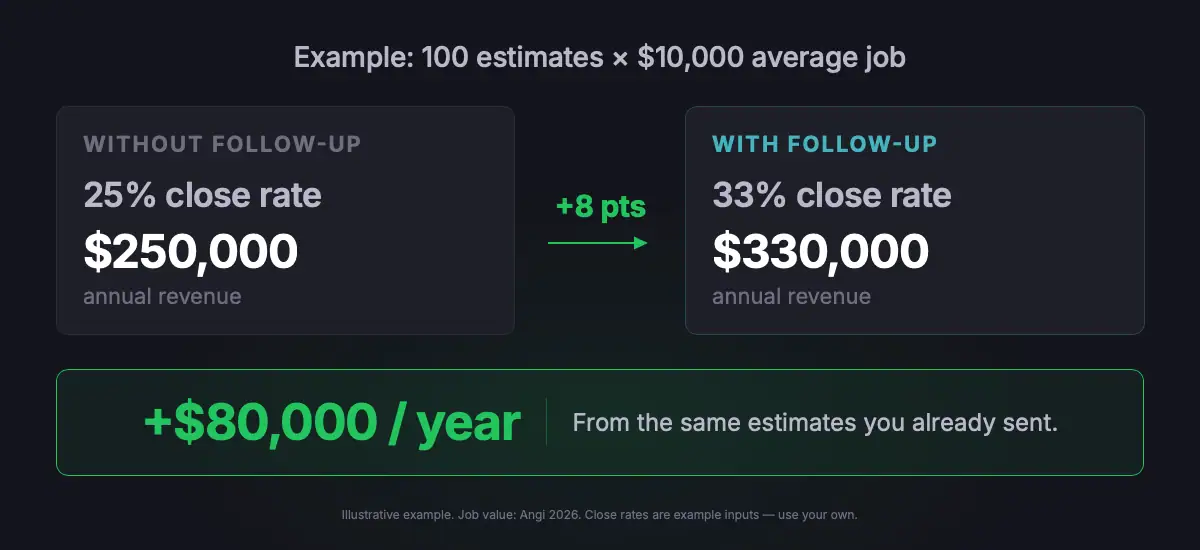
Take an example. A roofer sends 100 estimates a year at a $10,000 average job. At a 25 percent close rate that is $250,000. Move the close rate eight points — which is what consistent follow-up on estimates you have already delivered tends to produce — and the same 100 estimates return $330,000. (Job value rounded from the $9,607 average professional roof replacement, Angi 2026)
25% close rate = $250,000
33% close rate = $330,000
Difference: $80,000/year — from the same estimates you already sent.
Eighty thousand dollars. No new leads. No additional ad spend. The same estimates, followed up.
Your numbers are not these numbers. That is the point. Put yours in.
Automated follow-up sequences solve this: a text message 24 hours after the estimate, an email at 72 hours, another text at one week. Each one keeps your company top-of-mind without requiring you or your office manager to track a spreadsheet.
AI search is deciding which roofer gets recommended.
When a homeowner asks ChatGPT “best roofing company in [city]” or Google’s AI Overview synthesizes a recommendation for “roof replacement near me,” the answer is increasingly generated by AI — not a list of 10 blue links.
Right now, those AI answers are dominated by national chains, lead aggregators, and franchise operations. Independent roofers with better reviews, better work, and better prices are invisible — because their online data isn’t structured for AI consumption.
The fix is structural: consistent business citations across all directories, schema markup on your website, a complete Google Business Profile, and steady review velocity. These are the same foundations that drive traditional SEO and Google Maps rankings. AI search visibility is the layer that compounds on top.
Check whether your roofing business appears in AI search →
What roofing lead generation actually looks like as a system.
The roofing companies that consistently grow without depending on expensive shared leads share the same infrastructure:
- Every call answered. Storm surge at 6pm on a Tuesday — AI voice agent captures overflow, qualifies damage, books inspections while you’re still on a roof. Response System
- Every job reviewed. Automated text the day the job wraps — before the scaffolding truck leaves. Reputation System
- Every estimate followed up. 14-day automated sequence for planned replacements, 7-day for storm repairs. Text, email, text — until they respond. Revenue System
- Maintenance inspections offered. Post-install follow-up at 12 months creates a touchpoint that generates referrals and catches warranty work.
- Online presence managed. Consistent citations, complete GBP, schema markup on service pages.
- AI visibility tracked. Weekly monitoring so you know when homeowners are finding you — and when they’re finding your competitor instead. AI Visibility Tracking
Common questions about roofing lead generation
How much should a roofing company spend on marketing?
Industry benchmarks suggest 5–10% of gross revenue, but the real question is return per dollar. Paid search in roofing runs $187 per lead against a $66 home services average (LocaliQ), and shared lead services are priced in the same territory. Either way, a bought lead costs far more per booked job than one generated from your own review profile and reputation. Roofers who build their own pipeline typically spend 3–5% of revenue on marketing and generate higher-quality leads.
Are lead-buying services worth it for roofers?
They can supplement your pipeline during slow periods, but they shouldn’t be the foundation. Shared leads go to multiple competitors, creating a race to respond first. Building your own lead generation through reviews and reputation gives you exclusive leads at a fraction of the cost.
How many Google reviews does a roofing company need?
More than your closest competitor. In most markets, the roofer with the most recent, highest-rated reviews dominates Google Maps and AI-generated recommendations. We set the target at 200 reviews and a 4.9 average. The median roofing company sits between 51 and 100. And here is the part most roofers miss: more than eighty percent of roofing companies already hold a 4.8 to 5.0 star rating. Your stars are not what separates you. Your volume and your recency are. (JobNimbus, Peak Performance 2026)
How do I handle storm-surge call volume?
An AI voice agent answers the overflow: it picks up within two rings, captures property address and damage description, and books the inspection. You review the lead summary between jobs. During a storm event it answers the calls a two-person crew on a roof cannot — every one of them, including the ones that would otherwise go to voicemail and then to the next roofer on the list.
What’s the single highest-ROI marketing investment for a roofing company?
Estimate follow-up automation. You already have the leads — you already spent the time and money to generate them and drive to the property. The estimates that do not close are mostly not lost because of price. They are lost because nobody followed up. Recovering even 10% of those unfollowed estimates produces more revenue than any new lead source.
You quoted 20 jobs this month. How many got a follow-up?
Most roofing estimates die silently — not because of price, but because nobody followed up. Your free Revenue Leak Audit shows the specific gaps: missed storm-surge calls, unfollowed estimates, review velocity against the roofer outranking you, and whether homeowners can find you in AI search. Your numbers. Your market. About 15 minutes of your time.
Book Your Free Revenue Leak Audit →Or call David directly: 970.508.9555 · Durango, CO
1 Roofing benchmarks in this guide draw substantially on JobNimbus’s Peak Performance 2026 report, the most comprehensive roofing-specific dataset published. JobNimbus is a roofing CRM vendor and sells an AI answering product. We cite its survey data because no independent equivalent exists, and we have noted throughout where a figure is vendor-reported rather than measured.