
Septic Service Marketing: The Revenue You’re Already Earning but Never Collecting
Your best customer already hired you three years ago. Nobody reminded them to call back.
Septic service marketing is the process of generating consistent calls, repeat business, and higher-value jobs for independent septic and well service companies — without depending on word-of-mouth alone. The most effective septic company marketing in 2026 focuses on three things most operators overlook: answering every emergency inquiry immediately, collecting reviews after every pump-out, and systematically recovering the recurring revenue that walks out the door when nobody tracks who is due for service. The review side is covered in managing online reviews for service businesses, and the broader technology shift in AI for service contracting businesses.
Septic and well service is a recurring revenue business — but almost nobody runs it that way.
More than 60 million Americans depend on septic systems. The EPA estimates roughly one in five U.S. households uses onsite wastewater treatment. (U.S. EPA, Septic Systems Overview) Another 43 million rely on private wells for drinking water, with over 500,000 new wells drilled annually. (USGS, EPA Private Wells Data) Demand is non-discretionary — you can delay a kitchen remodel, but you cannot delay a dry well or a septic backup.
The combined U.S. market for well drilling and septic services exceeds $18 billion annually. It is dominated by small, independent operators — exactly the companies that struggle most with marketing.
But the real story is not the market size. It is the business structure.
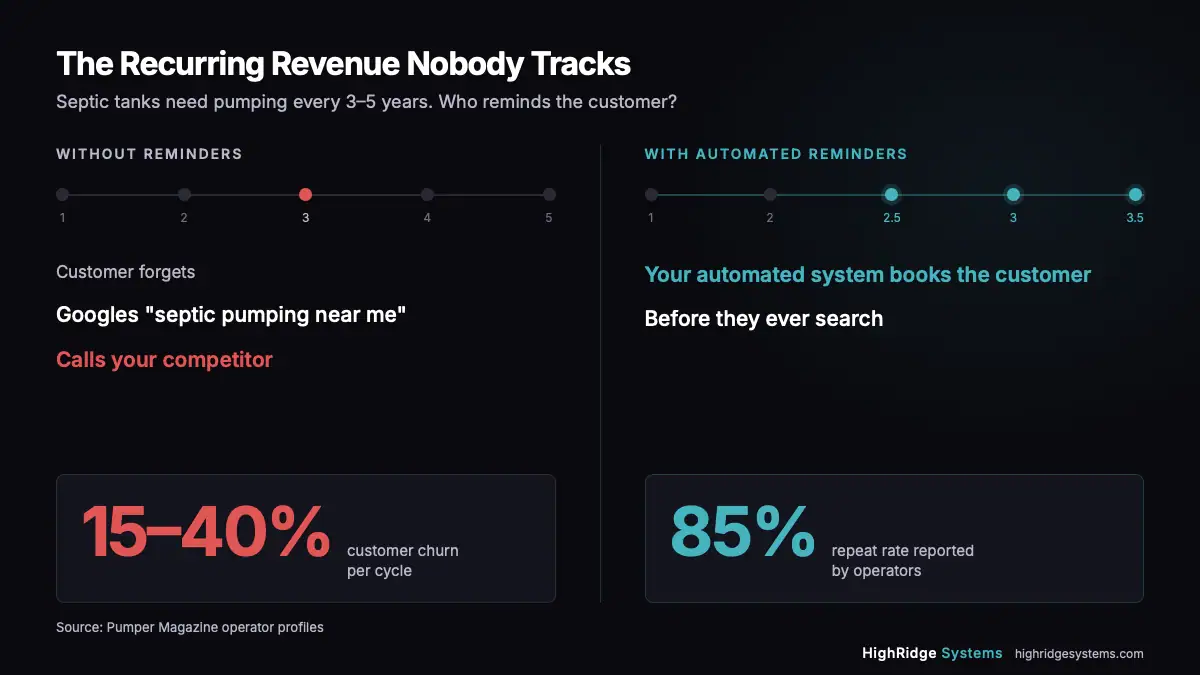
Septic pumping is inherently recurring. Every residential tank needs pumping every 3 to 5 years. That means every pump-out customer you served in 2023 is due again by 2026 to 2028. If you pumped 200 tanks last year, you have 200 customers who will need you again within 36 months.
The question is whether they will call you — or whoever shows up first when they Google “septic pumping near me.”
Operators who track this cycle report 85% repeat rates. One 25-year operator profiled in Pumper Magazine — no website, no marketing — gets 85% of calls from repeat customers built through customer education and honest service. (Pumper Magazine, operator profile) An Oklahoma septic company listing for sale reports “nearly 100% rate of repeat business.” (BizQuest business listing, 2025)
Operators who do not track the cycle lose customers silently. No dramatic cancellation. No complaint. The customer simply forgets who pumped their tank three years ago, Googles “septic pumping near me,” and calls whoever shows up first with decent reviews. You never know they left.
Want to see whether your recurring revenue is leaking?
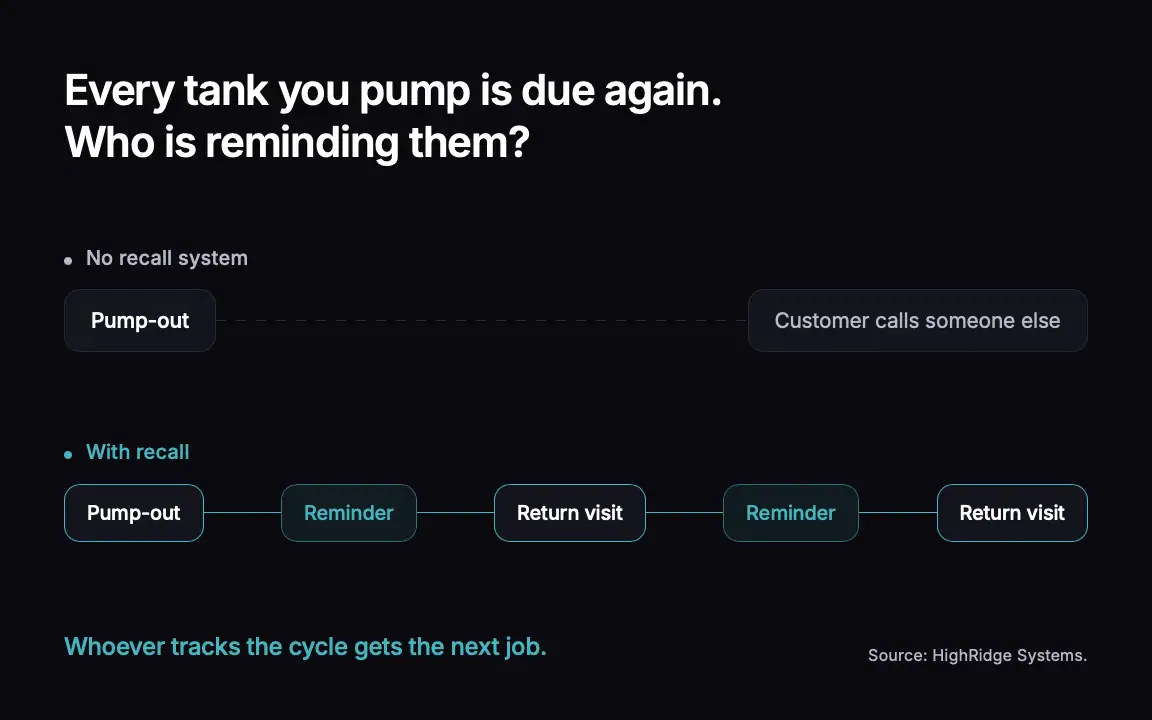
Every tank you pump is due again. Who is reminding them?
This is the most reliable revenue in septic service — and the one almost nobody systematises.
A pump-out is not a one-off job. The tank refills on a predictable cycle, and the customer is rarely the one keeping track of it. A cracked baffle. A failing riser. A deteriorating distribution box. A pump showing early signs of failure. A drainfield that is saturated.
Your technician sees these things. The homeowner hears it once, standing in the yard, and then gets on with their life.
By the time the tank is due again, they do not remember the conversation and they are not tracking the date. They are not being careless. Nobody thinks about a septic system that is working.
That is the largest single revenue leak in septic service, and it is hiding in plain sight: the customer who would say yes, if anyone asked them at the right moment.
The math: 200 pump-outs per year is 200 customers due again on a predictable cycle. Whoever reminds them first gets that work. If nobody does, it goes to whoever the customer happens to find when they finally notice a problem.
This is not new customer acquisition. This is revenue you already earned and never collected.
The phone problem is real — and more complicated than “just answer faster.”
Septic and well service has a genuine missed-call problem. The owner is in the field — often underground, in a crawl space, or driving rural roads with no cell signal. When the phone rings, it goes to voicemail.
The industry knows this. Operators talk about it openly in trade publications:
“When somebody calls, you have to answer the phone and you have to go. If someone is backing up, they want you there with a pump truck. If you do not answer the phone, you are going to miss that call and potentially miss a repair bill or an installation.” — Brian Miller, third-generation contractor (Onsite Installer)
But the answer is not as simple as “whoever answers first gets the job.” Customer behavior in this vertical splits by job type:
Emergency calls (well pump failure, septic backup): These are the highest-urgency calls in all of home services. A dry well means no water for drinking, cooking, bathing, or flushing. A septic backup means sewage in the yard. The customer will call their trusted company first — but if they reach voicemail and do not hear back within 15 to 30 minutes, they search. The window is short.
Scheduled service (pump-out, inspection, water testing): These customers have more patience. They will leave a voicemail. They will wait a day. Loyalty is high here — they know and trust you. The revenue leak is not the missed call; it is that nobody reminded them to call in the first place.
New customers (moved to a rural property, no existing relationship): These callers behave like every other first-time buyer in home services. They call the first company that answers with confidence, or they pick the company with the best reviews and most specific service pages. This is where answering speed, review volume, and search visibility all compound.
The platforms are catching up. Major field service software now offers built-in or bolt-on AI answering features. Standalone AI answering services are proliferating. The “answer the phone” message is table stakes in 2026.
The real gap is everything that happens after the call is answered. Who sends the review request two hours after the pump-out? Who follows up on the $28,000 system replacement estimate that went cold? Who texts the customer at 2.5 years that their tank is approaching its next pump-out? Who tracks the 120 repair opportunities identified during last year’s pump-outs?
Answering the phone is solved. The downstream revenue recovery is not.
Septic companies have one of the hardest review problems in the trades — and one of the easiest to fix.
Of all service businesses, septic and well companies collect the fewest reviews relative to their customer volume. The reason mirrors electrical: when the work goes right, nothing visible happens.
A successful pump-out means nothing visible happened. The tank is emptied, the lid goes back on, the truck leaves. The homeowner is relieved, not thrilled. There is no dramatic before-and-after to photograph, no warm house to appreciate, no running water to celebrate. The work is literally underground and invisible.
This creates a structural review gap. In many rural markets, the leading septic company has fewer than 50 Google reviews. Some well-established operators with 20+ years of business and hundreds of loyal customers have 12 to 15 reviews.
That is both the problem and the opportunity.
In a rural map pack where the leader has 40 reviews, adding 5 reviews per month transforms your competitive position within 6 months. The bar is low enough that a systematic review request program — automated text within 2 hours of job completion — creates outsized ranking improvement. Before you change anything, check your company’s online reputation.
What makes septic reviews convert when they exist: Specificity matters more than star count. “Pumped our tank, found a cracked baffle, replaced it the same day — fair price and thorough work” tells the next customer exactly what to expect. Generic five-star reviews do not differentiate. Automated requests that prompt specific feedback — what was done, how the technician explained the system condition — produce the detailed reviews that both Google and AI search engines weight most heavily.
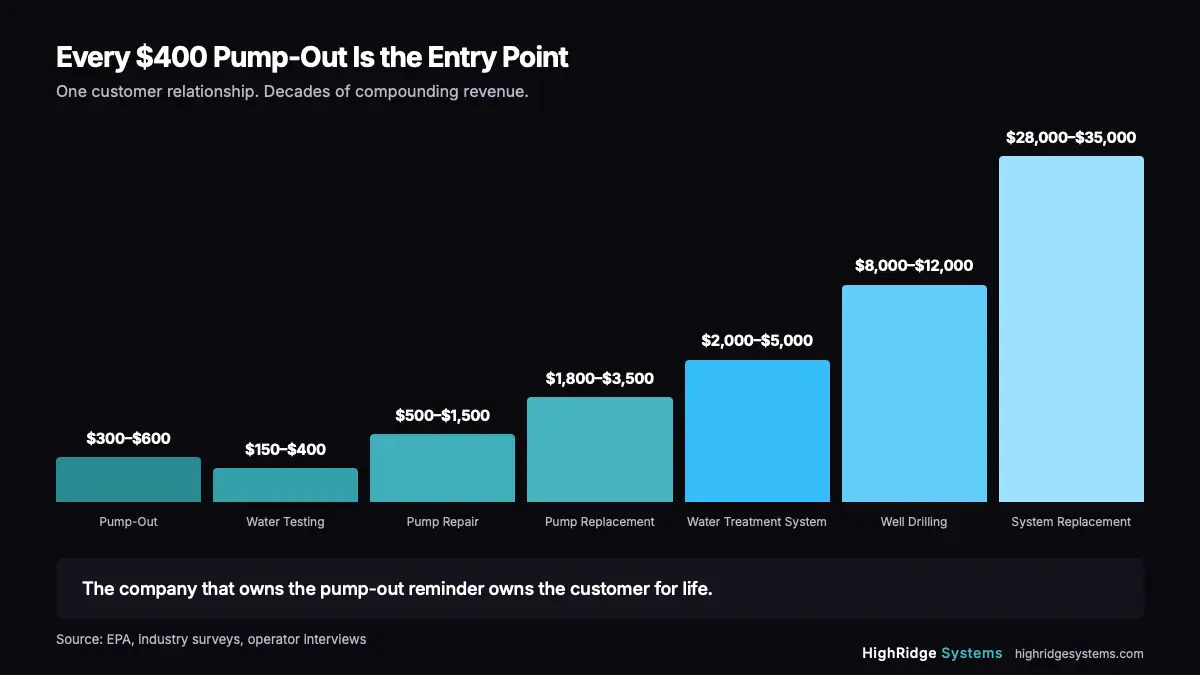
Every customer relationship starts at $400 and compounds upward — if you stay connected.
The septic and well service business has a value ladder that is steeper than almost any other trade:
- Pump-out: $300 to $600
- Water testing: $150 to $400
- Pump repair: $500 to $1,500
- Pump replacement: $1,800 to $3,500
- Water treatment system: $2,000 to $5,000
- Well inspection (real estate): $300 to $600
- Well drilling: $8,000 to $12,000
- Septic system replacement: $28,000 to $35,000
- Commercial systems: $35,000 to $65,000
One operator reported that adding a pump truck increased installing and repairing revenue by 20% in the first 18 months. “Having the pumper truck gives you first contact with your customer. It is a service we provide that refers work back to us to keep our excavators busy.” (Les Harris, Onsite Installer)
The pump-out is the entry point to everything. The company that owns the pump-out reminder — that proactively reaches customers at 2.5, 3, and 3.5 years — owns the customer relationship for decades. Each pump-out becomes a diagnostic visit that surfaces the next job. Over a 20-year homeownership span, a single customer relationship can generate $15,000 to $50,000 in lifetime revenue.
The company that waits for customers to remember? They are subsidizing a competitor’s growth.
Real estate inspections are a referral network hiding in plain sight.
Well inspections and septic inspections are required or strongly recommended for most rural property sales. This is seasonal, high-volume work that connects directly to realtors — the most powerful referral network in local service.
Most septic and well companies get this inspection work reactively. A realtor calls when they have a closing. The company does the inspection. Nobody builds the relationship systematically.
The companies that treat inspections as a referral pipeline — sending inspection reports promptly, following up with the realtor after closing, providing educational content about system maintenance for new homeowners — create a channel that generates leads year-round. New homeowners who just bought a property with a well and septic system need exactly the services you offer. The realtor who sold them the house is the natural connector.
In Colorado, spring and summer drive real estate inspection volume. March through October is the window where inspection work is heaviest — and where the referral relationships generate the most value.
Most septic companies are invisible in AI search — and that matters more every quarter.
When a homeowner asks an AI assistant “who pumps septic tanks near [city]” or “best well pump repair in [county],” independent septic and well companies almost never appear. Franchise operations and large aggregator platforms dominate those answers.
Building AI visibility for septic and well companies starts with the same foundation as every other local service business: consistent reviews mentioning specific services, complete citations, schema markup, and detailed service pages.
But the rural market dynamic creates a unique advantage: competition for AI visibility in “well pump repair [rural county]” or “septic pumping [mountain town]” is dramatically lower than in urban markets. A septic company that builds targeted service pages — separate pages for pumping, installation, inspection, repair, and water treatment — gives AI systems specific content to recommend. In a market where competitors have a generic “Services” page, specificity wins.
Check whether your septic business appears in AI search →
Spring snowmelt is your surge — and most companies are not ready for it.
In Colorado and mountain communities, the March through May window brings a predictable seasonal spike. Spring snowmelt saturates soils, overwhelming drain field absorption capacity. Systems that performed fine all winter start backing up as the water table rises.
This creates a surge in emergency calls that hits at the same time real estate inspection season ramps up. Companies that prepare for this — with call capacity, staffing, and pre-season outreach to past customers — capture disproportionate revenue during the highest-demand months.
Companies that do not prepare miss calls during the only months when customers cannot wait.
What septic service marketing actually requires.
- Every call answered. Including the Saturday morning emergency when you are already on a job 45 minutes from town. AI voice agent captures the inquiry, qualifies urgency, and routes emergencies. Response System
- Every pump-out reviewed. Automated text within 2 hours — overcomes the “underground and invisible” review gap that is unique to well and septic. Reputation System
- Every repair opportunity followed up. The baffle replacement you identified during a pump-out. The system replacement estimate that went cold. The 14-day automated follow-up sequence on every quoted job. Revenue System
- Every past customer on a reminder cycle. Automated pump-out reminders at 2.5, 3, and 3.5 years. This is the unique revenue recovery mechanism in septic that does not exist in any other trade.
- AI visibility tracked. Weekly monitoring for “septic pumping near me,” “well pump repair near me,” and real estate inspection queries in your service area. AI Visibility Tracking
The franchise has a marketing department running this. The national aggregator platform has a dev team. You need a system that runs it for you.
Common questions about septic service marketing
How do septic companies get more Google reviews?
Ask immediately after every pump-out. Septic work is invisible when done right — there is no dramatic before-and-after for the customer to photograph. Automated review requests sent within 2 hours of job completion, before the customer moves on and forgets the experience, are the only reliable way to build review volume. The key is prompting specific feedback: what was done, what the technician found, how the condition of the system was explained.
How often should a septic company follow up with past customers?
Septic tanks need pumping every 3 to 5 years. Automated reminders at 2.5 years, 3 years, and 3.5 years keep you top of mind without being intrusive. Operators who track this cycle report 85% repeat rates. Those who wait for customers to remember on their own lose 15 to 40% of recurring customers per cycle to competitors or neglect.
What is the biggest revenue leak for septic companies?
The customer who never comes back. A pump-out is a scheduled service on a multi-year cycle, and the homeowner is rarely the one tracking when it is due. Reminding them is the difference between one visit and a customer for the life of the system. Systematic recall on that cycle is the single largest revenue recovery opportunity in the business.
How much should a septic company spend on marketing?
Industry benchmarks suggest 5 to 8% of gross revenue. But the highest-ROI marketing for septic companies is not paid advertising — it is automated reminders, review collection, and repair follow-up. A pump-out reminder system that recovers 20 customers per year at $400 each generates $8,000 in direct recurring revenue — before counting any additional work those visits surface.
How do I compete with companies that have been here for 30 years?
You do not outspend them. You out-system them. A 30-year operator with 85% repeat rates has loyalty but typically has fewer than 50 reviews and no automated follow-up. An operator who answers every call, sends review requests after every job, and runs pump-out reminders will overtake the review count within 12 months — and start capturing the 15 to 40% of customers the established operator loses silently every cycle.
Are you capturing every pump-out, every repair opportunity, and every returning customer?
Your free Revenue Leak Audit shows the gaps — missed calls, untracked pump-out cycles, unfollowed repair quotes, review velocity compared to competitors, and AI search visibility for septic and well queries in your market.
If the numbers do not show a clear gap, we will tell you — and you will have lost nothing but about 15 minutes.
Book Your Free Revenue Leak Audit →Or call David directly: 970.508.9555 · Durango, CO