
How Lead Follow-Up Automation Works for Service Businesses
The estimate you already sent is the highest-value lead in your pipeline. Most service businesses never follow up on it.
Lead follow-up automation is a managed system that contacts customers automatically after an estimate is sent and not accepted — through text, email, or both — on a timed sequence until the customer books, responds, or the sequence closes. For service businesses, this isn’t a CRM feature to configure. It’s the single most recoverable revenue leak in the business — the gap between work already quoted and work never booked, because nobody followed up.
The revenue hiding in your sent estimates.
The estimate you sent last Tuesday is dead. Not because the price was wrong — because nobody followed up.
You drove to the site, measured the job, spent 45 minutes writing the estimate, and sent it over. Then you went to the next job. And the next one. A week later, you assume they went with someone cheaper.
They didn’t. They forgot. And while you were on a roof or under a sink, the contractor who followed up at day 3 landed the job you’d already earned.
That’s not a lost lead. That’s revenue your business already earned — the customer chose you, requested the estimate, and was ready to move forward. The collection failed at the last mile. Not because your work wasn’t good enough. Because the follow-up didn’t happen.
This is the follow-up gap — and for most service businesses, it’s where the largest share of recoverable revenue hides. Not in new leads. Not in better marketing. In the estimates you’ve already sent that nobody chased.
What the data says about follow-up.
The research on follow-up timing is unambiguous.
Responding to a lead within 5 minutes makes you 21× more likely to qualify them compared to waiting 30 minutes. The average business responds in hours. Some take days. (InsideSales / MIT Lead Response Management Study)
80% of sales require five or more follow-up touches before the customer moves forward. But 48% of salespeople — and most service business owners — never follow up even once. (Invesp)
That gap between “five touches needed” and “zero touches given” is where revenue disappears. Not because the customer said no. Because nobody asked again.
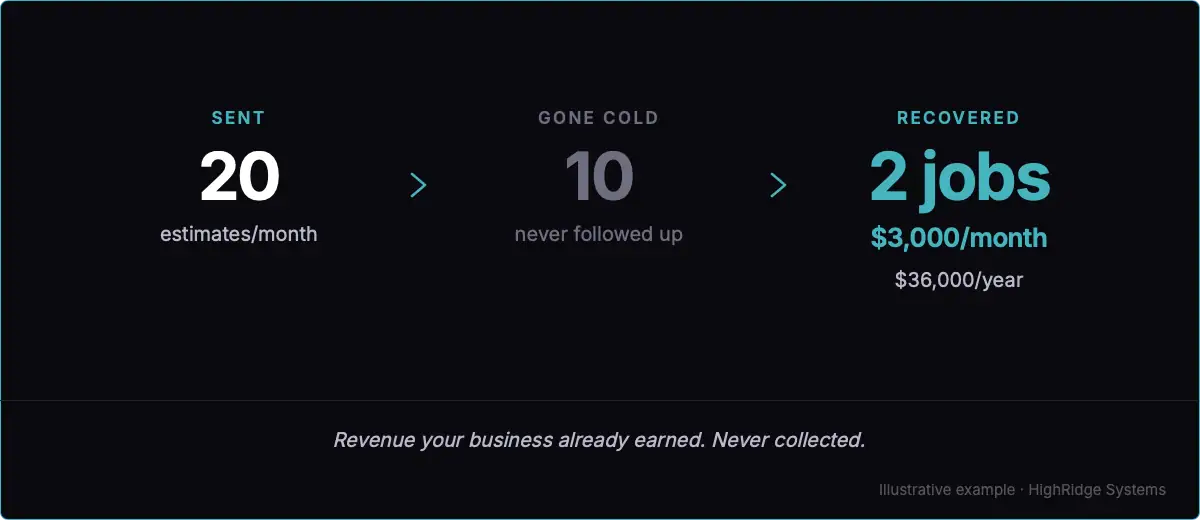
For a contractor sending 20 estimates per month with a 50% non-conversion rate, recovering even 20% of those through automated follow-up represents 2 additional jobs per month. At $1,500 average job value, that’s $3,000/month — $36,000/year — from work you’ve already done.
That revenue isn’t theoretical. The customer already called you. The estimate already went out. The demand already existed. The system just catches what falls through.
See what that gap looks like for your business.
Why manual follow-up doesn’t work.
Because you’re on a job. Your team is on jobs. Nobody’s job description includes “check the CRM at 2 pm and send follow-up texts on estimates from last week.”
Manual follow-up requires someone to remember which estimates are outstanding, check the CRM, write a personalized message, send it at the right time, track the response, and follow up again if there’s no reply. That person doesn’t exist in most service businesses — not because the team is lazy, but because following up on 20 estimates while running 20 active jobs isn’t a people problem. It’s a capacity problem.
This is exactly where software fatigue starts. The CRM has the data. The automation tool has the sequences. The feature exists. The sequences can be configured. The templates can be written.
But nobody configured them, nobody maintains them, and nobody checks whether they’re working. The tool sits there. The estimates sit there. The revenue sits there.
What lead follow-up automation actually does.
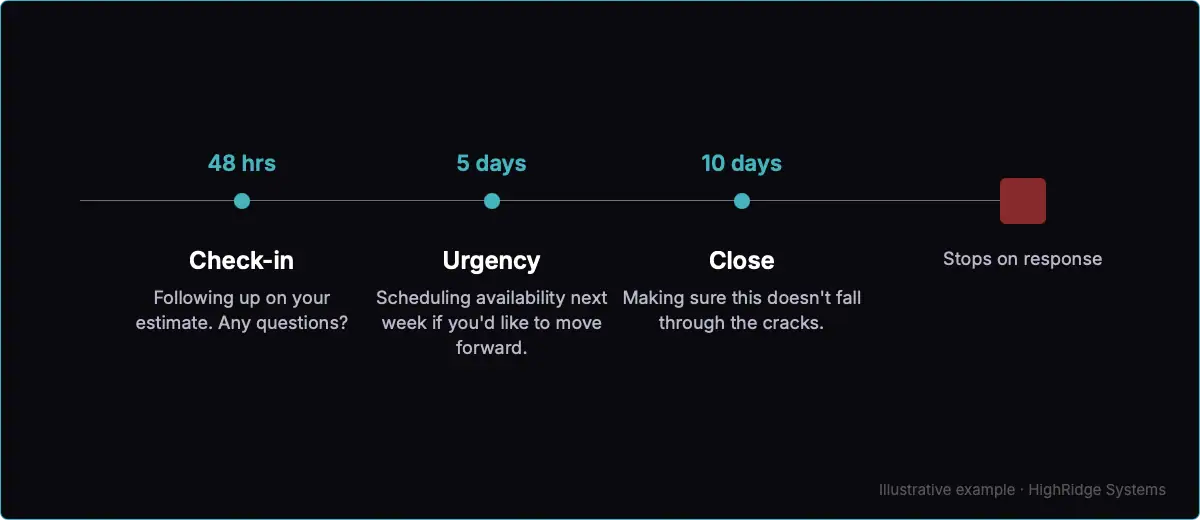
A structured follow-up sequence fires automatically when an estimate is sent and not accepted within a defined window:
Touch 1 (48 hours): A check-in via text or email. “Hey, just following up on the estimate for [service]. Any questions I can answer?”
Touch 2 (5 days): A light urgency signal. “We have scheduling availability next week if you’d like to move forward.”
Touch 3 (10 days): A closing note. “Just want to make sure this doesn’t fall through the cracks. Happy to revisit the scope if anything’s changed.”
The sequence stops the moment the customer books or responds. No pestering. No over-sending. Just the follow-up that would have happened if someone on your team had the bandwidth.
How it adapts to your vertical.
Lead follow-up automation isn’t one-size-fits-all. The language, timing, and urgency signals change by industry:
HVAC: Sequences reference seasonal urgency. “Tune-up season fills up fast — we’re holding your slot through Friday.” Emergency follow-ups are faster (same day) because the customer’s problem is urgent.
Roofing: Storm-season follow-ups reference the inspection window. “Insurance adjusters are scheduling inspections this week — we can meet them on-site if you’d like to move forward.”
Electrical: Panel upgrade and EV charger estimates get longer decision windows — homeowners research before committing. The sequence adjusts timing and includes educational touches. Read the electrical contractor marketing guide
Dental: Recall sequences reference insurance benefits. “Your preventive benefits reset at year-end — booking your cleaning now saves the out-of-pocket cost later.”
Plumbing: Non-emergency estimates (repiping, water heater replacement) get longer follow-up windows. Emergency calls get immediate booking, not follow-up. Read the plumbing marketing guide
The system adapts because it’s configured for your business — your services, your language, your timing. Not a template shared across 500 accounts.
The math — manual vs. automated.
A dedicated follow-up person costs $35,000 to $50,000 per year. They work business hours. They remember to check the pipeline when they’re not doing six other things. They’re effective on the days they’re not sick, on vacation, or overwhelmed.
Automated lead follow-up runs on every estimate, every time, at the intervals proven to recover the most jobs. It doesn’t take days off. It doesn’t prioritize some estimates over others. It doesn’t forget.
The cost comparison isn’t close. But the more important comparison isn’t cost — it’s consistency. A person follows up sometimes. A system follows up every time. The revenue difference between “sometimes” and “every time” defines the growth trajectory of the business.
What “managed” means in this context.
Most CRM platforms — HubSpot, Jobber, ServiceTitan, Housecall Pro — have follow-up automation built in. The feature exists. The sequences can be configured. The templates can be written.
The problem is that configuring them, maintaining them, and optimizing them is a job. A job that nobody in a 5-person HVAC shop has time to do.
Managed lead follow-up automation means someone else builds the sequences, tests the messaging, monitors the conversion rates, and adjusts the timing based on what’s working. Every month. Not a set-it-and-forget-it configuration — an actively managed system that gets smarter over time.
You don’t learn the CRM. You don’t configure the workflows. You don’t write the templates. You run your business. The follow-up runs alongside it.
And every Monday morning, you get a briefing showing what it caught — how many sequences ran, how many customers responded, how many jobs booked. Revenue your business already earned, now collected.
The follow-up gap is where most revenue hides.
Not in new leads. Not in new marketing. Not in a better website. In the estimates you’ve already sent that nobody chased. The work you’ve already done that’s sitting in an email outbox, aging from “sent yesterday” to “sent last month.”
Every estimate that goes unfollowed is revenue your business already earned — the customer already chose you. The demand already existed. The collection just didn’t happen.
Close the follow-up gap first. Everything else compounds on top of it.
Lead follow-up is one of the highest-ROI applications of AI for service businesses. For the strategic overview — including missed calls, reviews, and AI search visibility — see AI for Contractors.
Common questions about lead follow-up automation.
How many follow-up touches should I send?
Research shows 80% of sales require five or more touches. Most businesses stop at zero or one. A 3-touch sequence (48 hours, 5 days, 10 days) captures the majority of recoverable revenue. Longer sequences (5-7 touches) are appropriate for higher-value estimates like panel upgrades, repiping, or system replacements where the decision cycle is longer.
Won’t automated follow-up feel impersonal?
Only if the messages are generic. Effective sequences reference the specific service quoted, use the customer’s name, and adjust tone by urgency. “Following up on the EV charger estimate” lands differently than a template that says “Just checking in!” The system sends the message. The message is written for your business, your services, and your customer.
What if I already have follow-up sequences in my CRM?
Most businesses that have sequences configured don’t maintain them. The templates go stale, the timing drifts, and nobody monitors conversion rates. Managed follow-up means someone builds, tests, and optimizes the sequences monthly — not just sets them up and walks away. Read: Managed vs. DIY — What’s the Real Difference?
Does the sequence stop if the customer responds?
Yes. The moment a customer replies, books, or takes any action, the sequence stops automatically. No double-sending. No pestering. The system is designed to catch revenue that would otherwise disappear — not to annoy customers who’ve already engaged.
What does this cost compared to hiring someone?
A dedicated follow-up coordinator costs $35,000 to $50,000 per year, works business hours, and handles follow-up when they’re not doing five other things. Managed follow-up automation runs 24/7 on every estimate at a fraction of the cost — with higher consistency, no sick days, and no training ramp.
Find out how much revenue is sitting in your unsent follow-ups.
The Revenue Leak Audit measures your follow-up gap specifically — how many estimates go out, how many convert, and what the delta is worth. Then we show you what automated follow-up would recover. Free. About 15 minutes of your time.
Book Your Free Revenue Leak Audit →Or call David directly: 970.508.9555 · Durango, CO