
Review Management for Service Businesses: What Changed, What It Costs You, and How to Fix It
Your five-star work should speak for itself. For most service businesses, it doesn’t.
The homeowner who shakes your hand and says “great work” almost never leaves a review. The one who had a bad experience posts at 11 PM. And right now, that lopsided picture isn’t just shaping what other homeowners think — it’s shaping what AI search engines tell them.
Review management used to be simple: get more stars on Google. In 2026, that shifted under everyone’s feet — part of a broader change in how AI is changing home service businesses. Consumer expectations rose, new platforms emerged, federal regulators stepped in, and artificial intelligence started reading your reviews to decide whether to recommend your business. Most contractors are still managing reviews the way they did three years ago — if they’re managing them at all.
This guide covers the full picture: what changed, what it’s costing you, and what a review system actually looks like when it runs without you touching it.
Why Reviews Matter More in 2026 Than They Did Last Year
The data isn’t subtle. According to a widely cited consumer review survey — the largest annual study of its kind, surveying over 1,000 U.S. consumers — 97% of consumers now read online reviews before choosing a local business. Not occasionally. Routinely.
But the real shift isn’t that people read reviews. It’s how much more they demand from them.
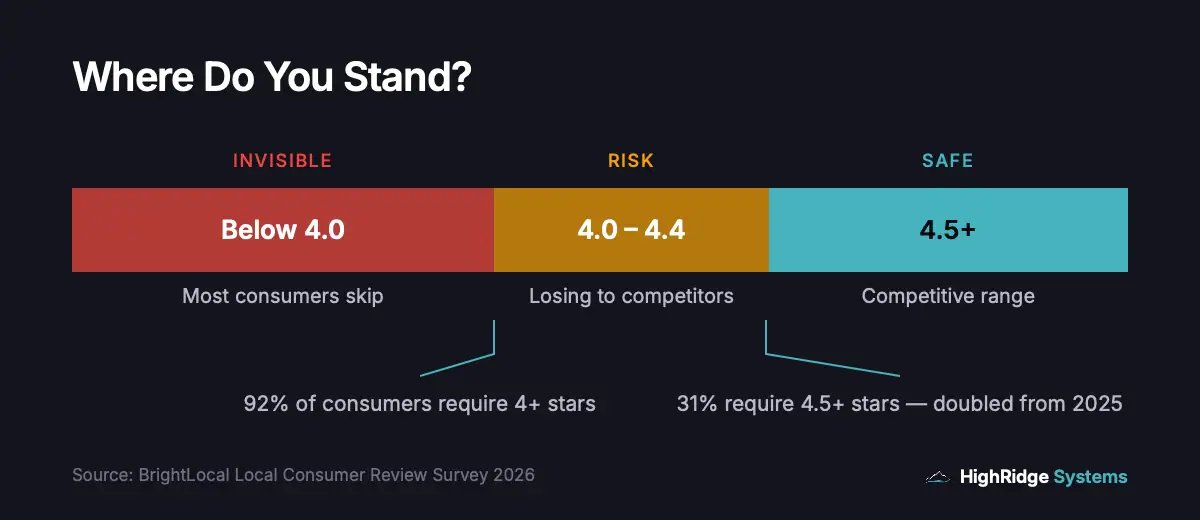
In 2025, 17% of consumers said they’d only hire a service business with a 4.5-star rating or higher. One year later, that number hit 31%. It nearly doubled. If your rating dropped from 4.6 to 4.3 this year, you didn’t get worse — the threshold moved past you.
And it’s not just the star average. Nearly half of consumers (47%) won’t consider a business with fewer than 20 reviews. Volume signals legitimacy. A 5.0 average with four reviews reads as “too small to evaluate,” not “perfect.”
A 5-star rating with 6 reviews loses to a 4.7 with 120. Volume is the signal — not perfection.
Here’s where it hits revenue directly: products and services with five or more reviews see conversion rates up to 270% higher than those with none. A one-star improvement in your average rating correlates with a 5-9% increase in revenue. For a service business doing $400,000 a year, moving from 4.1 to 4.5 stars represents $20,000-$36,000 in annual revenue you’re currently leaving on the table.
The businesses winning in 2026 maintain a 4.5+ average, generate a steady flow of new reviews every month, and respond to every single one. The businesses losing don’t have a bad product — they have a missing system.
Businesses with 200+ reviews earn roughly twice the revenue of an average business. The gap between your current count and that number is measurable lost income.
Your reviews don’t just influence customers anymore — they influence whether AI recommends you at all.
AI search engines like ChatGPT and Google AI read your reviews to decide which businesses to name when someone asks for a recommendation. The number of reviews you have, how recent they are, and whether you respond all factor into that decision. Everything in this guide makes your business easier for AI to recommend.
The Review Platforms That Actually Matter for Service Businesses
Google still leads. Seventy-one percent of consumers use Google for local business reviews. But that number dropped from 83% in just one year — and where that traffic went matters.
Consumers now check an average of six different review platforms before choosing a service provider. Six. For a contractor, that means your Google profile alone isn’t the whole picture anymore.
Here’s where your reviews need to be, ranked by impact for home service businesses:
Google Business Profile remains the highest-priority platform. It directly affects your Map Pack ranking, your star rating visibility in search results, and increasingly, what Google’s own AI features tell consumers about you. If you’re only active on one platform, this is the one.
Facebook is the second most-used review source — 49% of consumers check Facebook reviews for local businesses. Many homeowners discover contractors through neighborhood groups and community pages, then check the business’s Facebook reviews before calling.
Yelp reaches 44% of consumers and over 132 million monthly visitors. It’s particularly strong in metro markets and for consumers who distrust Google’s review ecosystem.
Industry-specific platforms — Angi (formerly Angie’s List), HomeAdvisor, Thumbtack, Houzz — carry outsized weight in home services because consumers using these platforms are already in buying mode. A strong profile on these platforms often converts at a higher rate than a Google review because the user intent is more specific.
Nextdoor is the sleeper. Neighbor-to-neighbor recommendations on Nextdoor carry trust that no other platform replicates. You can’t automate Nextdoor presence, but you can make it easy for happy customers to recommend you there.
The takeaway: your review strategy can’t be a Google-only strategy anymore. The platforms your customers check are diversifying — and as you’ll see in the next section, so are the systems reading your reviews.
Check your Google review profile now — free, instant analysis.
The Response Gap: Why 95% of Businesses Are Losing Before They Start
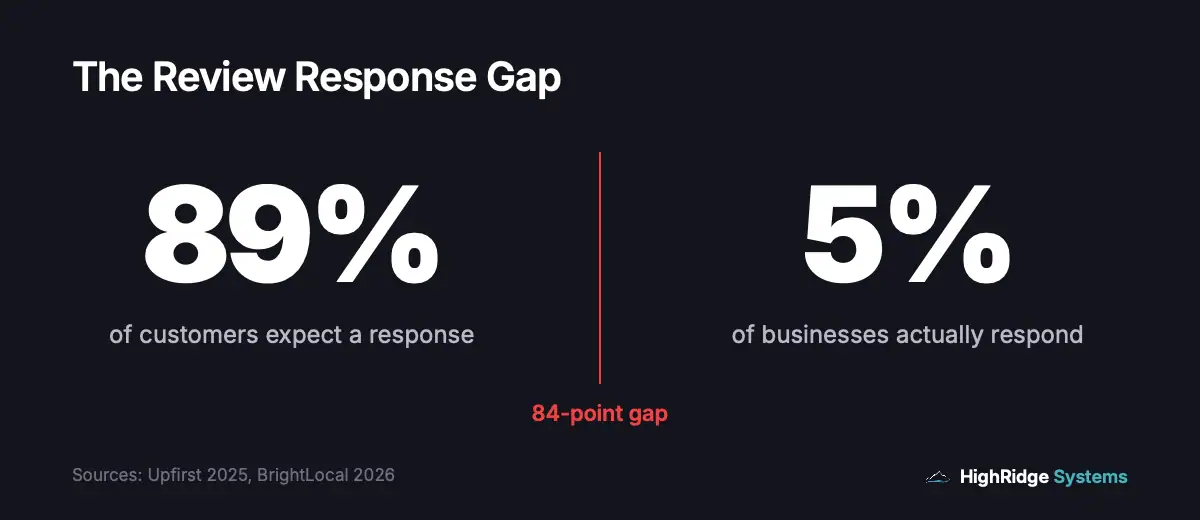
Here’s the most dramatic mismatch in local marketing: 89% of consumers expect businesses to respond to their reviews. Only 5% of businesses actually do.
That 84-point gap is where your competitor’s next customer comes from.
When you respond to a positive review, you’re not just being polite — you’re reinforcing the reviewer’s decision to choose you, making them more likely to refer you, and showing every future reader that you’re attentive and engaged. According to the research, 56% of consumers change their opinion of a business based on how they respond to reviews.
When you respond to a negative review, the stakes are even higher. You’re not writing for the unhappy customer — you’re writing for the hundreds of future homeowners who will read that exchange. A measured, professional response to a one-star review often builds more trust than the five-star reviews around it. And the data backs this up: 67% of dissatisfied customers stay loyal to a brand that responds quickly.
The response window is tightening. In 2026, 19% of consumers expect a same-day response to their review — up from just 6% the year before. A full 32% expect a response by the next day. Waiting a week to respond now puts you behind the majority of consumer expectations.
What a good response looks like for a service business
For positive reviews: thank the customer by name, reference the specific job or service, and keep it brief. “Thanks, Sarah — glad the water heater install went smoothly. Appreciate you trusting us with it.” That takes 20 seconds to write and signals to every reader that you pay attention after the invoice is paid. Naming the job matters more than it looks: the plumbing marketing guide covers why service-specific language in reviews outperforms generic praise.
For negative reviews: acknowledge the experience, don’t argue facts publicly, and move the conversation offline. “We’re sorry this didn’t meet your expectations. We’d like to make it right — could you call us at [number] so we can discuss?” The goal isn’t to change the reviewer’s mind. It’s to show the next 500 readers that you handle problems professionally.
The real question isn’t whether you should respond. It’s whether you have the time to respond to every review within 24 hours while also dispatching trucks, quoting jobs, and managing your crew. That’s the system problem — and it’s why most businesses fall into the 95% that don’t respond.
Your Reviews Now Have a Second Audience — and It’s Not Human
Your reviews used to be a yard sign. Now they’re the resume your business submits to every AI search engine.
This is the shift most service businesses haven’t caught yet, and it changes everything about how review management works.
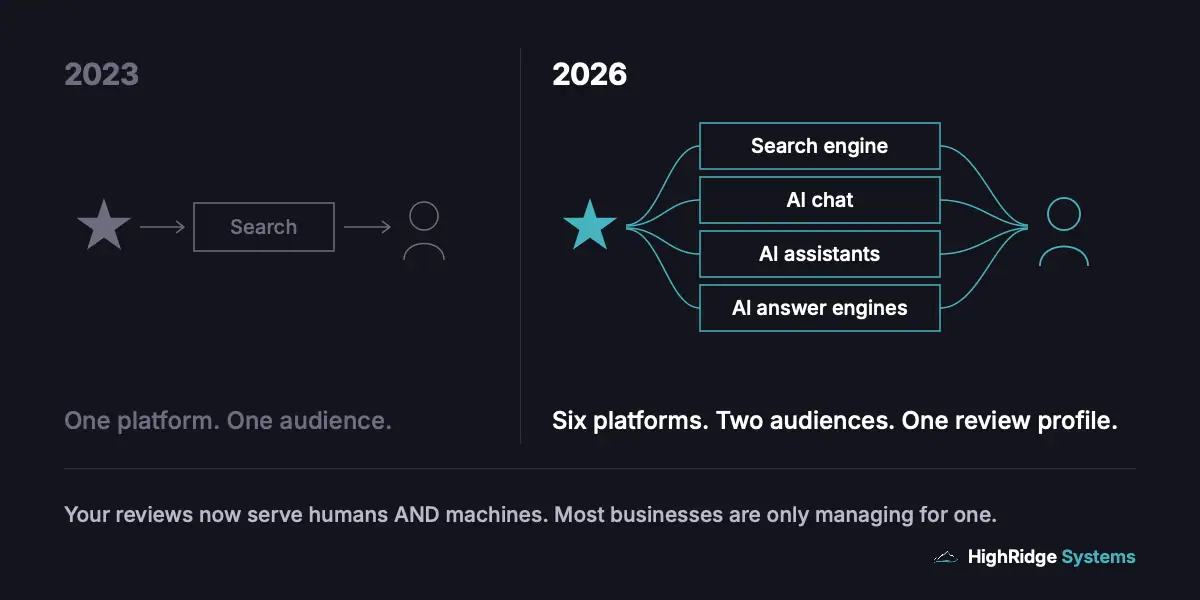
According to the same 2026 consumer research, 45% of consumers have used AI tools — ChatGPT, Google’s AI Mode, Gemini, Perplexity — to find local business recommendations in the past year. That number was 6% in 2025. It didn’t grow by 6%. It went from 6% to 45% in twelve months.
The age group leading this adoption? Consumers aged 30-44, at 64%. These are your homeowners. The people calling for HVAC repairs, roof replacements, and kitchen remodels are increasingly asking AI for the recommendation instead of scrolling through Google results. The trade-level detail is in the HVAC lead generation guide and the roofing lead generation guide.
And here’s what AI does differently than a human: it doesn’t browse your reviews. It parses them.
When a homeowner reads your Google reviews, they skim for stories they relate to, look at the star average, and make a gut decision. When ChatGPT or Gemini processes your reviews, it extracts structured data: service type, response time, pricing signals, geographic coverage, technician names, and sentiment patterns. A review that says “Mike replaced our water heater the same day we called — quick, clean install, fair price” gives an AI engine three citable data points: same-day service, water heater expertise, and competitive pricing.
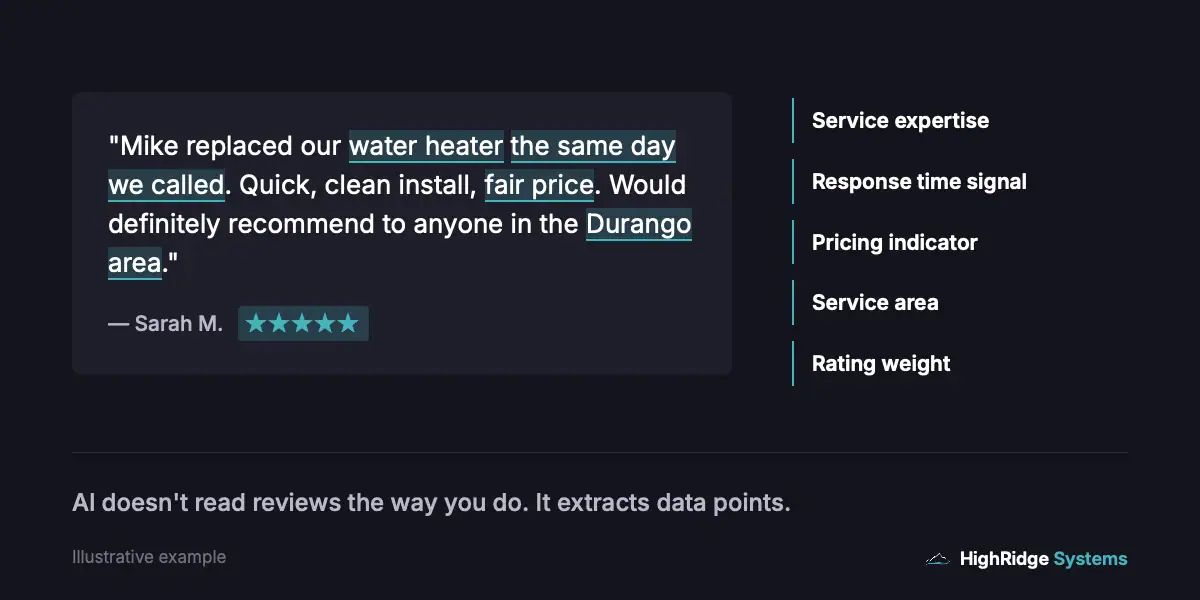
This means the content of your reviews matters as much as the quantity. A business with 200 reviews mentioning specific services, response times, and positive outcomes will consistently outrank a competitor with 30 vague “great service!” reviews — even if the star averages are identical. The AI needs something to cite. Give it specifics.
There’s another wrinkle: ChatGPT doesn’t have direct access to your Google reviews the way Google’s own AI does. Reporting indicates ChatGPT pulls from Bing-indexed web results, Yelp, Foursquare, BBB, industry directories, and your website. This is why the multi-platform review strategy from the previous section isn’t just a nice-to-have — it’s the difference between existing in AI search and being invisible in it.
The businesses that show up in AI recommendations share three characteristics: high review volume across multiple platforms, recent review activity (not a burst of reviews three years ago followed by silence), and a pattern of owner responses that demonstrates engagement. AI systems are risk-averse. They recommend businesses that are easy to verify across multiple independent sources.
Your review profile is no longer just social proof for the human scrolling through Google Maps. It’s the input data for every AI system deciding whether to recommend you. For the full mechanics of that shift, see how AI search engines use reviews to recommend local businesses.
See how AI search engines describe your business right now.
What the FTC’s New Review Rules Mean for Your Business
In October 2024, the Federal Trade Commission finalized a rule that changed what you can and can’t do with customer reviews. In December 2025, they started enforcing it — sending warning letters to 10 companies as the first wave of action. The penalties: up to $53,088 per violation. Per violation, not per incident.
Here’s what the FTC’s rule on fake reviews prohibits:
Fake reviews — creating, purchasing, or distributing reviews from people who didn’t actually use your service. This includes AI-generated reviews. If a review doesn’t come from a real customer’s real experience, it violates the rule.
Incentivized sentiment — offering a discount, gift card, or any reward in exchange for a positive review specifically. You can ask every customer for a review. You can make it easy with a direct link. You cannot say “leave us a 5-star review and get 10% off your next service.”
Review suppression — selectively hiding or removing negative reviews to make your profile look better than it is. If you display reviews, you can’t cherry-pick only the positive ones.
Undisclosed insider reviews — reviews from employees, family members, or anyone with a material connection to the business that don’t clearly disclose that relationship.
What’s still perfectly fine: asking every customer for a review after a completed job, sending an automated review request via text or email, making it easy with a direct Google review link, and responding to all reviews — positive and negative. All of that is consistent with Google’s review policies.
The line is clear: you can ask. You can make it easy. You cannot buy, fake, or filter.
For service businesses running a clean operation, this rule actually helps. It penalizes the competitors who gamed the system with purchased reviews and fake accounts. A business generating authentic reviews from real customers has less noise to compete against. The FTC is cleaning up the field for businesses that play it straight.
This is an educational overview of the FTC Consumer Review Rule, not legal advice. For compliance questions specific to your business, consult an attorney.
How to Build a Review System That Runs Without You
You finish a job. The homeowner’s happy. They shake your hand, say they’ll tell their friends, and you’re on to the next call. A week later, no review. A month later, no review. They meant it when they said “great work” — they just didn’t think about opening Google and writing something down.
This is the gap that kills most service businesses’ review profiles. Not bad work. Not unhappy customers. Just the absence of a system that turns completed jobs into reviews without depending on anyone to remember.
Here’s what a review system needs to do — automatically, every time, without you or anyone on your team logging into a dashboard:
The ask goes out within two hours of job completion. Not the next day. Not “when you get a chance.” Satisfaction peaks immediately after the job. A text message sent within that window converts at 3-4x the rate of an email sent the next morning. The channel matters, and the timing matters more.
The best time to ask for a review is when the customer is still standing in the result of your work.
The message is sentiment-neutral. “How was your experience?” — not “We’d love a 5-star review!” This isn’t just best practice. Under the FTC’s rule, conditioning incentives or language on positive sentiment is prohibited. A clean ask that invites honest feedback is both more effective and legally sound.
Responses go out within 24 hours. Every review — positive, negative, three stars with a vague complaint — gets a response. Manually crafting these is where most business owners fall off. The response doesn’t need to be a novel. It needs to be timely, professional, and specific.
The system monitors multiple platforms. Google, Facebook, Yelp, industry directories. If a review appears anywhere, you should know about it and respond to it. Most review management platforms can aggregate this. The question is whether someone actually logs in to use them.
And that’s the real fork in the road. It’s not between businesses that have review software and businesses that don’t. It’s between businesses that have a review system running without them and businesses where someone still has to remember to hit “send.”
A contractor running four trucks doesn’t have 45 minutes a day to monitor review platforms, craft responses, and trigger follow-up sequences. Neither does the office manager who’s also answering phones, scheduling, and handling billing. The tool isn’t the bottleneck — the human attention required to operate it is.
The businesses that build review momentum aren’t the ones with the best software. They’re the ones with a system — whether that’s a dedicated person, an agency, or a managed service — where the asking, the monitoring, and the responding happen without anyone on the team adding it to their to-do list.
That’s the difference between review management as a chore and review management as infrastructure. One depends on your memory. The other runs while you’re on the next job.
Want this running without you touching it?
Book your free Revenue Leak Audit → About 15 minutes of your time. We’ll show you what your review gaps are actually costing and what closing them looks like.
Frequently Asked Questions
How many Google reviews does my business need?
There’s no single magic number, but the research gives clear benchmarks. Nearly half of consumers (47%) won’t use a business with fewer than 20 reviews. In competitive markets — multiple contractors serving the same zip codes — you need enough volume that your profile looks established, not new. For most service businesses in mid-size markets, 50+ reviews with a 4.5+ average puts you in a competitive position. In metro markets, 100+ is the entry point. More important than hitting a number: generating reviews consistently every month. A burst of 30 reviews followed by six months of silence looks suspicious to both consumers and algorithms.
Can I offer a discount or incentive for leaving a review?
You can offer incentives for leaving a review — but not for leaving a positive review. The FTC’s Consumer Review Rule prohibits conditioning any compensation on a specific sentiment. You can say “We’d appreciate your feedback — here’s a link.” You cannot say “Leave us 5 stars and get 10% off.” The distinction is sentiment-neutral vs. sentiment-directed. When in doubt, keep the ask simple and honest.
How should I handle a fake or unfair review?
Report it through the platform’s flagging process — Google, Yelp, and Facebook each have review-reporting mechanisms. Don’t engage with obviously fake reviews in a public response, as that can escalate the situation. For reviews that are genuine but feel unfair, respond professionally and move the conversation offline. The audience for your response is never the reviewer — it’s the hundreds of future customers reading the exchange.
Do online reviews affect how AI search engines recommend my business?
Yes. ChatGPT references reviews in 58% of its local business responses, and Perplexity uses review data in 100% of its recommendations. AI systems don’t just read your star rating — they extract service descriptions, pricing signals, response times, and geographic details from your review text. The businesses that show up in AI recommendations typically have high review volume across multiple platforms, recent review activity, and consistent owner response patterns. Your review profile is now input data for AI recommendation engines, not just social proof for human readers.
What should I do if my Google reviews disappear?
Don’t panic, and don’t take drastic action. Google periodically runs review audits that can temporarily remove reviews — including legitimate ones. Do not edit your business profile, change categories, or flood your listing with new review requests during an investigation. Screenshot your current review count for documentation, check the Google Business Profile forums for similar reports, and wait. Google has historically restored reviews that were incorrectly removed. This is also a reminder of why a multi-platform strategy matters: if your entire reputation lives on one platform, a single algorithm change can erase it overnight.
Find out what your review gaps are actually costing.
The Revenue Leak Audit measures your reputation gap alongside missed calls, slow follow-up, and AI search visibility — then shows you what closing them is worth. Specific to your trade. About 15 minutes of your time. No obligation.
Book Your Free Revenue Leak Audit →Or call David directly: 970.508.9555 · Durango, Colorado