
How to Get Found in AI Search: A Local Business Owner’s Guide
AI search engines now recommend specific local businesses by name. Here’s how to become one of them.
Last updated: August 2026
Key takeaways
- AI search engines like ChatGPT now recommend specific local businesses by name — and most businesses aren’t showing up.
- AEO (answer engine optimization) is how you become the business AI recommends, not just a name on a search results list.
- The signals AI uses — your Google Business Profile, your reviews, your website content — are things you already control.
- You can check your AI visibility right now using the free tool linked on this page.
- Most of this work overlaps with what already drives Google rankings — it’s not starting over, it’s adding a layer.
Try This Right Now
Open ChatGPT on your phone. Type “best [your trade] in [your city].” Look at what comes back.
Three businesses get named. Maybe four. Yours probably isn’t one of them.
That’s not a bug. It’s a pattern — and it’s one you can change.
The same thing happens across Google’s AI answers, Perplexity, and Claude. When someone asks AI for a recommendation, it doesn’t hand back a list of ten websites to sort through. It picks a few businesses and names them directly. There’s no second page. There’s no scrolling. There’s a short answer with a few names in it, and everyone else is invisible.
That’s a different game than ranking on Google. On a results page, being sixth still gets you seen. In an AI answer, being sixth means you don’t exist.
Here’s the part worth sitting with: the businesses getting named aren’t paying for it. There’s no ad slot. AI picks them because they’re the easiest to verify and the easiest to describe — and those are things you control.
This page explains what’s happening, why it matters, and what you can do about it, starting today.
What Is Answer Engine Optimization?
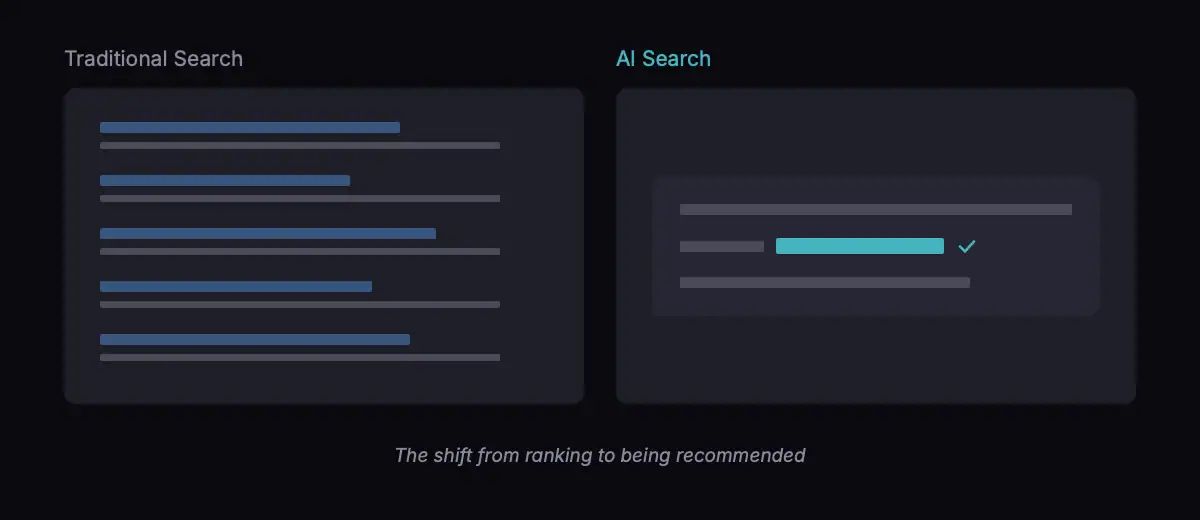
You know how Google shows a list of ten websites when you search? SEO is how you get onto that list.
AI search is different. When someone asks ChatGPT or Google’s AI for a recommendation, it doesn’t show a list. It picks a few businesses and names them directly. Answer engine optimization — AEO — is how you become one of the businesses it names.
Same goal. New game.
The industry uses a few terms for this: answer engine optimization (AEO), generative engine optimization (GEO), AI search optimization. They all describe the same shift — making sure AI can find your business, understand what you do, and recommend you by name when someone asks.
The difference comes down to what each system is doing. A search engine builds an index and ranks pages against a query. An AI answer engine reads, summarizes, and then commits to a recommendation. Ranking is a sorting problem. Recommending is a trust problem. AI won’t name a business it can’t confidently describe, because a wrong answer costs it more than a vague one.
That’s why AEO isn’t a keyword exercise. It’s about being unambiguous: what you do, where you do it, who says you’re good at it, and whether all of that agrees with itself everywhere it appears.
The good news is that most of the work overlaps with what already drives Google rankings. You’re not starting over. You’re adding a layer.
SEO gets you found on a list. AEO gets you chosen as the answer.
See where your business stands right now. The AI Visibility Checker runs your business through ChatGPT, Claude, Perplexity, and Google, and shows you exactly what each one says. Takes about 30 seconds. No email required.
If your score surprises you, you’re not alone. Most local businesses we’ve checked score below 35 out of 100.
How Do AI Search Engines Decide Who to Recommend?
AI search engines don’t pick businesses randomly. They look for businesses that are easy to verify and easy to recommend. Five signals do most of the work.
- Your Google Business Profile. Hours, services, service area, photos, posts. This is the first thing most AI systems check. A profile with 12 photos and weekly posts looks very different to AI than a profile with a phone number and nothing else.
- Your reviews. Volume, recency, and what customers actually say. AI reads reviews the same way a homeowner does, except it reads all of them in a second. A plumber with 80 reviews mentioning “showed up on time” and “fixed the leak fast” gets recommended over one with 12 reviews and no detail. This is covered in depth in the review management guide.
- Your website content. Does your site answer the questions customers actually ask? “How much does a furnace replacement cost?” “Do you offer emergency service?” If those answers are on your site in clear language, AI can find them and cite you. The HVAC lead generation guide and the plumbing marketing guide both walk through the questions that matter in those trades.
- Structured data. This is code on your website that tells AI exactly who you are — the format is described in Google’s documentation on structured data — your business name, address, services, hours, service area. Think of it as a label on a box. Without the label, AI has to guess what’s inside.
- Consistency across the web. Is your business name, phone number, and address the same everywhere — your website, Google, Yelp, Facebook, industry directories? When the details match everywhere, AI trusts that you’re a real, current business. When they don’t match, AI skips you. Solid answer engine optimization achieves that alignment so AI will select and name your business in relevant searches and summaries.
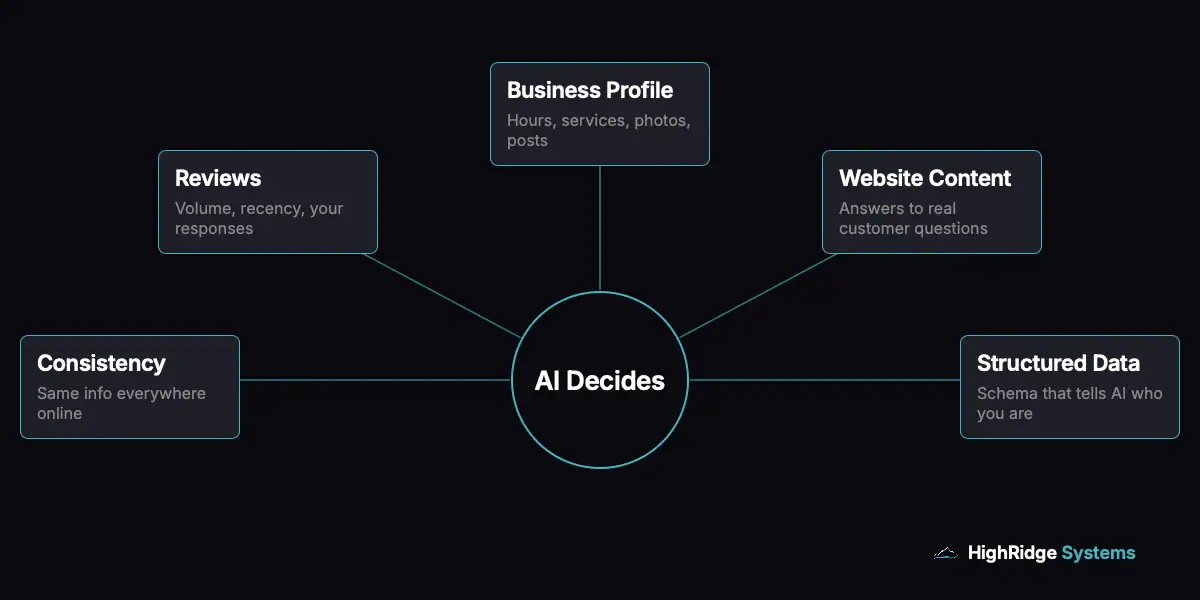
AI reads your Google reviews the same way a homeowner does — except it reads all of them in a second.
Notice what’s not on that list: ad spend, agency retainers, and anything you have to buy. Every one of these five is something you already own and already control.
They also stack. A complete Google Business Profile makes your reviews more credible. Reviews that name specific services make your website content easier to corroborate. Structured data ties it together so a machine doesn’t have to infer any of it. Fix one and you get a little lift. Fix all five and you become the obvious answer.
You didn’t get into your trade to become a search engine expert. You got into it because you’re good at the work.
The point isn’t to master all five signals overnight — it’s to understand what AI is looking at so you can make smart decisions about where to spend your time. If you run a seasonal business, the roofing lead generation guide shows how this plays out when demand spikes and every missed opportunity costs more than usual.
AEO vs SEO — What Actually Changed
SEO and AEO aren’t competitors. They’re layers. SEO gets you found on a list. AEO gets you chosen as the answer. You need both.
| SEO | AEO | |
|---|---|---|
| Goal | Rank on a list of results | Be named as the answer |
| What you’re optimizing for | Search engine crawlers | AI language models |
| What matters most | Keywords, backlinks, page speed | Clear answers, reviews, structured data |
| How you measure it | Rankings, clicks, traffic | AI mentions, citations, calls |
| Where you show up | Google search results | ChatGPT, Perplexity, Google AI, voice assistants |
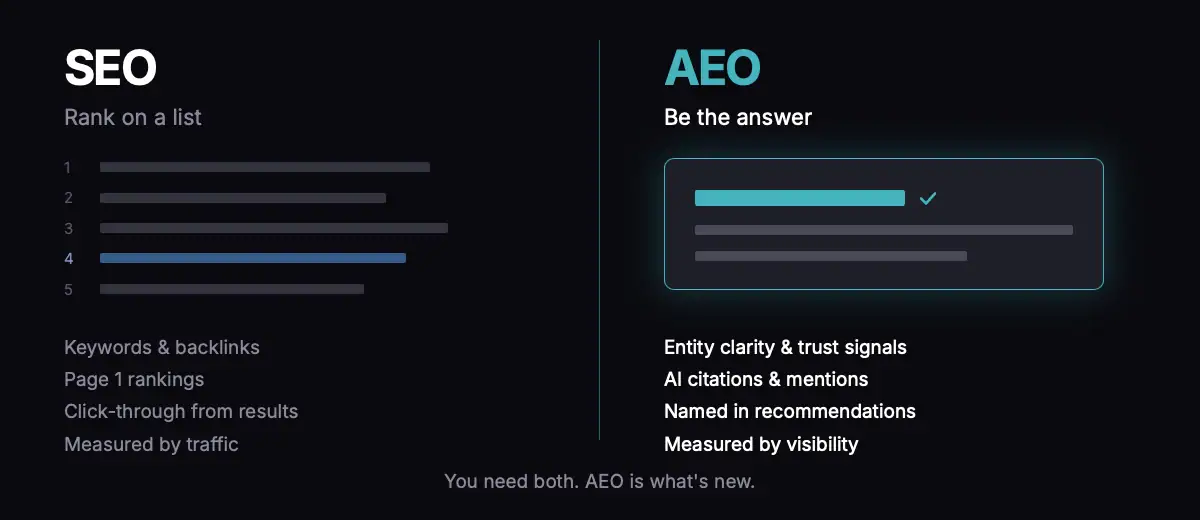
Here’s what still matters from SEO, unchanged: a site that loads fast, works on a phone, and answers real questions. Backlinks from real local sources — the chamber, a supplier, the paper that covered your storm response. None of that got less important. AI systems lean on the same web that Google indexed.
Here’s what’s new. AI needs to know you’re an entity, not a page — a specific business, in a specific place, doing specific work. It needs your details to agree with themselves everywhere they appear. And it needs you to be quotable: a sentence it can lift and attribute without hedging. “We offer 24/7 emergency service in La Plata County” is quotable. “We pride ourselves on exceptional customer service” is not.
That’s the real shift. SEO rewarded pages that covered a topic. AEO rewards businesses that are easy to describe.
Most businesses doing SEO well are about 60% of the way to AEO already. The last 40% — entity clarity, citation consistency, and being genuinely quotable — is what separates the businesses AI names from the ones it doesn’t. If you’d rather have that last 40% handled and monitored rather than guessed at, managed AI visibility tracking is what that looks like as an ongoing service.
Knowing your score is the first step.
The Revenue Leak Audit goes deeper — we walk through your Google Business Profile, your review signals, your website structure, and show you exactly what’s costing you leads right now. About 15 minutes of your time. No pitch, no obligation.
7 Things You Can Do This Week
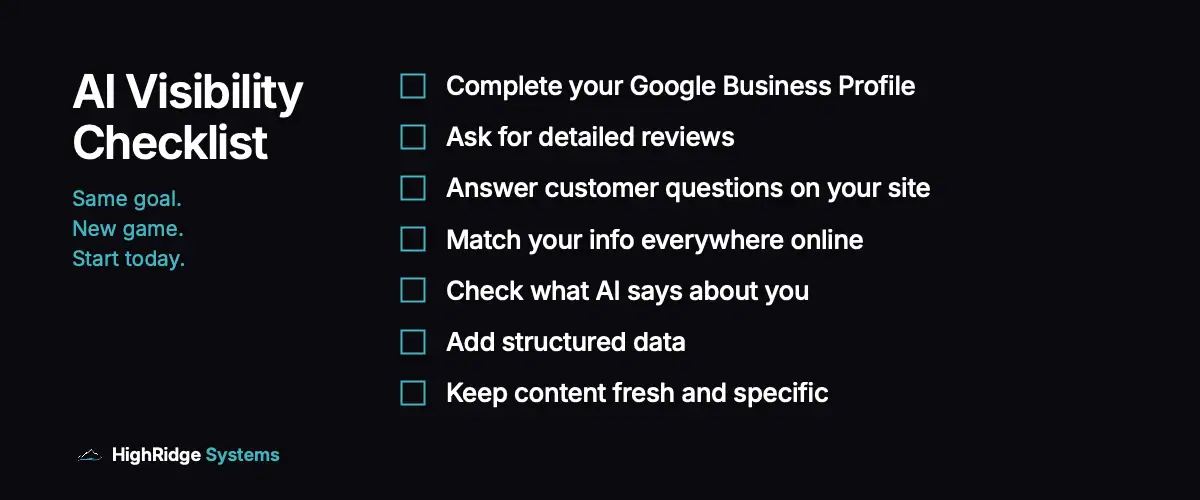
- Complete every field in your Google Business Profile. Hours, services, service area, business description, photos from real jobs, and the Q&A section. AI checks here first. A half-filled profile is like handing someone a business card with no phone number.
- Ask for reviews that mention what you do and where. “Great plumber” helps. “Fixed our water heater same day in Durango” helps more. The specific words in reviews are what AI reads when deciding who to recommend for specific searches.
- Answer your customers’ real questions on your website. What do people ask when they call? “How much does X cost?” “Do you offer emergency service?” “What areas do you serve?” Put those answers on your site clearly, in their own sections, not buried mid-paragraph.
- Make sure your business name, address, and phone match everywhere online. Your website, Google, Yelp, Facebook, industry directories, the Better Business Bureau. Inconsistencies make AI doubt you’re a real, current business.
- Check what AI actually says about your business. Use the AI Visibility Checker, or open ChatGPT and ask “Who’s the best [your trade] in [your city]?” Do the same in Perplexity and Google. What you see might surprise you.
- Add structured data to your website. This is code that labels your business information for machines — LocalBusiness schema, FAQ schema, Service schema — all defined at Schema.org. If that sentence made your eyes glaze over, that’s normal. This is where most business owners bring in help. It’s a one-time setup, not ongoing work.
- Keep your content fresh and specific to your services. AI systems prefer recent, specific information. A blog post from 2019 about “5 tips for homeowners” doesn’t help. A page updated this quarter about your specific services in your specific area does.
Work down that list in order. The first five cost you nothing but time, and they move the signals AI weighs most heavily. If you only do one thing this week, do the first one.
What you say in each field changes by trade. An electrician wants panel upgrades and EV chargers named explicitly, which the electrical contractor marketing guide covers. Seasonal businesses have a narrower window to get this right — see the landscaping marketing guide. And practices booking patients rather than jobs have their own version of the same problem, covered in the chiropractic marketing guide.
Why This Matters More Every Month
The shift to AI search isn’t theoretical. Three data points make the case.
First: according to SparkToro’s zero-click research, more than half of Google searches now end without a click — the user gets the answer directly and never visits a website. If your business isn’t part of that answer, you’re not part of the decision.
Second: according to research on voice search behavior, 58% of voice searches are looking for local business information. “Hey Siri, find a plumber near me” isn’t a future scenario. It’s happening in your service area right now.
Third: according to Conductor’s State of AEO report, 94% of marketing leaders plan to increase AEO spending this year. Your competitors’ agencies are already working on this. The question is whether you get ahead of it or react to it.
One more pattern worth knowing: AirOps research on AI citation patterns finds that first-party data — your own numbers, your own outcomes — earns brand-specific citations that recycled third-party statistics do not.
This isn’t coming. It’s here. And the businesses that figure it out first get the advantage that compounds — because once AI learns to recommend you, it keeps recommending you.
Common Questions About AI Search
Does ChatGPT actually recommend specific local businesses?
Yes. When someone asks ChatGPT, Perplexity, or Google’s AI for a local recommendation, these tools name specific businesses. They pull from Google Business Profiles, reviews, website content, and directory listings. The businesses they name aren’t paying for placement — they’re the ones AI can most easily verify and recommend.
What’s the difference between AEO and SEO?
SEO (search engine optimization) helps your website rank in Google’s list of results. AEO (answer engine optimization) helps your business get named directly in AI-generated answers. You need both. Most businesses doing SEO well are already partway to AEO — the additional work is about making your information clearer and more consistent so AI can confidently name you.
Can I do this myself?
Some of it, yes. Updating your Google Business Profile, asking for reviews, answering customer questions on your website — you can handle all of that this week. The more technical answer engine optimization work — structured data markup, ongoing AI visibility monitoring, content optimization — is where it gets harder to DIY. The checklist above is a real starting point, not a teaser.
How long does it take to show up in AI search?
Some changes, like completing your Google Business Profile, can affect AI recommendations within weeks. Building a consistent review profile and earning AI citations is more like 2 to 6 months of steady work. There’s no switch to flip, but there’s also no waiting years for results like old-school SEO sometimes required.
Does AEO replace Google SEO?
No. answer engine optimiztion (AEO) adds to SEO — it doesn’t replace it. Google search still drives the majority of local leads. But the share going to AI-generated answers is growing fast, and the businesses that show up in both channels will have a significant advantage over those that only show up in one.
How do I know if it’s working?
Three ways. Run the AI Visibility Checker periodically and compare your score over time. Ask ChatGPT and Perplexity your key questions monthly and track whether you’re being named. And watch your Google Business Profile insights and call volume — if the visibility work is landing, you’ll see increases in branded searches and direct calls.
You just learned more about AI search than most marketing agencies know.
The question is what you do with it. If you want to handle this yourself, the checklist above is a real starting point. If you’d rather have someone manage it — the monitoring, the optimization, the weekly reports — that’s what we do. We’ll show you where you stand and what it’s costing you. About 15 minutes of your time.
Book Your Free Revenue Leak Audit →Or call David directly: 970.508.9555 · Durango, Colorado